
A DUI conviction in Florida carries statutory fines starting at $500, jail exposure up to a year on a first offense, mandatory license suspension, and ignition interlock requirements that grow harsher with every repeat conviction. Fines and jail time roughly double when blood alcohol content hits 0.15 or a minor is in the car. A third conviction within 10 years becomes a felony, and a DUI that kills someone can bring up to 15 years in prison. Here’s the breakdown, tier by tier.
TL;DR:
- A first DUI conviction in Florida can result in fines up to $1,000, jail time up to six months, and a 10-day vehicle impoundment, with increased penalties for BAC of 0.15 or minors in the vehicle.
- Repeat DUIs and offenses involving injury or death escalate quickly to third-degree or first-degree felonies, with mandatory minimum jail sentences and potential decades in prison.
- The 10-day period after arrest to request an administrative hearing is critical to contest license suspension and avoid longer revocations due to paperwork errors or missed deadlines.
- Mandatory ignition interlock devices are required for certain convictions, with users bearing all costs and risking license revocation extensions if they tamper or neglect maintenance.
- Early evidence collection and legal advice during the first two weeks are essential to mitigate long-term job, license, and civil rights consequences.
Table of Contents
- Florida DUI Penalties by Conviction: The Statutory Chart
- Jail Time, Probation, Community Service, and Vehicle Impoundment
- How Florida’s Administrative License Suspension Actually Works
- When DUI Becomes a Felony: Injury, Manslaughter, and Repeat Offenses
- Ignition Interlock Devices: Who Pays, How Long, and What Happens If You Skip It
- What to Do in the First 10 Days After a DUI Arrest
- Why the First Two Weeks Matter More Than the Trial
- Talk to a Local Attorney Before Your 10-Day Window Closes
- Sources
- FAQ
Florida DUI Penalties by Conviction: The Statutory Chart
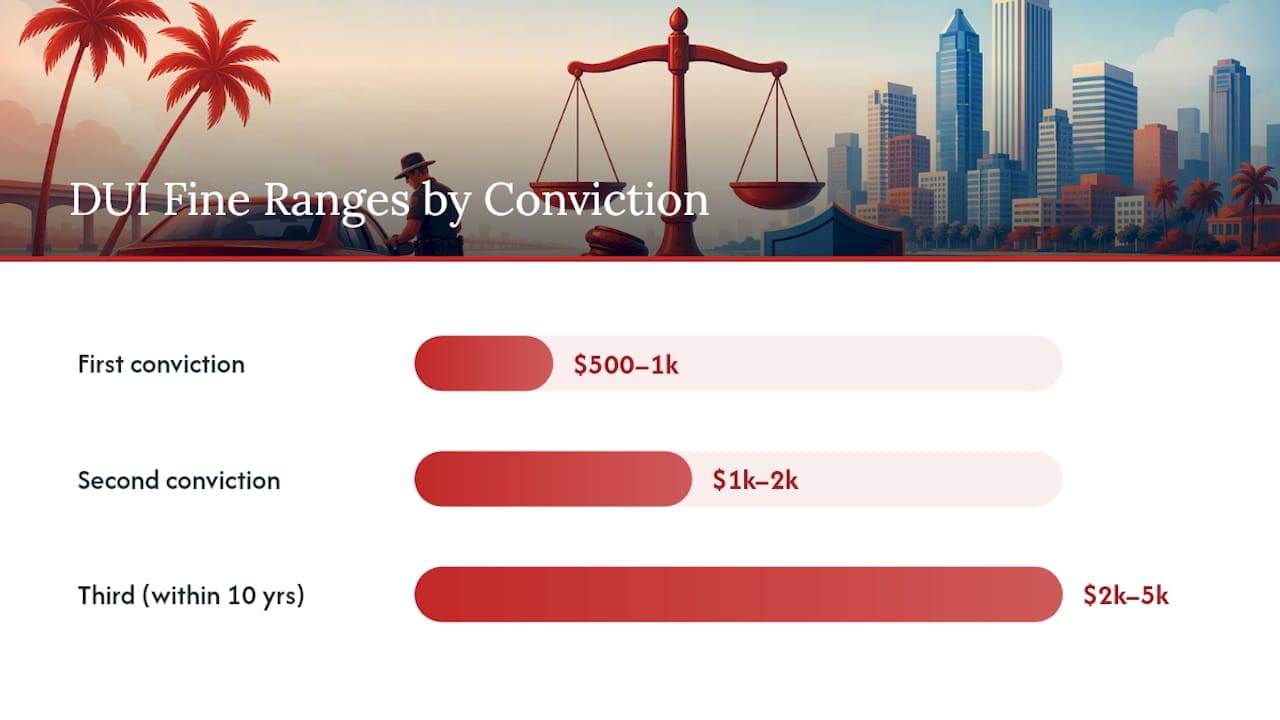
Florida Statute 316.193 sets fixed penalty ranges for every DUI conviction, and judges have very little room to go below them. The fine ranges alone surprise a lot of first-time offenders, who assume a DUI is a few hundred dollars and a slap on the wrist. It isn’t. Add court costs, probation supervision fees, and DUI school, and a “minor” first offense routinely costs $3,000 or more once everything is tallied.
First conviction. The fine runs $500 to $1,000, with up to six months in jail. If BAC was 0.15 or higher, or a minor was in the vehicle, the fine jumps to $1,000 to $2,000 and jail exposure doubles to nine months. Courts also impose probation, DUI school, and a minimum of 50 hours of community service.
Second conviction. Fines run $1,000 to $2,000, rising to $2,000 to $4,000 with the 0.15/minor aggravator. Jail exposure climbs to nine months, or 12 months under the aggravated tier. If the second conviction lands within five years of the first, the law requires a mandatory minimum of 10 days behind bars, at least 48 hours of which must be consecutive.
Third conviction within 10 years. This is where DUI stops being a misdemeanor. A third conviction within a decade of a prior conviction is a third-degree felony, carrying a mandatory minimum of 30 days in jail and fines generally in the $2,000 to $5,000 range, jumping to a $4,000 minimum with the 0.15/minor aggravator. The court must also order ignition interlock installation for at least two years once the person becomes eligible to drive again.
Third conviction outside 10 years. If more than 10 years have passed since the prior conviction, the offense stays a first-degree misdemeanor, but the fine schedule and jail exposure still track the third-tier ranges above. A judge has more sentencing discretion here than with a felony-tier third offense, but not much.
Fourth or subsequent conviction. Every conviction after the third is automatically a third-degree felony under 316.193, regardless of how much time has passed. Minimum fines start at $2,000, and there’s no cap on the fine a judge can impose. Felony DUI convictions also carry consequences well beyond the courtroom: loss of certain civil rights, difficulty with professional licensing, and permanent marks on background checks that misdemeanor convictions do not carry in the same way.
| Conviction | Fine range (standard) | Fine range (BAC ≥0.15 or minor) | Jail maximum | Mandatory minimum |
|---|---|---|---|---|
| First | $500–$1,000 | $1,000–$2,000 | 6 months | None |
| Second | $1,000–$2,000 | $2,000–$4,000 | 9 months | 10 days if within 5 years |
| Third (within 10 years) | $2,000–$5,000 | $4,000 minimum | 5 years (felony) | 30 days |
| Fourth+ | $2,000 minimum, no cap | Same statute applies | 5 years (felony) | Varies by case |
The pattern is consistent across every tier: the state doesn’t just punish harder for repeat offenses, it punishes harder for dangerous offenses, regardless of whether it’s a first or fourth conviction. A first-time driver with a 0.16 BAC and a child in the back seat can face steeper fines than a second-time offender who blew a 0.09 alone.
Jail Time, Probation, Community Service, and Vehicle Impoundment
Jail exposure and mandatory minimums are two different things, and the distinction matters more than most defendants realize going into sentencing.
The maximum jail term is the ceiling a judge could theoretically impose. The mandatory minimum is the floor a judge cannot go below, no matter how sympathetic the case. On a first DUI, there is no mandatory minimum, which means a judge has discretion to impose probation with no jail time at all. On a second DUI within five years, that discretion disappears. State law requires at least 10 days in jail, with 48 hours of it consecutive. On a third DUI within 10 years, the floor rises to 30 days, and it’s a felony besides.
Probation works alongside jail time rather than instead of it. For a first conviction, the combined length of incarceration and probation cannot exceed one year. Courts routinely order the minimum 50 hours of community service as a probation condition, though defendants who can show financial hardship may instead pay $10 per hour in lieu of the hours, roughly $500 total for a first offense.
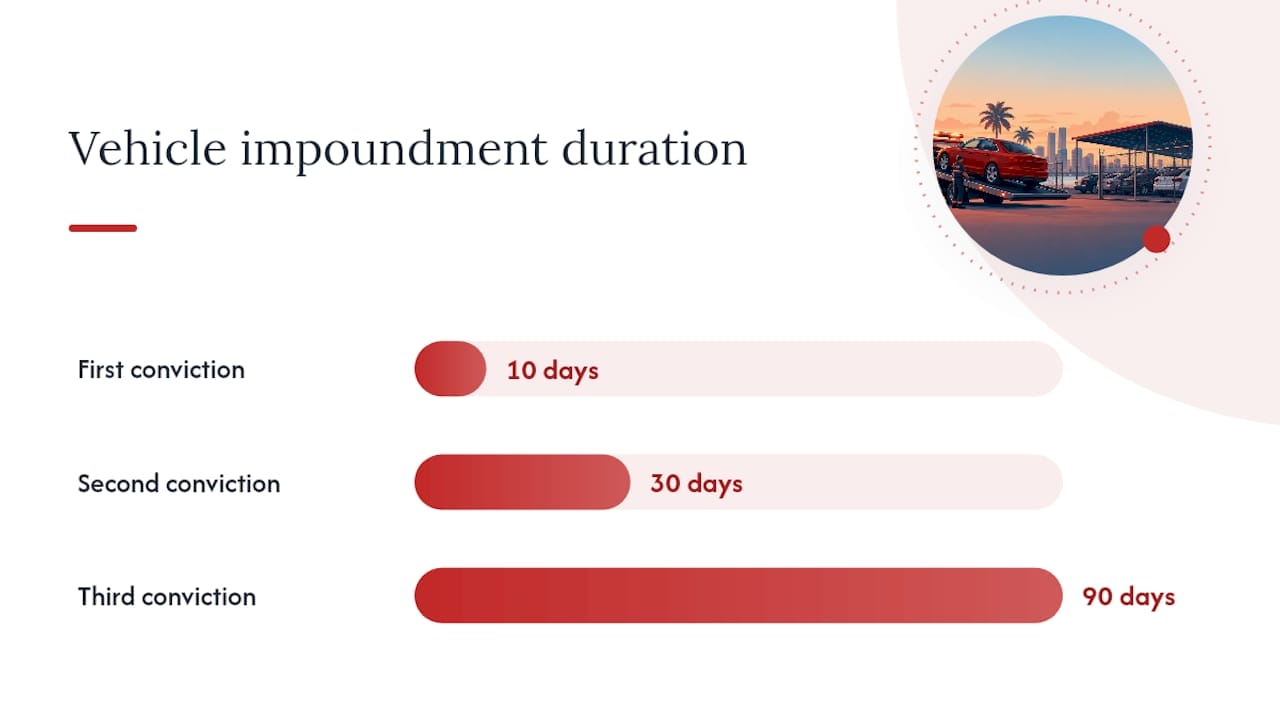
Vehicle impoundment or immobilization is a separate penalty layered on top of everything else. Courts can order a convicted driver’s vehicle impounded or immobilized for 10 days on a first offense, 30 days on a second, and 90 days on a third, and the vehicle in question doesn’t have to be the one driven at the time of arrest, if it’s registered to the defendant.
- First conviction: up to 6 months jail, no mandatory minimum, 10-day vehicle impoundment.
- Second conviction (within 5 years): 10-day mandatory minimum, 30-day impoundment.
- Third conviction (within 10 years): 30-day mandatory minimum, felony record, 90-day impoundment.
- Community service: 50 hours minimum, or $10/hour payment alternative for hardship cases.
Pro Tip: Courts can sometimes credit time served at a state-approved residential alcohol or drug treatment program toward a jail sentence. If substance use played a role in the arrest, ask your attorney early whether this option applies, since it typically needs to be arranged before sentencing, not after.
How Florida’s Administrative License Suspension Actually Works
A DUI arrest triggers two separate legal tracks that run at the same time and confuse almost everyone caught up in them. There’s the criminal case, which decides guilt and sentencing. Then there’s the administrative suspension, run entirely by the Florida Department of Highway Safety and Motor Vehicles (FLHSMV), which can strip your license before you ever see a judge.
- BAC failure suspension. A driver over 21 who tests at 0.08 or higher faces an automatic six-month administrative suspension for a first failure, rising to one year for any subsequent failure.
- Refusal suspension. Refusing the breath, blood, or urine test under Florida’s implied consent law triggers a one-year suspension for a first refusal and 18 months for a second, and the refusal itself can be used as evidence against you in the criminal case.
- The 10-day hearing window. You have only 10 days from the date of arrest to request a formal review hearing with FLHSMV. Miss it, and the suspension takes effect automatically with no further chance to contest it administratively.
- Reinstatement. Getting your license back requires a reinstatement fee, proof of insurance meeting Florida’s financial responsibility limits for bodily injury and property damage, and in many cases, completion of DUI school before driving privileges resume.
- Restricted driving. Depending on the suspension type and your history, you may qualify for a hardship license or a restricted license tied to ignition interlock installation, letting you drive to work or DUI school while the suspension runs.
The administrative suspension and the criminal sentence operate on separate clocks. You can resolve one and still be stuck waiting on the other, which is exactly why the CDL guidance on the 10-day deadline matters so much for commercial drivers, whose federal licensing consequences move even faster than the state process.
When DUI Becomes a Felony: Injury, Manslaughter, and Repeat Offenses
Most DUI arrests in Florida are misdemeanors. Three circumstances change that.
Repeat convictions. A third DUI within 10 years of a prior conviction is automatically a third-degree felony. Every conviction after that, regardless of timing, is also a third-degree felony under Florida law.
DUI causing serious bodily injury. If a DUI results in serious injury to another person, the charge becomes a third-degree felony on its own, independent of how many prior DUIs the driver has.
DUI manslaughter. Killing someone while driving under the influence is a second-degree felony carrying fines up to $10,000 and up to 15 years in prison. If the driver knew or should have known someone was killed and left the scene anyway, the charge escalates to a first-degree felony, punishable by up to 30 years.
- Third DUI within 10 years: third-degree felony, up to 5 years prison.
- Fourth or subsequent DUI: third-degree felony regardless of timing.
- DUI causing serious injury: third-degree felony.
- DUI manslaughter: second-degree felony, up to $10,000 fine, up to 15 years prison.
- DUI manslaughter with leaving the scene: first-degree felony, up to 30 years prison.
The jump from misdemeanor to felony isn’t gradual. It’s a cliff, and it’s worth remembering that “serious bodily injury” is a legal standard, not a medical one. A broken bone or a concussion can meet it just as easily as a permanent disability, which is part of why felony DUI causing injury charges catch defendants off guard more often than any other tier on this list.
Ignition Interlock Devices: Who Pays, How Long, and What Happens If You Skip It
An ignition interlock device (IID) requires a driver to blow into a breathalyzer wired to the ignition before the car will start, and Florida leans on it heavily for repeat and aggravated offenders.
IID placement becomes mandatory in several scenarios: any conviction involving BAC of 0.15 or higher, any conviction involving a minor in the vehicle, and any second or subsequent conviction. Duration scales with the offense, running roughly six months to a year for a first-offense aggravated case and stretching to two years or more once you’re at a third conviction.
- The convicted person pays every cost: installation, monthly monitoring, and removal, typically running $70 to $150 per month on top of installation fees.
- IID installation is often the fastest legal path to a restricted license during a suspension period.
- Tampering with the device, having someone else blow into it, or failing to maintain it can trigger license revocation extensions of up to five years.
- Missing IID paperwork deadlines is one of the most common reasons drivers end up with longer revocations than their sentence actually required.
Pro Tip: IID paperwork errors are more common than the penalties themselves. A missed calibration appointment or an incomplete manufacturer certification form can add years to a revocation that has nothing to do with your driving record. Our guide to avoiding a five-year IID revocation walks through the specific paperwork mistakes that cause this.
What to Do in the First 10 Days After a DUI Arrest
The clock starts running the moment you’re arrested, not when you’re formally charged, and most of the damage that follows a DUI happens in decisions made in the first two weeks.
- Request the administrative hearing immediately. You have 10 days to challenge the administrative suspension with FLHSMV. This is a hard deadline with no extensions, and it’s separate from your criminal court dates.
- Preserve every piece of evidence you can. Ask your attorney to request the arrest video, breathalyzer calibration and maintenance logs, and the officer’s field notes before records get lost or overwritten.
- Write down everything you remember while it’s fresh. Time of last drink, what you ate, any medications you were taking, and exactly what the officer said during the stop.
- Do not discuss the arrest on social media or with anyone besides your attorney. Prosecutors routinely pull social media as evidence in DUI cases.
- Consult an attorney before your first court date, not after.
Common defenses in Florida DUI cases include challenging probable cause for the traffic stop, disputing breathalyzer calibration or chain-of-custody records, and raising medical explanations, such as certain medications or conditions that mimic impairment symptoms officers are trained to spot. None of these defenses guarantee dismissal, but they routinely lead to reduced charges, alternative sentencing arrangements, or negotiated plea deals that keep a felony off a client’s record.
Pro Tip: If you’re a commercial driver’s license holder, the stakes are different and faster. A DUI conviction can disqualify a CDL even when the offense happened in a personal vehicle, and the disqualification period often runs longer than the underlying suspension itself.
Why the First Two Weeks Matter More Than the Trial
Most people facing a DUI charge fixate on the criminal trial date and treat the administrative suspension as an afterthought. That’s backwards. By the time a case reaches trial, the license suspension has often already run its course, unappealed, because nobody told the driver about the 10-day window until it had closed.
I’ve watched suspensions and IID orders do more damage to a person’s job and family stability than the criminal sentence itself. A construction worker who can’t drive to a job site for six months loses more than a driver’s license. Employers don’t wait around for court dates to resolve.
That’s why early administrative challenges and evidence preservation matter as much as courtroom strategy. A tailored plea approach that protects license eligibility and gets IID paperwork filed correctly the first time often does more for a client’s actual life than fighting for an acquittal that was never realistic to begin with. If you’re inside that 10-day window right now, that’s the moment to talk to someone, not after the suspension has already taken effect.
— John
Talk to a Local Attorney Before Your 10-Day Window Closes
Local drivers who need someone familiar with the local courts may benefit from an attorney who offers a free initial consultation, direct attorney access, and extensive experience navigating the specific judges, prosecutors, and administrative hearing officers in the area.

Every day that passes after an arrest is a day closer to losing the right to challenge your administrative suspension, and IID paperwork mistakes can add years to a revocation that has nothing to do with your actual sentence. If you or someone in your family was arrested for DUI in Brevard County, reach out through the DUI Lawyers practice page today to schedule your free consultation and find out exactly where your case stands before that 10-day clock runs out.
This article is general information, not a substitute for advice from a qualified lawyer. Consult a qualified legal professional about your own circumstances before acting on anything here.
Sources
- Florida DUI and Administrative Suspension Laws — FLHSMV
- 316.193 Driving under the influence; penalties — Florida Senate (2025)
- 316.193 Driving under the influence; penalties — Justia / Florida statutes
FAQ
What are the penalties for a first-time DUI in Florida?
A first DUI conviction carries a fine of $500 to $1,000, up to six months in jail, probation, and a minimum of 50 hours of community service. Fines and jail exposure roughly double if BAC was 0.15 or higher or a minor was in the vehicle.
Is a DUI a felony in Florida?
A DUI is typically a misdemeanor for a first, second, or third offense outside a 10-year window. It becomes a third-degree felony on a third conviction within 10 years of a prior one, on any fourth or later conviction, or when the DUI causes serious bodily injury to someone else.
Can you drive for 10 days after a DUI in Florida?
You may retain limited driving privileges during the 10-day period allowed to request an administrative review hearing with FLHSMV, but this depends on your specific arrest circumstances. Missing that 10-day deadline means the suspension takes effect with no further chance to contest it administratively.
Which state has the strictest DUI penalties?
Penalty severity varies significantly by state and by category, jail time, fines, license suspension length, so there’s no single answer that holds across every category. Florida ranks among the stricter states for repeat and aggravated offenses, given its mandatory minimums and rapid felony escalation on third convictions.
Does a DUI affect a commercial driver’s license (CDL)?
Yes. A DUI conviction can disqualify a CDL even if the arrest happened in a personal vehicle, and the federal disqualification period often runs longer than the state license suspension. Commercial drivers should review the 10-day CDL deadline immediately after an arrest.