
Family court is the official legal venue where disputes involving divorce, child custody, and financial support are resolved through structured procedures designed to protect every party’s rights. Understanding how the family court process works gives you a realistic picture of what lies ahead, from the first filing to the final judge’s order. The process follows defined stages, each with its own deadlines, evidence requirements, and decision points. Knowing those stages in advance reduces surprises, helps you prepare stronger evidence, and puts you in a better position to protect what matters most.
What are the main stages of the family court process?
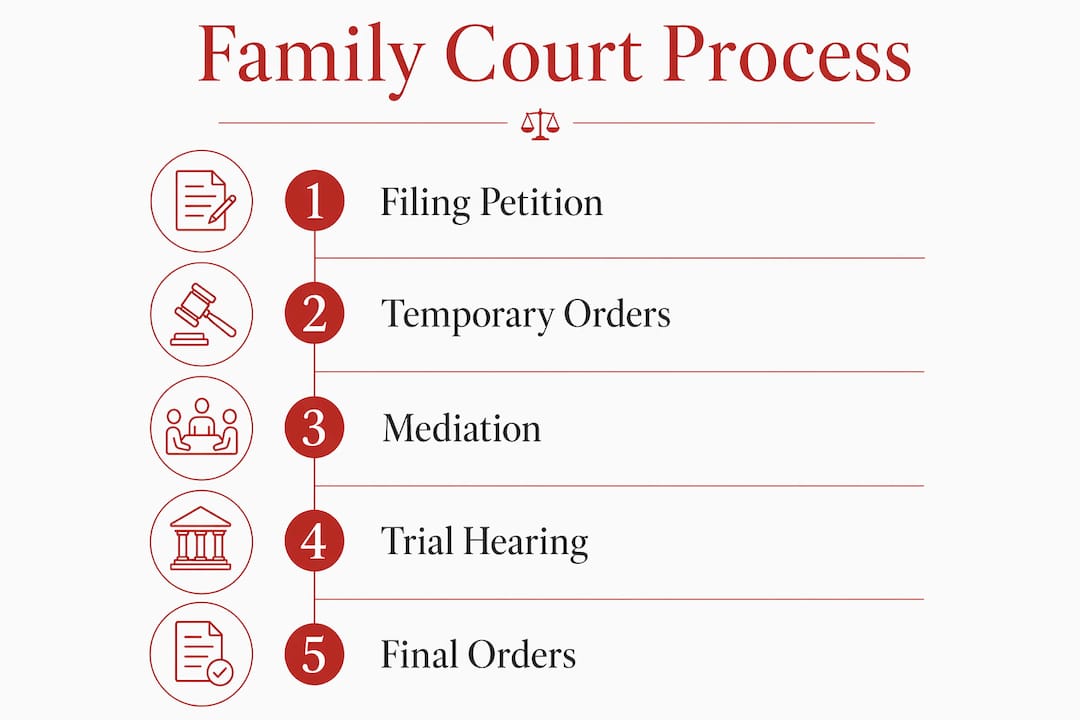
The family court procedures follow a predictable sequence, even when individual cases vary widely in complexity. Each stage builds on the one before it, so missing a deadline or skipping a step creates problems that follow you through the entire case.
-
Filing the petition. One party files a petition with the court describing the dispute, whether it involves divorce, custody, or support. The court assigns a case number and issues a summons.
-
Service of process. The other party must be formally served with the petition and summons. This is not optional. Without proper service, the case cannot move forward.
-
Response and pleadings. Once served, the opposing party has 30 days to file a written response. Missing this deadline can result in a default judgment, which means the court rules without hearing the other side.
-
Temporary orders hearings. Either party can request temporary orders to address urgent needs like custody arrangements, child support, or use of the family home while the case is pending. These hearings happen well before any trial.
-
Discovery and financial disclosure. Both parties exchange documents, financial records, and other evidence. This stage often takes the longest in contested cases involving complex assets or business valuations.
-
Mediation. Before a trial can be scheduled, mediation is typically required. A neutral mediator works with both parties to reach a voluntary agreement.
-
Trial. If mediation fails, the case goes before a judge. Each side presents evidence and testimony. The judge issues final orders that are legally binding.
-
Post-judgment actions. After final orders are issued, either party can return to court to modify orders if circumstances change, such as a job loss or a relocation request.
Pro Tip: Document everything from day one. Text messages, emails, financial statements, and school records all become potential evidence. Courts respond to written proof, not verbal accounts.
How do temporary orders and hearings work within family court?

Temporary orders are court rulings that govern the situation while the case is still active. They cover custody schedules, child support payments, spousal support, and who stays in the family home. These orders are not permanent, but they carry real legal weight and often set the tone for the entire case.
Standard temporary relief hearings are scheduled within 30–45 days of the request. Emergency hearings, which are reserved for situations involving safety risks or immediate financial harm, are scheduled within 5–14 days. That speed matters when children’s welfare or housing is at stake.
The mechanics of these hearings differ from what most people expect. Temporary hearings rely heavily on written evidence packets rather than live testimony. Judges review affidavits, financial declarations, and supporting documents submitted in advance. This means the quality of your written evidence determines the outcome, not how well you speak in court.
Key types of evidence used in temporary hearings include:
- Affidavits: Sworn written statements from you or supporting witnesses
- Financial declarations: Income, expenses, assets, and debts laid out in a standardized form
- Bank and tax records: Objective proof of financial standing
- Communication records: Texts, emails, or voicemails relevant to custody or conduct
- School and medical records: Used to establish parenting involvement and the child’s needs
Early procedural decisions, including temporary orders and financial disclosures, shape settlement leverage far more than most people realize. A strong temporary order in your favor creates a baseline that the other side must work to change.
What role does mediation play in family court cases?
Mediation is a structured negotiation session where both parties meet with a neutral third party, called a mediator, who helps them reach a voluntary agreement. The mediator does not decide the case. The mediator guides the conversation and helps identify solutions both sides can accept.
Mediation is often mandatory before a trial can be scheduled in most jurisdictions. Courts require it because it resolves a significant portion of cases without a trial, saving time, money, and emotional strain for everyone involved, including the children.
The benefits of mediation are concrete:
- Cost: Mediation costs a fraction of a full trial, which can run thousands of dollars in attorney fees and court costs
- Speed: A mediated agreement can be reached in a single session rather than waiting months for a trial date
- Control: You and the other party craft the agreement, rather than leaving the decision entirely to a judge
- Privacy: Mediation sessions are confidential, unlike court proceedings
Pro Tip: Go into mediation with a written list of your priorities ranked in order. Know what you will accept and what you will not. Mediators move faster when both sides come prepared.
When mediation fails, the case proceeds to trial. At that point, the judge has full authority to decide every unresolved issue. Learn more about how mediators work in family court before your session so you know what to expect.
How long does the family court process take?
Timeline is one of the most common questions people have when entering family court. The honest answer is that it depends heavily on how contested the case is and how efficiently both parties cooperate.
Simple uncontested cases resolve in a few months. Contentious cases involving disputed custody, business valuations, or hidden assets regularly take over a year.
| Case type | Typical timeline | Primary driver of delay |
|---|---|---|
| Uncontested divorce | 2–4 months | Paperwork and court scheduling |
| Contested custody | 6–12 months | Discovery, evaluations, hearings |
| High-asset divorce | 12–24 months | Financial disclosure and valuation |
| Post-judgment modification | 3–6 months | Court availability and evidence |
Court scheduling itself adds time. Judges manage heavy caseloads, and trial dates are often set months in advance. Discovery disputes, requests for extensions, and delays in financial disclosure all push timelines further. The most reliable way to shorten your case is to respond to every deadline promptly and avoid unnecessary motions.
What should individuals expect during a family court trial?
A family court trial is a formal hearing where both sides present their full case to a judge. Unlike criminal court, there is no jury. The judge hears all evidence and makes every decision.
Judges apply the “best interests of the child” standard when ruling on custody and visitation. This standard supersedes what either parent wants. The judge weighs factors like each parent’s involvement, the child’s relationships, stability of each home, and any history of domestic issues.
What happens during a family court trial:
- Opening statements: Each attorney summarizes what the evidence will show
- Witness testimony: Parties, experts, and other witnesses testify under oath and face cross-examination
- Document evidence: Financial records, communications, and reports are formally admitted
- Closing arguments: Each side argues how the evidence supports their position
- Judge’s ruling: The judge issues final orders, sometimes from the bench and sometimes in writing days later
Final orders govern custody, support, and property division and are legally binding the moment they are signed. Violating a final order carries serious legal consequences, including contempt of court.
Key Takeaways
The family court process follows defined stages from filing through trial, and early procedural decisions on temporary orders and financial disclosures carry more weight on the final outcome than most people expect.
| Point | Details |
|---|---|
| Staged process | Family court moves from filing and service through hearings, mediation, and trial in a fixed sequence. |
| 30-day response window | The served party must respond within 30 days or risk a default judgment against them. |
| Temporary orders matter | Written evidence quality determines temporary hearing outcomes, not courtroom performance. |
| Mediation is mandatory | Most courts require mediation before scheduling a trial, and it resolves many cases entirely. |
| Timeline varies widely | Uncontested cases close in months; contested cases with complex assets can exceed one year. |
What I’ve learned after years in family court
Family court procedures are designed to be fair, not to punish either party. That said, procedural mistakes carry long-lasting consequences, and I have seen good people lose ground simply because they did not understand what the court expected from them at each stage.
The single biggest mistake I see is treating the temporary hearing as a formality. Those early orders set the schedule your family lives under for the entire case. If you get a poor temporary custody arrangement, you are fighting uphill from that point forward. Written evidence submitted before the hearing is your most powerful tool, and most people underestimate it.
Emotional preparation matters just as much as legal preparation. Family court forces you to discuss the most personal parts of your life in a formal setting, often in front of the other party. Clients who come in with realistic expectations, clear documentation, and a willingness to consider settlement options consistently reach better outcomes than those who arrive ready for a fight at any cost.
My strongest advice is to get legal guidance before you file, not after. The decisions made in the first 60 days of a case shape everything that follows. A free consultation costs you nothing and can prevent errors that cost you months of time and thousands of dollars to correct.
— John
Trusted legal support for your family court case
Family court is not a process you want to figure out as you go. Each stage has deadlines, evidence requirements, and procedural rules that directly affect your rights and your family’s future.

Jmoorelegal has represented families in Brevard County, Florida through divorce, custody disputes, and support matters for decades. The firm offers free initial consultations, direct attorney access, and mediation-certified representation. Whether you are at the filing stage or preparing for trial, the family law team at Jmoorelegal builds a strategy around your specific situation. If you want to understand your options before your next court date, contact Jmoorelegal and schedule your free consultation today.
FAQ
What happens first when you file in family court?
The filing party submits a petition, the court issues a summons, and the other party is formally served. The served party then has 30 days to file a written response.
Do all family court cases go to trial?
No. Most cases resolve through mediation or negotiated settlement before reaching trial. Courts require mediation in most jurisdictions before a trial date is even scheduled.
How does a judge decide custody in family court?
Judges apply the best interests of the child standard, weighing each parent’s involvement, the child’s relationships, home stability, and any history of harm or neglect.
Can family court orders be changed after they are issued?
Yes. Either party can file a post-judgment motion to modify orders if there is a substantial change in circumstances, such as a job loss, relocation, or change in the child’s needs.
How long does a typical family court case take?
Uncontested cases often close within a few months. Contested cases involving custody disputes or complex assets regularly take over a year to reach final orders.
Recommended
- Role of Mediator in Family Court: A Parent’s Guide – The Law Office of John Vernon Moore, P.A.
- Divorce Procedure in Florida: Complete Legal Guide – The Law Office of John Vernon Moore, P.A.
- Why Choose Our Family Law And Divorce Lawyers? – The Law Office of John Vernon Moore, P.A.
- Family Law – The Law Office of John Vernon Moore, P.A.