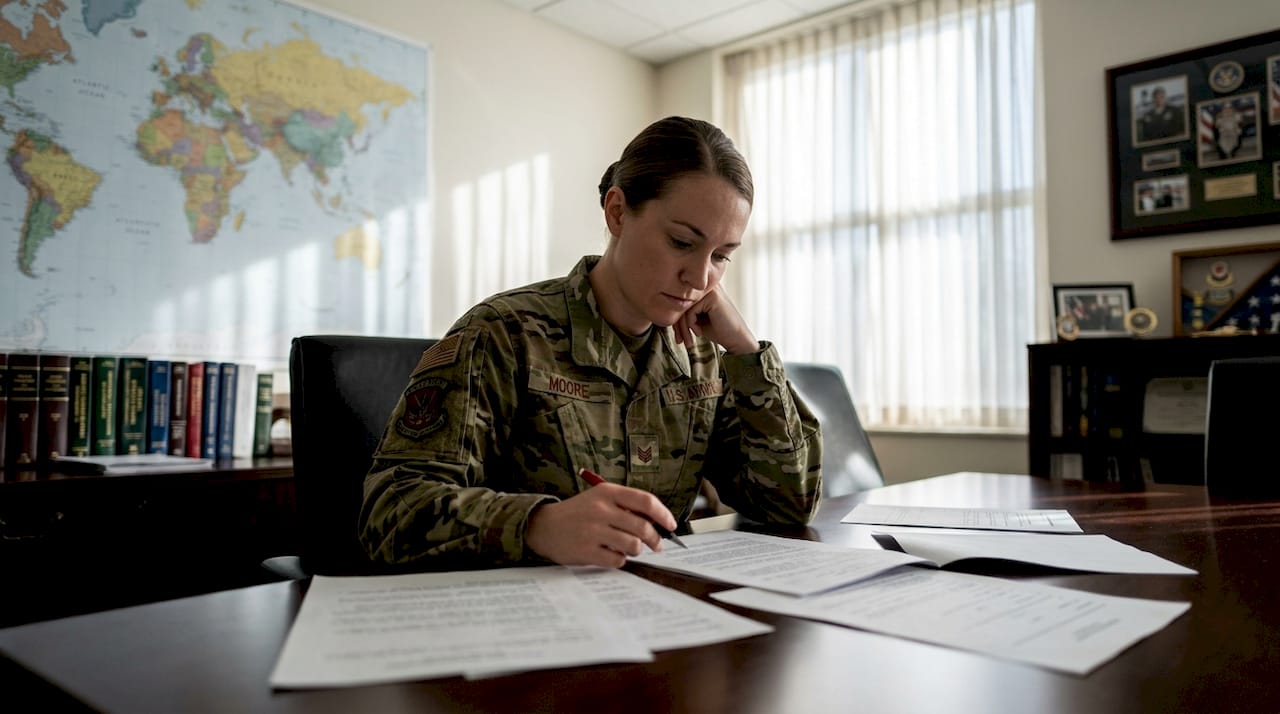
A JAG attorney, formally known as a Judge Advocate General officer, is defined as a military legal advisor who provides advisory services on military matters but cannot represent service members in civilian divorce court. The role of JAG attorney in divorce is widely misunderstood. Most service members assume their base legal office handles everything. It does not. Understanding exactly what a JAG attorney can and cannot do is the first step to protecting your rights, your pension, and your family.
Military legal assistance offices provide free, confidential consultations governed by Army Regulation 27-3. That regulation defines the advisory scope clearly. JAG attorneys help you understand military pay documents, federal statutes, and base-specific procedures. They do not file court documents, negotiate settlements, or appear in state family court on your behalf.
What legal services do JAG attorneys provide in military divorce?
JAG legal assistance is free and confidential for active-duty service members and eligible family members. That access is genuinely valuable, but the scope is specific and limited.
JAG attorneys provide the following services related to divorce:
- Consultations by appointment governed by Army Regulation 27-3, focused entirely on advice rather than representation
- Explanation of your Leave and Earnings Statement (LES) and how military pay factors into support calculations
- Overview of the Survivor Benefit Plan (SBP) and what elections mean for a former spouse’s long-term financial security
- Guidance on federal statutes including the Servicemembers Civil Relief Act (SCRA) and the Uniformed Services Former Spouses’ Protection Act (USFSPA)
- Divorce/Separation Worksheet preparation guidance to help you organize financial and legal information before your appointment
What JAG attorneys cannot do is equally important. They cannot file court documents or represent you in civilian family court under military policy and ethical rules. They do not negotiate with opposing counsel. They do not attend hearings.
Pro Tip: Complete the Divorce/Separation Worksheet before your JAG appointment. Arriving with organized financial records, pay stubs, and benefit documents means you get substantive advice instead of spending your limited appointment time gathering basic facts.

Why civilian family law attorneys are essential in military divorces
Civilian attorneys are mandatory for representation in divorce proceedings. They manage state court filings, attend hearings, and negotiate settlements. No JAG attorney performs these functions.
The reasons civilian counsel is non-negotiable in military divorce include:
- State court licensing. JAG attorneys are not licensed to practice in civilian state courts. Florida, for example, requires attorneys admitted to the Florida Bar to appear in family court.
- State-specific divorce law. Florida uses equitable distribution, which requires knowledge of how courts divide marital assets, including military pensions, under Florida Statutes Chapter 61.
- Federal and state law integration. Applying USFSPA correctly within a state divorce decree requires an attorney who understands both systems simultaneously.
- Filing deadlines. Missing a response deadline in a divorce case can result in a default judgment. JAG attorneys do not monitor civilian court dockets.
- Pension division errors. Improperly drafted pension division orders can permanently forfeit retirement benefits. A civilian attorney with military divorce experience drafts these orders correctly.
JAG attorneys are military officers first, rotated through various practice areas. Their primary mission is keeping service members’ personal legal affairs in order to support military readiness. Deep, state-specific family law expertise is not their function. Relying on JAG advice alone in a contested divorce is one of the most costly mistakes a service member can make.
How federal military laws intersect with state divorce laws
Two federal statutes define the legal framework for every military divorce. Understanding them is not optional.
| Federal Law | What It Does | Key Limitation |
|---|---|---|
| Servicemembers Civil Relief Act (SCRA) | Protects against default judgments during deployment; allows court stay requests | Service member must assert rights; protection is not automatic |
| Uniformed Services Former Spouses’ Protection Act (USFSPA) | Authorizes states to divide military retired pay as marital property | Does not guarantee division; state court decides the amount |
| The 10/10 Rule | Allows Defense Finance and Accounting Service (DFAS) to pay former spouse directly | Requires 10 years of marriage overlapping 10 years of service |
The 10/10 rule is one of the most misunderstood provisions in military divorce law. Courts can divide a military pension even when the 10/10 overlap does not exist. The rule only controls whether DFAS pays the former spouse directly. Confusion about this distinction causes significant financial losses in divorce settlements.
Florida’s equitable distribution standard applies to military retired pay as marital property. A Florida court can award a former spouse a share of retirement benefits accumulated during the marriage, regardless of the 10/10 overlap. The divorce decree must include specific language directing DFAS on how to calculate and pay that share.
Pro Tip: Ask your civilian attorney to verify that any pension division language in your decree meets DFAS requirements before the judge signs it. Correcting a defective order after the fact is expensive and sometimes impossible.
SCRA protections during deployment do not activate automatically. A service member must formally request a stay from the court, typically by submitting a letter from their commanding officer confirming that military duty materially affects their ability to appear. A civilian attorney files that request. A JAG attorney advises you that the right exists.
How to effectively use JAG legal assistance alongside civilian counsel
The most effective model for military divorce treats JAG and civilian attorneys as partners, not substitutes. Each handles what they do best.
- Schedule your JAG appointment first. Use it to get a clear picture of your military benefits, pay structure, and federal protections. Bring your LES, SBP election documents, and a list of questions about SCRA and USFSPA.
- Prepare your Divorce/Separation Worksheet in advance. Detailed financial preparation before your appointment ensures you get substantive advice rather than administrative guidance.
- Hire a civilian family law attorney licensed in your state. Share the information and documents from your JAG consultation. This gives your civilian attorney a head start on the military-specific issues.
- Authorize communication between your attorneys when appropriate. Your JAG attorney and civilian attorney can coordinate on military-specific questions, creating consistency in your legal strategy.
- Do not rely on either attorney alone. JAG handles the military side. Your civilian attorney handles the court side. Combining both roles produces better outcomes than either can achieve independently.
A collaborative approach using both JAG and civilian attorneys leads to better outcomes in military divorce cases. The two roles are genuinely complementary. Treating them as competing options is the mistake that costs families the most.
Common misconceptions about JAG attorneys in divorce
Several persistent myths about JAG attorney roles lead service members into serious legal trouble.
- Myth: The military will request a court delay on your behalf. False. SCRA allows for stays, but the service member must assert those rights through the court. The military does not intervene automatically.
- Myth: JAG attorneys represent you in divorce court. False. JAG attorneys provide advice. They do not appear in civilian court, file motions, or negotiate with opposing counsel.
- Myth: The 10/10 rule limits how much of your pension a court can award. False. Courts can divide pensions in any proportion the law allows. The 10/10 rule only affects direct DFAS payment.
- Myth: Your spouse cannot touch your pension if you divorce before 10 years. False. State courts can award a share of military retirement regardless of marriage length under USFSPA.
- Myth: JAG advice is sufficient for an uncontested divorce. Risky. Even uncontested divorces require properly filed court documents, correct pension division language, and compliance with state procedural rules.
“Proactive legal advocacy is required. Relying on the assumption that the military will protect your interests in a civilian court is one of the most dangerous misconceptions in military divorce.” — Military divorce legal misconceptions
Missing a filing deadline or submitting an improperly worded pension order can permanently alter your financial future. The cost of a civilian military divorce attorney is far less than the cost of correcting a preventable legal error.
Key Takeaways
The role of a JAG attorney in divorce is advisory, not representational. Civilian family law counsel is required for every court filing, hearing, and negotiation in a military divorce.
| Point | Details |
|---|---|
| JAG role is advisory only | JAG attorneys provide free consultations but cannot file documents or appear in civilian court. |
| Civilian counsel is mandatory | Only a state-licensed attorney can represent you in divorce court and negotiate settlements. |
| Federal laws require expertise | SCRA, USFSPA, and the 10/10 rule each carry specific requirements that affect pension and benefit outcomes. |
| Preparation maximizes JAG value | Completing the Divorce/Separation Worksheet before your appointment produces more useful advice. |
| Collaboration produces the best results | Using JAG for military questions and civilian counsel for court work is the most effective approach. |
What I’ve learned after years of military divorce cases
Military families come to me after relying solely on JAG advice, and the pattern is consistent. They received accurate information about their federal rights. Then they missed a state court deadline, filed an incomplete petition, or signed a decree with defective pension language. The JAG attorney did nothing wrong. The system failed them because no one explained where JAG advice ends and civilian representation begins.
The most common error I see is treating the JAG consultation as a substitute for hiring a civilian attorney. Service members hear “free legal help” and assume the base legal office handles everything. It handles the military side. The state court side requires a licensed civilian attorney every time, without exception.
Deployment complicates this further. A service member overseas cannot easily monitor a divorce proceeding back home. SCRA protections exist, but asserting them requires a formal court filing. That filing requires a civilian attorney. I have seen service members return from deployment to find default judgments entered against them because no one filed the SCRA stay request.
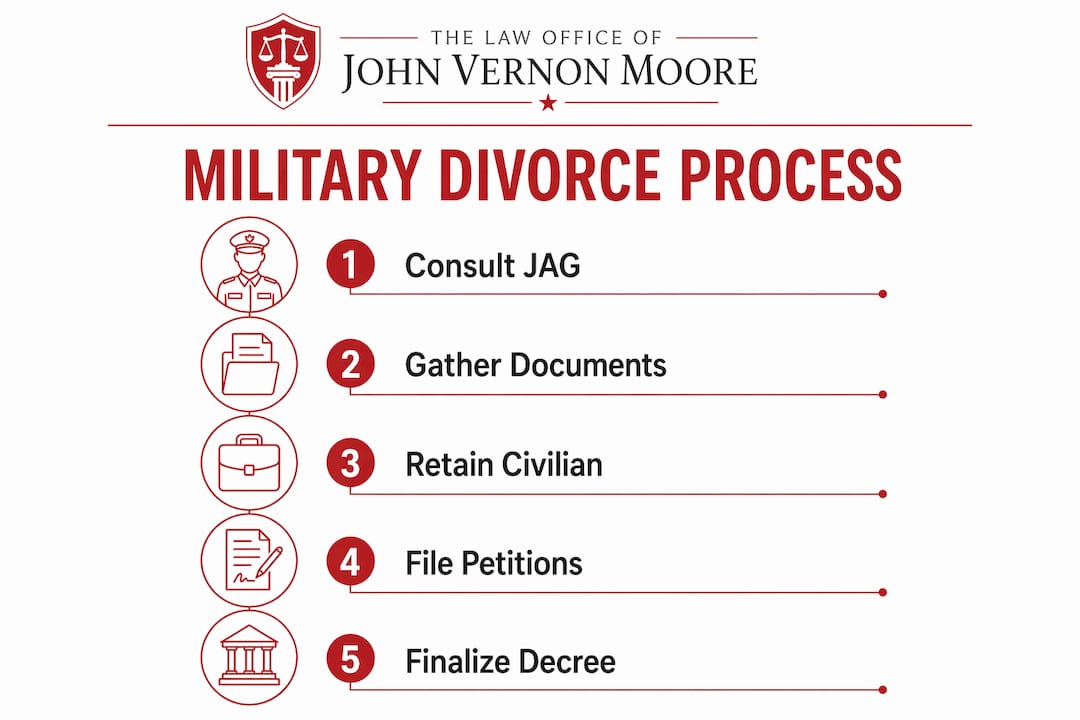
My advice is direct: use your JAG appointment to understand your military benefits, then hire a civilian family law attorney to handle everything that touches a courtroom. The two attorneys working together give you the best possible outcome. One working alone leaves gaps that are expensive to close.
— John
Military divorce legal support from Jmoorelegal
Military divorce cases involve federal law, state court procedures, pension division rules, and custody considerations that change depending on deployment status and residency. Jmoorelegal provides dedicated military divorce representation for service members and their families in Brevard County, Florida.

The Law Office of John Vernon Moore, P.A. works alongside JAG legal assistance to cover every dimension of your case. From Florida child custody matters to pension division and DFAS compliance, Jmoorelegal handles the court side so your rights are protected at every stage. Free initial consultations are available. Contact Jmoorelegal to schedule yours and get civilian representation that complements the advice you receive from your base legal office.
FAQ
What is the role of a JAG attorney in divorce?
A JAG attorney provides free, confidential legal advice on military-specific matters such as pay, benefits, and federal statutes. JAG attorneys cannot represent service members in civilian divorce court or file court documents on their behalf.
Can a JAG attorney represent me in divorce court?
No. JAG attorneys are not licensed to practice in civilian state courts and are prohibited by military policy from representing service members in divorce proceedings. A civilian family law attorney is required for all court appearances.
What is the 10/10 rule in military divorce?
The 10/10 rule allows DFAS to pay a former spouse directly when the marriage overlapped at least 10 years of military service. Courts can still divide a military pension even when this overlap does not exist.
Does SCRA automatically delay my divorce during deployment?
No. SCRA allows a service member to request a court stay during deployment, but the request must be formally filed with the court. The military does not request delays automatically on your behalf.
How do I choose a divorce attorney for a military case?
Choose a civilian family law attorney licensed in the state where your divorce will be filed, with specific experience in military pension division, USFSPA, and SCRA. Use your JAG consultation for military-specific questions, then rely on your civilian attorney for all court work.
Recommended
- Tips and Information on Military Divorces in Florida – The Law Office of John Vernon Moore, P.A.
- Florida Child Custody and Military Divorces – The Law Office of John Vernon Moore, P.A.
- Military Divorces – The Law Office of John Vernon Moore, P.A.
- Divorce Procedure in Florida: Complete Legal Guide – The Law Office of John Vernon Moore, P.A.