
An overseas custody agreement is a custody arrangement — either a court order or a private agreement incorporated into a court decree — that governs where a child lives and how parents share parenting time when one or both parents reside in different countries. If you are worried right now about a child being taken abroad, do three things immediately: preserve every piece of evidence establishing where your child habitually lives (school records, medical records, lease agreements); make sure your custody order contains explicit travel-restriction language; and contact an attorney or the U.S. Department of State’s Office of Children’s Issues if removal feels imminent.
Three frameworks govern almost every cross-border custody dispute involving U.S. parents:
- The Hague Convention — a multilateral treaty that requires signatory countries to promptly return wrongfully removed children to their country of habitual residence.
- The UCCJEA (Uniform Child Custody Jurisdiction and Enforcement Act) — adopted in most U.S. states, it provides the mechanism for registering and enforcing foreign custody orders in American courts.
- The U.S. Department of State — specifically its Office of Children’s Issues, which serves as the U.S. Central Authority under the Hague Convention and coordinates international abduction cases.
Understanding how these three tools interact is the core of any overseas custody strategy.
Key Takeaways
An overseas custody agreement only protects your child if it is incorporated into a court order, contains precise cross-border clauses, and is backed by a clear enforcement strategy under the Hague Convention or UCCJEA.
| Point | Details |
|---|---|
| Court order beats private agreement | An unincorporated separation agreement cannot be enforced by contempt; only a court decree carries that power across borders. |
| Habitual residence controls jurisdiction | Courts decide which country has authority based on where the child has actual ties, not where a parent is stationed or a citizen. |
| Three drafting must-haves | Every cross-border agreement needs a travel-restriction clause, a governing-law designation, and a relocation-notice requirement. |
| Act within one year of removal | A Hague application filed more than a year after wrongful removal faces an additional “settled” defense; contact the State Department and an attorney immediately. |
| Jmoorelegal for Brevard County families | The firm handles Hague strategy, UCCJEA registration, emergency filings, and military custody matters from Brevard County, Florida. |
This article is general information, not a substitute for advice from a qualified lawyer. Consult a qualified legal professional about your own circumstances before acting on anything here.
Table of Contents
- What an overseas custody agreement actually covers
- How jurisdiction is decided across borders
- Hague Convention vs. UCCJEA: which tool does what
- How to get a foreign custody order recognized in the United States
- What to include in an enforceable overseas custody agreement
- Preventive steps to reduce the risk of international parental abduction
- If a child has been wrongfully removed or retained abroad
- Short answers to common questions about overseas child custody
- When to contact an attorney for overseas custody help
- A perspective on why clear drafting and fast action matter
- Jmoorelegal handles overseas custody matters in Brevard County
- Sources
What an overseas custody agreement actually covers
The phrase “overseas custody agreement” is not a formal legal term. Courts and attorneys use it to describe any custody arrangement that must function across national borders. That covers a wide range of situations: a service member stationed in Germany whose spouse and children remain in Florida; a parent who emigrates to Canada after a divorce; a dual-citizen family splitting time between the U.S. and another country.
The most important structural distinction is between a private separation agreement and a court order. A separation agreement is a contract between two parents. It can be detailed, carefully drafted, and signed by both parties — and it still carries no contempt remedy if one parent ignores it. Once a court incorporates that agreement into a final custody decree, it becomes an enforceable order. Violating it can result in contempt proceedings, fines, or even criminal charges. The North Carolina State Bar’s guidance for military personnel makes this point plainly: an unincorporated separation agreement is only a contract between the parents, full stop.
For international purposes, the distinction matters even more. Foreign courts and Central Authorities under the Hague Convention work with court orders, not private contracts. If your agreement has never been entered as a court decree, you may have no enforceable instrument when you need one most.
How jurisdiction is decided across borders
Jurisdiction is the first and most critical question in any international custody case. Before any court can issue or modify a custody order, it must have authority to do so — and in cross-border cases, that authority turns almost entirely on the concept of habitual residence.
Habitual residence is not the same as citizenship, domicile, or where a parent happens to be stationed. Courts look at where the child has actually established roots: where they go to school, where they receive medical care, where their social and community ties are. A child whose parent is deployed to Japan but who lives with the other parent in Florida is almost certainly habitually resident in Florida. The American Bar Association’s guidance for military families confirms this directly — being stationed abroad as a parent does not automatically make a child habitually resident in that country.
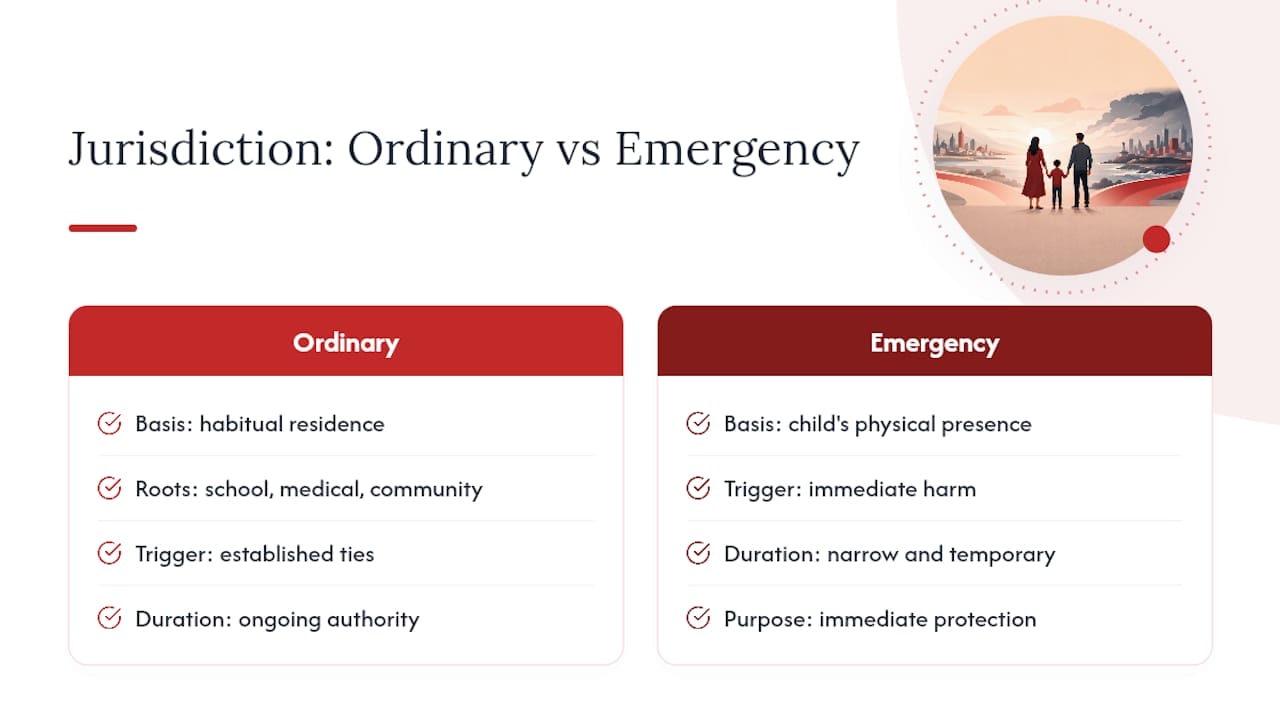
Ordinary jurisdiction follows habitual residence. The courts of the country where the child habitually resides generally have authority to make custody decisions. Emergency jurisdiction is different: a local court can act to protect a child who is physically present in its territory, even when another court would normally have jurisdiction. Emergency jurisdiction is narrow and temporary, but it can be critical when a child faces immediate harm.
Why does this matter practically? Because if you file in the wrong court, or if the other parent files first in a foreign court, you may face an uphill battle to have that order recognized. Timing and documentation of habitual residence can determine which court controls the case.
Pro Tip: Document your child’s habitual residence continuously. Keep copies of school enrollment records, pediatric visit records, lease agreements, and utility bills in the child’s state of residence. For military families, retain PCS orders and any written agreements about where the child will live during deployment — these records can be decisive in a jurisdictional dispute.
Hague Convention vs. UCCJEA: which tool does what
These two frameworks are not interchangeable, and choosing the right one — or using both — is where experienced counsel earns its keep.
| Feature | Hague Convention | UCCJEA |
|---|---|---|
| Purpose | Prompt return of wrongfully removed children; not a custody merits ruling | Register and enforce foreign custody orders in U.S. courts |
| Requires existing custody order? | No — rights of custody under law of habitual residence suffice | Yes — a foreign order must exist to register |
| Child age limit | Under 16 at time of removal | No age limit in the statute |
| Country requirement | Both countries must be Hague signatories | Applies to foreign orders from any country if jurisdictional standards met |
| Timeline guidance | Six-week target for court decision | Expedited enforcement available; hearing can be set quickly |
| Defenses available | Narrow (grave risk of harm, child’s objection, settlement) | Broader — due process, jurisdictional conformity |
| Who administers | Central Authorities in each signatory country | State courts; no central body |
| Outcome | Return of child to country of habitual residence | Enforcement or modification of the custody order itself |
The Hague Convention’s object is specifically to secure the prompt return of wrongfully removed children and to ensure that custody and access rights are respected among contracting states. It is not a vehicle for relitigating who should have custody. A Hague court decides one question: was the child wrongfully removed, and should they be returned?
The UCCJEA, by contrast, gives U.S. state courts a mechanism to register a foreign custody order and enforce it as if it were a domestic order — including through contempt. The foreign court must have had jurisdiction substantially conforming to UCCJEA standards, and both parties must have had notice and an opportunity to be heard.
Experienced attorneys often pursue both remedies in parallel or in sequence. A Hague application can secure a child’s return quickly; UCCJEA registration then gives the returning parent an enforceable order in their home state. Neither path is exclusive.
How to get a foreign custody order recognized in the United States
Getting a foreign order enforced in a U.S. court is a multi-step process. Here is the practical sequence:
-
Verify the foreign court had proper jurisdiction. The U.S. court will ask whether the foreign court’s jurisdictional basis substantially conforms to UCCJEA standards. If the foreign court lacked jurisdiction — for example, if the child was not habitually resident there — the order may be refused.
-
Gather and authenticate your documents. You need a certified copy of the foreign custody order, a certified translation if it is not in English, and any supporting evidence of the child’s habitual residence. Many countries require an apostille (a form of international authentication under the Hague Apostille Convention) or consular legalization for documents to be accepted in U.S. proceedings.
-
File a petition to register the foreign order in the appropriate U.S. state court. Under the UCCJEA, you file in the state where the child currently lives or where enforcement is sought. The registration process gives the other parent an opportunity to contest, but the grounds for contesting are narrow.
-
Seek expedited enforcement if the situation is urgent. The UCCJEA includes expedited enforcement tools. A court can set a hearing on very short notice when a child’s safety or presence in the jurisdiction is at risk.
-
Consider a mirror order if you need enforcement abroad. A U.S. custody order is not automatically enforceable in a foreign country. Practitioners routinely obtain a “mirror order” — a locally enforceable order from the foreign court that mirrors the U.S. decree. Without it, enforcement in the foreign country typically requires cooperation with local counsel and, often, a separate legal proceeding.
For Hague matters, the U.S. State Department’s Office of Children’s Issues serves as the U.S. Central Authority. It can receive and transmit Hague applications, coordinate with foreign Central Authorities, and provide case-specific guidance. The Hague Convention sets a six-week target for courts to reach a decision on return applications — though actual timelines vary by country and case complexity.
Costs vary significantly depending on whether foreign counsel is needed, whether translation is required, and how contested the proceedings become. Budget for local counsel in the foreign country if enforcement there is part of your strategy.
What to include in an enforceable overseas custody agreement
Vague agreements fail internationally. A clause that says “the parents will share time reasonably” gives a foreign court nothing to enforce. Precision is not just good drafting practice — it is the difference between an agreement that works across borders and one that collapses the moment a dispute arises. Here is what every cross-border custody agreement should contain:
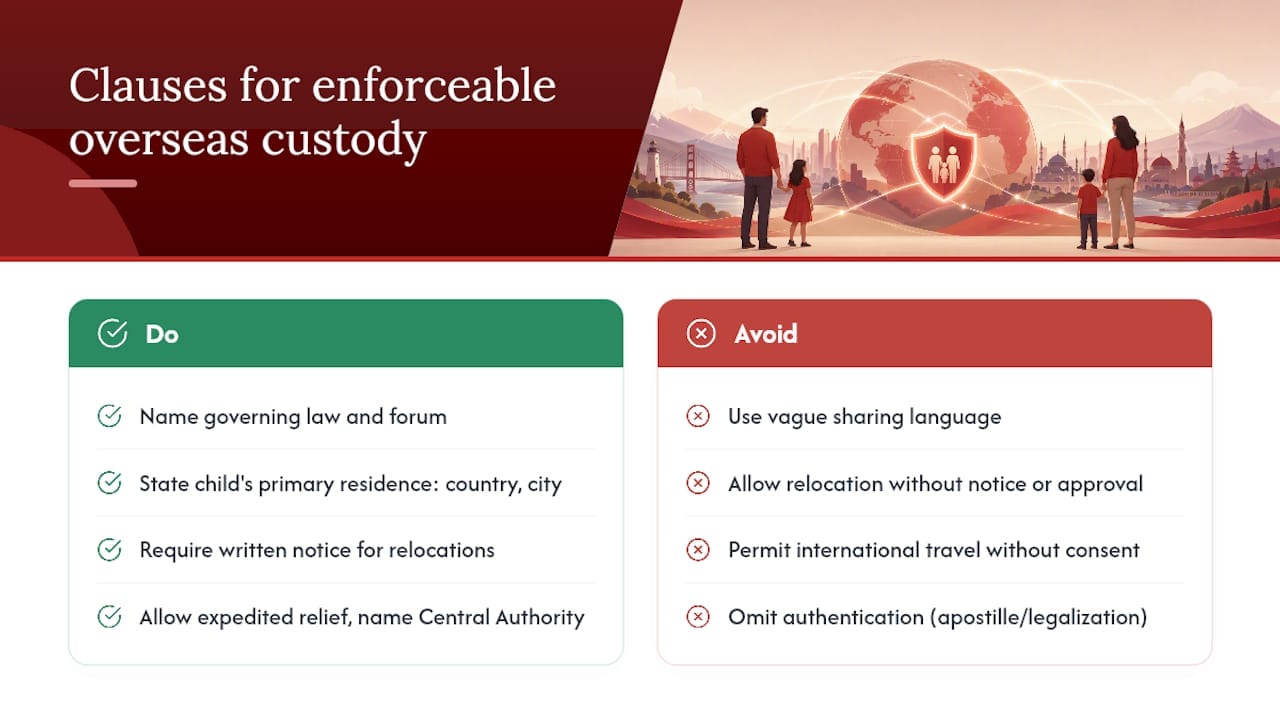
Governing law and choice of forum. Name the country and state whose law governs the agreement, and specify which court has jurisdiction over disputes. Without this, a parent can argue that a more favorable foreign court should decide.
Primary residence definition. State explicitly the country and city where the child’s primary residence is located. This establishes habitual residence for Hague and UCCJEA purposes.
Relocation notice and approval process. Require written notice before any international relocation, and specify whether court approval or the other parent’s written consent is required. See the firm’s relocation custody guide for how U.S. courts analyze relocation requests.
Travel restriction and passport consent language. Prohibit international travel without the other parent’s written consent or prior court order. Specify who holds the child’s passport and under what conditions it may be released. This clause, once incorporated into a court order, is enforceable by contempt.
Dispute resolution clause. Specify mediation or arbitration as a first step before litigation, and name the governing rules (e.g., American Arbitration Association international rules). Mediation can resolve international relocation disputes far faster and less expensively than litigation, particularly when both parents are willing to cooperate.
Enforcement clause. Explicitly authorize either party to seek expedited relief in the courts of the governing jurisdiction, and name the Central Authority or attorney responsible for Hague or UCCJEA filings if a removal occurs.
Parenting time schedule with costs. Define international visitation in specific terms: dates, travel logistics, who pays for international flights, and what happens if travel is disrupted.
Pro Tip: Attorneys drafting cross-border agreements should include a clause that expressly authorizes expedited relief and identifies which Central Authority or designated counsel will handle Hague or UCCJEA proceedings if a wrongful removal occurs. Naming the mechanism in advance removes one layer of delay in an emergency.
Authentication matters too. A custody order that will be used in a foreign country may need an apostille or consular legalization before foreign courts will accept it. Build that step into your timeline before any international move happens, not after. For practical drafting guidance, the firm’s child custody agreement guide covers clause language and incorporation requirements in detail.
Preventive steps to reduce the risk of international parental abduction
The best time to address abduction risk is before it happens. Once a child is overseas, the legal process is expensive, slow, and emotionally devastating — even when it ultimately succeeds.
- Add explicit travel-restriction clauses to your custody order (not just your separation agreement). An incorporated order allows a court to hold a violating parent in contempt. Justia’s international custody guidance recommends prohibiting international travel without express written consent or prior court approval.
- Control passport issuance. For children under 16, both parents must consent to a U.S. passport application. Form DS-3053 is the notarized parental-consent form the State Department uses when one parent provides written consent. Withholding consent — or requiring court approval — is a concrete preventive step.
- Alert the State Department’s Children’s Passport Issuance Alert Program. This program flags passport applications for your child and notifies you if one is submitted.
- Keep original travel documents secure. Store the child’s passport in a location the other parent cannot access unilaterally.
- Document habitual residence continuously. School enrollment, medical records, and housing documents establish where the child lives. These records are the foundation of any Hague or UCCJEA proceeding.
- Register concerns with the U.S. State Department if you have a credible fear of abduction. The Office of Children’s Issues can provide country-specific guidance and connect you with resources.
- Obtain a court order prohibiting international travel without prior written consent if the risk is serious. Courts can issue these orders on an expedited basis when the facts support it.
For military families, the interaction between PCS orders and habitual residence deserves specific attention. A service member’s assignment to an overseas installation does not shift the child’s habitual residence to that country. Courts look at where the child has established actual ties. If you are a military parent facing a PCS move, address custody and habitual residence in writing before the move happens, not after.
If a child has been wrongfully removed or retained abroad
Speed is everything. The Hague Convention’s one-year rule means that applications filed more than a year after a wrongful removal face an additional defense — that the child is now “settled” in the new environment. Act immediately.
-
Contact local law enforcement. Report the removal. In the U.S., international parental abduction is a federal crime under the International Parental Kidnapping Crime Act. A police report creates an official record and may trigger an Interpol notice.
-
Contact the U.S. State Department’s Office of Children’s Issues. If the child has been taken to a Hague signatory country, the Office of Children’s Issues serves as the U.S. Central Authority and can initiate the Hague return process. Reach them at travel.state.gov or by phone.
-
Preserve all evidence. Gather travel records, communications with the other parent, the custody order, and any evidence of the child’s habitual residence. These documents form the core of your Hague application.
-
Contact an experienced international family law attorney immediately. The Hague application process has specific procedural requirements. An attorney familiar with international custody and Hague Convention procedures can prepare and submit the application correctly and quickly.
-
File a Hague application through the Central Authority. The Central Authority system allows applicants to request assistance for return; authorities are required to act expeditiously. The six-week target for a court decision begins once the application is properly filed in the destination country.
-
Pursue parallel UCCJEA remedies in U.S. courts. Even while a Hague application is pending abroad, you can register your custody order in the appropriate U.S. state court and seek orders preventing the other parent from obtaining travel documents or disposing of assets.
-
Contact the National Center for Missing & Exploited Children. NCMEC provides coordination assistance in international abduction cases and can help locate children and connect families with resources.
If the child has been taken to a country that is not a Hague signatory, the options are narrower but not exhausted. UCCJEA registration, civil custody actions in U.S. courts, and seeking a mirror order in the foreign jurisdiction through local counsel are all possible routes. The State Department can provide country-specific guidance on non-Hague countries.
For urgent situations in Florida, emergency custody procedures are available and can be initiated quickly when a child faces imminent risk.
Short answers to common questions about overseas child custody
-
Can one parent take a child abroad without the other parent’s consent? Generally no, when both parents share legal custody. Doing so without consent or court approval typically constitutes wrongful removal under the Hague Convention and may be a federal crime under U.S. law. The specific rules depend on the custody order’s language and the laws of the destination country.
-
Can a non-U.S. citizen parent get custody of a child? Yes. U.S. courts decide custody on the merits — the child’s best interests — and immigration status alone is not determinative. A parent’s citizenship or visa status may be one factor in a relocation analysis, but it does not disqualify a parent from seeking or holding custody.
-
Can a custodial parent move a child overseas? Not unilaterally when the other parent has legal custody rights. Most U.S. states require either the other parent’s written consent or a court order authorizing the relocation. Courts weigh the child’s best interests, the reason for the move, and the impact on the other parent’s relationship with the child. The UCCJEA and Hague Convention both apply once the move crosses a border.
-
Does a U.S. custody order automatically work in another country? No. A U.S. order has no automatic force abroad. Enforcement requires either a Hague return proceeding (if the child was wrongfully removed) or a separate legal proceeding in the foreign country, often through a mirror order obtained with local counsel.
-
What happens to child support when parents live in different countries? Child support enforcement across borders depends on whether the countries involved have a reciprocal enforcement treaty or bilateral agreement. The U.S. has income withholding and enforcement mechanisms domestically, but collecting from a parent living abroad requires engagement with that country’s enforcement system. An attorney familiar with international family law can assess the specific options.
When to contact an attorney for overseas custody help
Some custody situations allow time for deliberate planning. International custody situations often do not. Here is when you need counsel immediately:
An experienced family law attorney handles the full range of services these cases require: assessing which court has jurisdiction and why, choosing between Hague and UCCJEA strategy (or both), drafting enforceable clauses before a dispute arises, registering foreign orders in U.S. courts, filing emergency motions when a removal is imminent or has already occurred, coordinating with foreign counsel for mirror orders, and managing the Central Authority process from application through hearing.
Seek counsel immediately if you suspect the other parent is planning to take the child abroad, if you are planning an international relocation yourself, if you are drafting or modifying a custody agreement that will cross borders, or if a child has already been removed.
Jmoorelegal handles family law matters including international custody, Hague Convention proceedings, and military family law from Brevard County, Florida. The firm’s experience with military families — including the intersection of PCS orders and habitual residence — is directly relevant to many overseas custody situations. Military family law resources are available for service members and their families navigating custody across international lines.
A perspective on why clear drafting and fast action matter
Most international custody problems I see were preventable. Not because the parents were careless, but because no one told them that a separation agreement without court incorporation is just a piece of paper — or that a custody order without travel-restriction language gives the other parent a legal opening to take a child abroad. The legal framework exists to protect children and parents alike, but it only works when the documents are right and the action is timely. Many of these situations are solvable, even after a removal has occurred, when a parent moves quickly and works with counsel who knows the Hague process and the UCCJEA. The families I worry about most are the ones who wait, hoping the situation resolves itself. It rarely does. If you have any concern about cross-border custody risk, the right time to address it is now, not after a plane has taken off.
Jmoorelegal handles overseas custody matters in Brevard County

Cross-border custody cases require a lawyer who understands both the procedural mechanics and the human urgency. Jmoorelegal’s family law practice covers international custody strategy from initial agreement drafting through Hague applications and emergency court filings. The firm works with military families, expats, and parents in Brevard County, Florida facing custody disputes that cross state lines or national borders. Free initial consultations are available — call or use the firm’s online contact form to schedule one. This article is general legal information and does not create an attorney-client relationship; confirm current rules and procedures with qualified counsel for your specific situation.
Sources
- International Child Custody Under the Law | Child Custody and Support Law Center | Justia
- Convention on the Civil Aspects of International Child Abduction (Hague Convention) — UN Treaty Collection
- OVERSEAS CUSTODY & VISITATION ISSUES | North Carolina State Bar
- Custody orders across state-lines/overseas | American Bar Association
- Creating enforceable international custody agreement | Catalyst Legal
- International Parental Child Abduction — U.S. Department of State
- Travel
Recommended
- International Custody & Hague Convention | Florida
- Child Custody Agreement Guide for Parents in 2026 – The Law Office of John Vernon Moore, P.A.
- Shared vs. Sole Custody Explained: What Parents Need to Know – The Law Office of John Vernon Moore, P.A.
- Third-Party Custody in Florida: Non-Parent Caregivers