A domestic violence charge is defined as a criminal offense committed by one person against a spouse, intimate partner, family member, or cohabitant within a qualifying domestic relationship. Understanding what is a domestic violence charge matters because it is not a single crime. It is a legal category covering assault, battery, stalking, harassment, and property destruction when committed between people in domestic relationships. The charge reflects a pattern of power and control, not just a single violent act. Courts in 2026 apply this framework broadly, and the consequences reach far beyond a criminal record.
What actions and relationships legally trigger a domestic violence charge?
A domestic violence charge requires two things: a qualifying relationship and abusive conduct. Both elements must be present. Without the relationship qualifier, the same act is charged as a standard assault or battery between strangers.
The qualifying relationships include:
- Spouses and former spouses
- Current or former intimate partners, including dating relationships
- Family members related by blood, marriage, or adoption
- Cohabitants sharing a household, even without a romantic relationship
- Co-parents, regardless of whether they ever lived together
The conduct that triggers charges covers a wide range. Physical abuse is the most recognized form, but courts do not require visible injuries. Courts treat text threats or financial control as sufficient grounds for a charge. Emotional abuse, psychological manipulation, stalking, harassment, and property destruction all qualify. Sexual violence within a marriage or partnership is also prosecuted as domestic violence in every U.S. state.
The distinction from stranger crimes matters legally. When the same punch is thrown between strangers, it is simple battery. When thrown between intimate partners, it becomes a domestic violence offense. That distinction triggers a separate set of laws, mandatory procedures, and collateral consequences that do not apply to standard criminal charges.

How are domestic violence charges classified as misdemeanors or felonies?
Charge classification depends on state laws and aggravating factors such as weapon use, strangulation, serious bodily injury, or prior convictions. The same act can be charged as a misdemeanor in one state and a felony in another. Many states also use “wobbler” offenses, meaning prosecutors can charge them at either level depending on the facts.
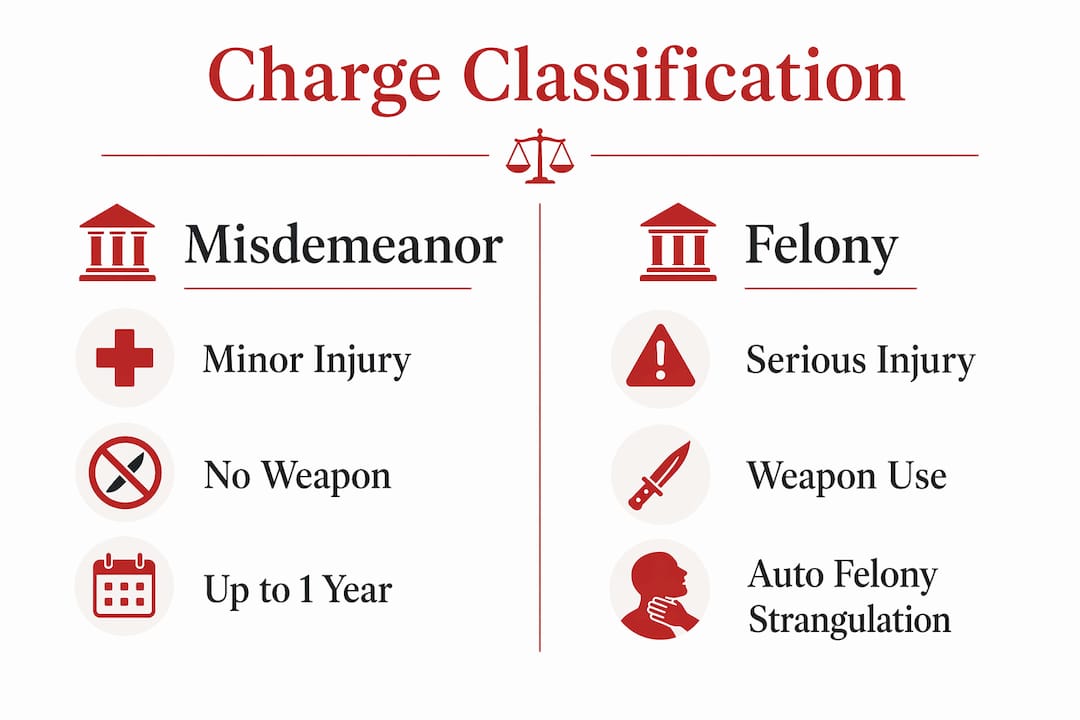
| Factor | Misdemeanor charge | Felony charge |
|---|---|---|
| Injury level | Minor or no visible injury | Serious bodily harm |
| Weapon use | No weapon involved | Weapon present or used |
| Strangulation | Not applicable | Automatic felony in most states |
| Prior convictions | First offense | Prior domestic violence conviction |
| Protective order | No active order | Violation of existing order |
Strangulation deserves special attention. Most states treat it as an automatic felony, regardless of whether the victim sustained visible marks. Prosecutors view strangulation as a high-risk indicator for future lethal violence, and courts treat it accordingly.
Pro Tip: If you are facing a charge that involves any of the aggravating factors in the table above, the case is almost certainly heading toward felony territory. Get legal counsel before your first court appearance, not after.
Penalties at the misdemeanor level typically include up to one year in county jail, fines, probation, and mandatory batterers’ intervention programs. Felony convictions carry state prison sentences ranging from one year to life, depending on the severity of the offense and the defendant’s criminal history.
What is the domestic violence arrest process from arrest to prosecution?
The arrest process in domestic violence cases moves faster and with less discretion than most people expect. Police must arrest when probable cause exists, regardless of whether the victim wants to press charges. Many jurisdictions operate under mandatory arrest policies, meaning officers have no choice once they determine probable cause is present.
The process from arrest to initial court appearance typically follows these steps:
- Police respond to the scene and assess the situation based on visible evidence, statements, and injuries.
- Arrest occurs if probable cause exists. The victim’s cooperation is not required.
- Booking and processing take place at the local jail, often within hours of the arrest.
- Arraignment is scheduled, usually within 24–72 hours, where the defendant enters a plea.
- Protective orders are issued automatically in many jurisdictions at or before arraignment.
- Bail conditions are set, which frequently include no-contact provisions and firearm surrender.
Arraignment hearings typically result in automatic protective orders barring contact and prohibiting return to a shared home, even before any evidence is reviewed. This is one of the most disruptive immediate consequences of a charge.
Prosecution proceeds independently of the victim’s wishes. The legal action is between the state and the defendant, not between the victim and defendant. A victim who recants or refuses to testify does not automatically end the case. Prosecutors can use police reports, 911 recordings, medical records, and witness statements to proceed without victim cooperation.
Pro Tip: Violating a no-contact order, even at the victim’s invitation, is a separate criminal offense. Many defendants make this mistake and face additional charges on top of the original domestic violence charge.
What are the consequences of a domestic violence charge and conviction?
The consequences of a domestic violence conviction extend well beyond jail time. Convictions trigger custody presumptions, deportation risks, and can permanently affect licensed professions. Defendants are often blindsided by how many areas of their life a single conviction touches.
| Consequence category | Misdemeanor conviction | Felony conviction |
|---|---|---|
| Criminal sentence | Probation, fines, up to 1 year jail | Prison sentence, extended probation |
| Firearms | Lifetime federal ban (Lautenberg Amendment) | Lifetime federal ban |
| Child custody | Negative presumption in custody proceedings | Strong presumption against custody |
| Immigration | Possible deportation for non-citizens | Near-certain deportation |
| Employment | Background check disclosure required | Severe restrictions on licensed professions |
| Protective orders | No-contact and stay-away orders | Same, with stricter enforcement |
The federal firearms ban deserves direct attention. A misdemeanor domestic violence conviction triggers a lifetime federal firearms ban under the Lautenberg Amendment, with no waiver available. This applies to hunters, military personnel, and law enforcement officers equally. A misdemeanor conviction, not a felony, is all it takes.
The impact on child custody after domestic violence is significant. Most states create a legal presumption against awarding custody to a parent convicted of domestic violence. Even an unresolved charge can influence temporary custody arrangements during proceedings.
Immigration consequences are severe for non-citizens. Domestic violence offenses are classified as crimes of moral turpitude under federal immigration law. A conviction can trigger removal proceedings, bar re-entry, and affect naturalization applications.
How can you fight domestic violence charges effectively?
Fighting a domestic violence charge requires a defense built on the specific facts of the case, not a generic approach. Evidence admissibility plays a central role in determining what the prosecution can actually use at trial. Weak evidence does not automatically mean a weak case for the state, because prosecutors are experienced at building cases from secondary sources.
Common defense strategies include:
- Self-defense or defense of others, where the defendant acted to prevent imminent harm
- False allegations, supported by inconsistencies in the accuser’s statements or timeline
- Lack of qualifying relationship, challenging whether the parties meet the legal definition
- Insufficient evidence, attacking the quality and admissibility of the state’s proof
- Mutual combat, where both parties engaged in physical altercation
The biggest mistake defendants make is assuming the case will disappear if the victim stops cooperating. It will not. Prosecutors routinely proceed without victim testimony, using the evidence gathered at the scene. Waiting to hire an attorney until after the first court date costs defendants critical time for evidence gathering and witness interviews.
No-contact order violations are the second most common mistake. Defendants who contact the alleged victim, even through a third party, face new criminal charges. Those charges are often easier to prove than the original offense.
Pro Tip: Document everything immediately after an arrest: save text messages, note witness names, photograph any injuries you sustained, and write down your account of events while memory is fresh. This material becomes the foundation of your defense.
Consulting a domestic violence defense attorney early gives you the best chance of challenging the charge before the prosecution’s case solidifies. The earlier you engage counsel, the more options remain available.
Key Takeaways
A domestic violence charge is a legal designation that triggers criminal penalties, federal firearms bans, custody consequences, and immigration risks that outlast the case itself.
| Point | Details |
|---|---|
| Legal definition | Domestic violence charges require a qualifying relationship and abusive conduct, not just physical injury. |
| Charge severity | Aggravating factors like strangulation or prior convictions elevate charges from misdemeanor to felony automatically. |
| Arrest process | Police arrest on probable cause alone; victim cooperation is not required to initiate or continue prosecution. |
| Federal firearms ban | Any misdemeanor domestic violence conviction triggers a lifetime ban under the Lautenberg Amendment. |
| Defense timing | Hiring an attorney immediately after arrest preserves evidence and maximizes available defense options. |
What I’ve learned after years of handling these cases
Most people who call me after a domestic violence arrest share the same assumption: if the other person drops the charges, the case goes away. That belief causes more damage than almost any other misconception I encounter. The state files the charges. The state decides whether to proceed. The alleged victim is a witness, not the decision-maker.
The second thing that surprises people is how quickly their life changes before any conviction occurs. A no-contact order can remove you from your home within hours of an arrest. Your firearms must be surrendered. Your access to your children may be restricted. All of this happens before a judge or jury has heard a single piece of evidence. That is the reality of how these cases work in 2026, and defendants who are not prepared for it make decisions that hurt them later.
What I tell every client is this: the charge is not the conviction. A charge is the beginning of a legal process, and that process has rules, standards, and opportunities to challenge the state’s case. The outcome depends heavily on how quickly and strategically you respond. Defendants who engage counsel early, follow court orders precisely, and avoid contact violations give themselves a real chance. Those who wait, assume the case will resolve itself, or violate protective orders almost always face worse outcomes than the original charge warranted.
— John
Facing a domestic violence charge in Brevard County?
The Law Office of John Vernon Moore, P.A. handles domestic violence defense cases across Brevard County, Florida. Jmoorelegal brings a client-centered approach to every case, with direct attorney involvement from the first consultation through resolution.

If you or someone you know is facing a domestic violence charge, the time to act is now. Jmoorelegal offers free initial consultations and builds defense strategies tailored to the specific facts of each case. The firm’s criminal law practice covers the full range of domestic violence offenses, from misdemeanor battery to felony assault. For families dealing with the overlap between criminal charges and custody matters, Jmoorelegal’s family law services address both sides of the legal picture. Contact the office directly to schedule a confidential consultation.
FAQ
What is a domestic violence charge, exactly?
A domestic violence charge is a criminal offense, such as assault, battery, or stalking, committed against a spouse, intimate partner, family member, or cohabitant. It is a legal category, not a single crime, and the qualifying relationship is what separates it from a standard criminal charge.
Can a domestic violence case proceed if the victim recants?
Yes. The prosecution is between the state and the defendant, not the victim and defendant. Prosecutors can use police reports, 911 recordings, and medical records to proceed without victim testimony.
Does a misdemeanor domestic violence conviction affect gun rights?
A misdemeanor domestic violence conviction triggers a lifetime federal firearms ban under the Lautenberg Amendment, with no exceptions or waivers available, even for military personnel or hunters.
What happens immediately after a domestic violence arrest?
Police arrest on probable cause, booking follows within hours, and arraignment typically occurs within 24–72 hours. Automatic no-contact orders are issued at arraignment and can require defendants to vacate a shared home before any evidence is reviewed.
How do domestic violence charges affect child custody?
Most states apply a legal presumption against awarding custody to a parent convicted of domestic violence. Even an unresolved charge can influence temporary custody arrangements during active family court proceedings.
Recommended
- Domestic Violence Charge Defense Strategy: 2026 Guide – The Law Office of John Vernon Moore, P.A.
- How Domestic Violence Affects Custody: 2026 Guide – The Law Office of John Vernon Moore, P.A.
- Domestic Violence – The Law Office of John Vernon Moore, P.A.
- Domestic Violence Injunction Guide for Florida Victims – The Law Office of John Vernon Moore, P.A.