

A temporary custody order is a court-issued directive that establishes where a child lives, who makes decisions for them, and how visitation works while a final custody ruling is still pending. The temporary custody order process is one of the most consequential steps in any custody dispute. These orders carry real legal weight, and the arrangements they create often shape what a judge decides at the final hearing. Understanding how this process works gives you a real advantage when your child’s stability is on the line.
What does the temporary custody order process require?
Filing for a temporary custody order starts with a motion or petition submitted to your local family court. The motion must include detailed factual support. Vague claims do not move judges. You need specific dates, incidents, and documented evidence.
The core documents you will typically need include:
- Motion or petition for temporary custody with a sworn affidavit
- Financial declaration covering income, expenses, and assets
- Supporting evidence such as police reports, medical records, school records, or photographs
- Proof of service showing the other parent was properly notified
Proper service of process is legally required after filing. Failure to serve the other parent correctly can result in the order being challenged and overturned. Courts take this step seriously, and so should you.
Filing fees vary by county and state. If cost is a barrier, fee waivers are available based on financial hardship, such as income below certain thresholds or current enrollment in public assistance programs. Ask the court clerk for a fee waiver application when you file.

| Document | Purpose |
|---|---|
| Sworn affidavit | Provides factual basis for the request |
| Financial declaration | Establishes income and expense picture |
| Police or medical reports | Supports claims of harm or instability |
| Proof of service | Confirms the other parent received notice |
Pro Tip: Organize your evidence chronologically before you file. Judges review dozens of cases. A clear timeline of dated incidents is far more persuasive than a general narrative.
How do you file for a temporary custody order?
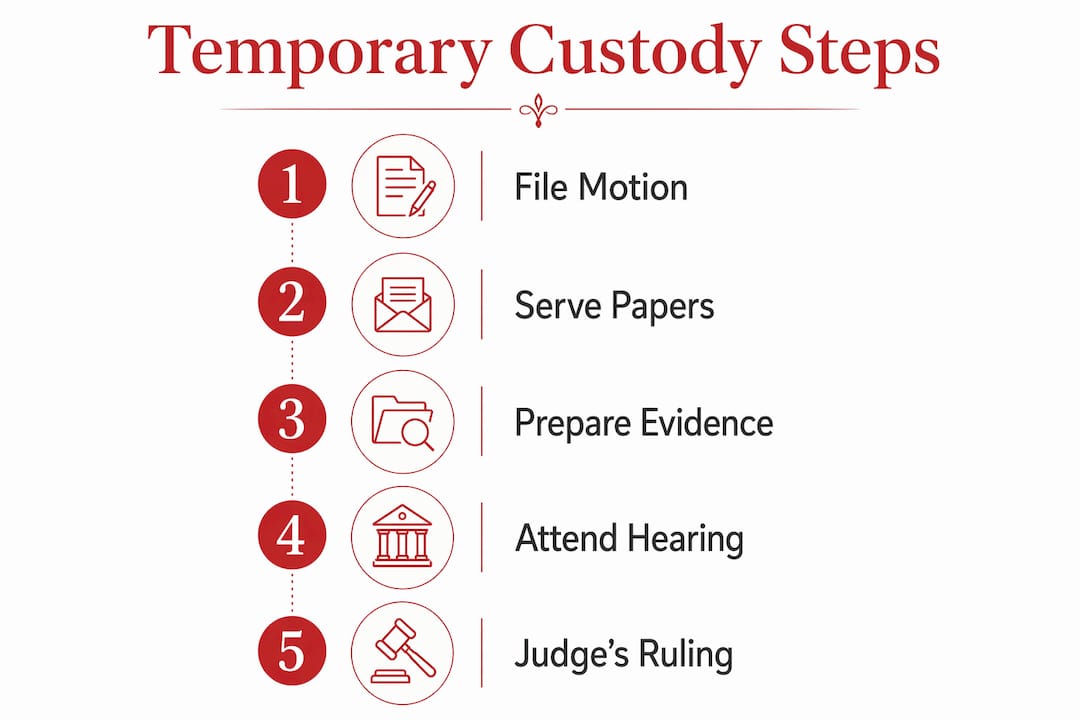
The standard filing process follows a predictable sequence. You submit your motion and affidavit to the family court clerk, pay the filing fee or submit your fee waiver, and then serve the other parent with copies of everything you filed. The court schedules a hearing, and both parties appear before a judge.
Emergency custody orders, also called ex parte orders, follow a faster and stricter path. You file on the same day you identify the threat, and a judge reviews the request within 0–72 hours. If granted, a full hearing is then scheduled within 14–21 days. This timeline comes from the emergency custody filing process used in most jurisdictions.
Emergency orders require proof of immediate harm. Courts do not grant them based on general concerns about the other parent’s behavior. The standard is high because ex parte orders are issued without the other parent present.
The steps for a standard temporary custody filing are:
- Draft your motion and affidavit. Be specific. Name dates, locations, and witnesses.
- Gather supporting documents. Attach police reports, medical records, or school communications.
- File with the family court clerk. Pay the fee or submit your waiver application.
- Serve the other parent. Use a process server or sheriff’s deputy to confirm legal service.
- Attend the scheduled hearing. Bring organized copies of all evidence for the judge.
Pro Tip: If you are filing an emergency motion, attach a separate declaration that explains why waiting for a standard hearing would put your child at risk. Judges look for that specific showing before granting ex parte relief.
For a broader look at how family court procedures work from filing through final order, Jmoorelegal has a plain-language overview that walks parents through each stage.
What happens at a temporary custody hearing?
Temporary custody hearings are brief and move fast. Judges typically allot as little as 5–15 minutes per side to present their case. That is not a lot of time to tell your story, which is why preparation matters more than passion.
The judge applies the “best interests of the child” standard at every temporary hearing. This is the same standard used at final trials. Courts focus on environmental stability, existing routines, and parental fitness. A parent who can show they have been the primary caregiver, maintained school attendance, and kept medical appointments starts from a strong position.
Courts prioritize minimizing disruption to children at temporary hearings. A judge is far more likely to preserve an existing routine than to uproot a child based on disputed allegations without clear evidence.
What you can expect during the hearing:
- Opening statements from each party or their attorney (brief, often 2–3 minutes)
- Presentation of evidence including documents and witness testimony
- Guardian ad Litem report, if one has been appointed to represent the child’s interests
- Judge’s ruling, which may issue a temporary order, deny the request, or order supervised visitation
Presenting concise, clearly dated evidence is critical given the limited time. Courts favor documented facts over generalized grievances or character attacks. If you walk in with a binder of organized, dated records, you will stand out.
How do temporary orders affect the final custody ruling?
Temporary orders are often the most influential court decisions early in custody litigation. They create a de facto custody arrangement that shapes what the final order looks like. Judges are reluctant to disrupt a stable arrangement that has been working for months, even when statutes technically say temporary orders do not bind the final ruling.
Temporary custody orders can remain in effect from a few months to more than a year in complex cases. That is a long time for a child to settle into a routine. It is also a long time for a parent to build a track record of compliance or noncompliance.
Violating a temporary custody order carries serious consequences. Contempt charges can result in fines, jail time, or a modification of custody in the other parent’s favor. Courts treat violations as evidence of a parent’s willingness to follow legal authority. That evidence follows you into the final hearing.
If circumstances change significantly after a temporary order is issued, either parent can file a motion to modify. The key steps to protect your position include:
- Document every custody exchange. Use a written log with dates, times, and any issues.
- Keep records of violations. Save text messages, emails, and voicemails that show the other parent’s noncompliance.
- Follow the order exactly. Even if you disagree with a term, comply and then file a motion to change it.
- Work with a Guardian ad Litem. Their report carries significant weight with judges.
Parents dealing with domestic violence concerns should know that safety issues directly affect how courts structure temporary custody and visitation. When you need to modify an existing order, Jmoorelegal’s custody modification page explains the legal standard and what evidence courts require.
Pro Tip: Use a co-parenting communication app to create a timestamped record of all exchanges with the other parent. That record is admissible and far more credible than memory alone.
Key Takeaways
The temporary custody order process creates legally binding interim arrangements that directly influence final custody rulings, making preparation, compliance, and documentation the three most critical factors for any parent.
| Point | Details |
|---|---|
| File with strong evidence | Attach dated police reports, medical records, and school documents to your motion. |
| Serve the other parent correctly | Improper service can invalidate your order and delay the entire case. |
| Hearings are short | Judges allow as little as 5–15 minutes per side, so organized evidence wins. |
| Temporary orders shape final rulings | Judges rarely disrupt stable arrangements created by temporary orders. |
| Violations carry real penalties | Contempt charges from violations can result in fines, jail, or lost custody. |
What I’ve learned after years in family court
After working custody cases in Brevard County for years, the pattern I see most often is parents who underestimate how much the temporary order matters. They treat it like a placeholder. It is not. The arrangement a judge puts in place at the temporary hearing is frequently the arrangement that survives to the final order, sometimes with minor adjustments.
The parents who do best come in prepared. They have a binder. They know their dates. They can answer the judge’s questions without fumbling. The parents who struggle come in with emotion and no documentation. Emotion does not move family court judges. Evidence does.
The other thing I tell every parent: follow the order, even if you think it is wrong. Filing a motion to modify is the right way to challenge a term you disagree with. Ignoring the order or working around it gives the other side ammunition that is very hard to overcome. I have seen parents lose custody not because they were bad parents, but because they violated a temporary order they thought was unfair.
Mediation is worth considering before or during the temporary order phase. A certified mediator can help both parents reach an agreement that avoids a contested hearing entirely. That saves time, money, and stress for everyone, especially the child. The role of a mediator in family court is often misunderstood, but in my experience, it is one of the most effective tools available to parents who are willing to use it.
— John
Jmoorelegal’s family law team is ready to help
Custody disputes move fast, and the decisions made early in the process carry long-term consequences. Jmoorelegal represents parents in Brevard County, Florida through every stage of custody litigation, from the first temporary custody application through final hearings and modifications.

The team at Jmoorelegal helps parents gather the right evidence, meet filing deadlines, and walk into hearings prepared. Whether you are filing for the first time or responding to a motion filed against you, experienced legal representation makes a measurable difference in outcomes. Jmoorelegal offers free initial consultations, so you can get clear answers before committing to a course of action. Visit the family law services page to learn more or schedule your consultation today.
FAQ
What is a temporary custody order?
A temporary custody order is a court-issued ruling that establishes where a child lives and how parenting time is divided while a final custody case is still pending. It carries full legal force and remains in effect until a final order replaces it.
How long does a temporary custody order last?
Temporary custody orders remain in effect until the court issues a final custody ruling. Depending on case complexity, that can range from a few months to more than a year.
Can a temporary custody order become permanent?
Temporary orders do not automatically become permanent, but judges are reluctant to disrupt stable arrangements. A long-standing temporary arrangement significantly influences the final ruling.
What happens if the other parent violates the temporary order?
Violating a temporary custody order can result in contempt of court charges, which carry penalties including fines, jail time, or a modification of custody in the complying parent’s favor.
Do I need a lawyer to file for temporary custody?
You are not legally required to have an attorney, but the filing process, evidence standards, and hearing procedures are complex. Legal representation significantly improves your ability to present a strong case, especially in emergency situations.
Recommended
- How Family Court Process Works: Your Clear Guide – The Law Office of John Vernon Moore, P.A.
- Modification of Child Custody – The Law Office of John Vernon Moore, P.A.
- Child Custody & Visitation – The Law Office of John Vernon Moore, P.A.
- How Domestic Violence Affects Custody: 2026 Guide – The Law Office of John Vernon Moore, P.A.


