In Florida, a no contest (nolo contendere) plea means you accept the disposition of a charge without admitting guilt; it waives your right to trial but does not guarantee leniency. Under Florida Statute §90.410, the plea generally cannot be used against you in a later civil or criminal case. Even so, the judge can still adjudicate you guilty and impose a full sentence unless adjudication is expressly withheld.
TL;DR:
- Section 90.410 generally bars using a no contest plea in later civil or criminal cases, but family courts may still consider the underlying conduct.
- Withheld adjudication avoids a formal judgment, but Florida districts disagree about whether it can count as a prior conviction on a future sentencing scoresheet.
- For many civil traffic tickets, file the conditional plea within 30 days; crashes and mandatory appearance offenses are excluded, and county procedures vary.
- A withheld adjudication does not prevent immigration consequences, and DUI statutes limit withholding or charge reductions, so confirm both issues before accepting terms.
- Even when both sides agree, the judge can reject or change the proposed sentence; before sentencing, you can generally seek withdrawal for good cause.
Table of Contents
- What a no contest plea means under Florida law
- No contest versus guilty and not guilty pleas
- Adjudication, sentencing, and where Florida courts disagree
- Traffic infractions: conditional no contest pleas
- Civil suits, immigration, and DUI-specific limits
- How the plea is entered and when you can withdraw it
- Deciding whether to plead no contest: a short checklist
- No contest pleas and family law proceedings
- Strategic considerations for a no contest plea
- How a no contest plea affects sentencing alternatives
- The defense attorney’s role in a no contest plea
- No contest pleas in adult versus juvenile court
- What happens after you enter a no contest plea
- Why local counsel matters when choosing a plea
- How our firm can help with your plea decision
- FAQ
- Sources
What a no contest plea means under Florida law
A no contest plea lets you accept punishment for a charge without admitting the underlying facts. Florida courts treat it almost the same as a guilty plea for sentencing purposes, but the admission never becomes part of the record the way a guilty plea does. Before a judge can accept either plea, Rule 3.172 requires the judge to confirm the plea is voluntary and that a factual basis exists, with the prosecution and defense assisting in that determination.
Florida also recognizes an Alford-style plea, where you maintain innocence but acknowledge that accepting the plea serves your best interest given the evidence against you. This still requires the same colloquy and factual basis finding as any other plea. One detail that surprises many defendants: a negotiated plea offer is not final until the judge actually accepts it in open court, under Rule 3.170. A judge can reject a deal both sides have already agreed to.
No contest versus guilty and not guilty pleas
Each plea option in Florida carries different consequences for your record, your civil exposure, and your sentencing outcome.
- Not guilty preserves your right to a jury trial and keeps the state to its burden of proof.
- Guilty is a formal admission that the facts alleged are true and can be used against you in a later civil case.
- No contest waives trial rights without admitting the facts, and under §90.410 it is generally inadmissible in a later civil or criminal proceeding.
People often consider a no-contest plea when they are worried about a related civil suit, such as a personal injury claim arising from the same incident, or when they simply want to avoid formally admitting fault while still resolving the criminal matter. The sentencing outcome, though, is frequently the same as if you had pleaded guilty.
Adjudication, sentencing, and where Florida courts disagree
“Withheld adjudication” means the judge accepts your plea and imposes sentence without entering a formal judgment of guilt, which can help you avoid some of the harsher consequences of a conviction, like certain license or licensing-board actions. When the judge adjudicates you guilty instead, the plea functions as a conviction for most practical purposes, even though you never admitted the facts.
This matters most at your next sentencing, if there ever is one. In Montgomery v. State, the Fourth District held that a no-contest plea followed by a withheld adjudication could still be scored as a prior conviction on a future sentencing scoresheet. Other district courts, including lines of cases often cited alongside Batchelor, Freeman, and Negron, reached different conclusions on when a withheld adjudication counts toward a scoresheet. That split means the practical effect of your plea can depend on which district you are in and how the state later characterizes the disposition. Our sentencing scoresheet guide walks through how prior convictions and adjudications factor into scoring under chapter 921.
Traffic infractions: conditional no contest pleas
Florida offers a simplified path for many civil traffic infractions: the Conditional Plea of No Contest and Waiver of Appearance. Under local administrative order procedures, you typically file the conditional plea within 30 days of the citation, and if accepted, the court can withhold adjudication to help you avoid points on your license.
- This option is not available for infractions involving a crash or for offenses that require a mandatory court appearance.
- Forms, filing methods, and review timelines vary by county, so check your specific circuit’s procedure before relying on a generic template.
- Once accepted, check the court’s order for the deadline to pay fines or complete any required course.
Civil suits, immigration, and DUI-specific limits
The inadmissibility protection under §90.410 is one of the biggest reasons people choose a no-contest plea: a plaintiff in a related civil case generally cannot point to your plea as an admission of fault. That protection has real limits, though, and does not erase the consequences that flow from the criminal case itself.
If you are not a US citizen, a no-contest plea can still be treated as a conviction for immigration purposes, regardless of whether adjudication was withheld, which is why judges are required to give a deportation advisement before accepting the plea. DUI charges carry their own statutory restrictions: Florida law limits when courts may withhold adjudication or accept certain plea reductions in DUI cases, so the flexibility available for other misdemeanors does not always apply. Readers facing a DUI charge may also want to review the penalties and timelines that attach once a plea is entered.
How the plea is entered and when you can withdraw it
When you enter a no-contest plea in open court, the judge works through a formal colloquy required under Rule 3.172: the nature of the charge, the maximum and mandatory penalties, the rights you are giving up, any immigration consequences, and, for felony charges, whether any physical evidence should be tested for DNA before the plea is finalized.
Nothing is final until the judge says so. Even after the prosecutor and your attorney reach an agreement, under Rule 3.171 the judge retains full authority to accept, reject, or modify the proposed sentence. Before sentencing, you can generally ask to withdraw a plea for good cause, and judges have discretion to grant that request. After sentencing, your options narrow considerably: check the applicable rules and consult an attorney promptly about whether a withdrawal motion may be available on grounds such as an involuntary plea or newly discovered evidence.
Deciding whether to plead no contest: a short checklist
Before you sign anything, work through these questions with your attorney.
- Confirm whether the judge will withhold adjudication or enter a formal conviction.
- Ask exactly what facts the prosecutor will present as the factual basis for the plea.
- Confirm the immigration and driver’s-license consequences that apply to your specific charge.
- Review every mandatory cost, fee, and probation condition attached to the offer.
- Ask how the plea will be scored if you are ever sentenced again under the state’s scoresheet rules.
Pro Tip: Get the plea terms in writing before your court date, and preserve any discovery, including physical evidence that could be tested for DNA, in case it later supports a different outcome.
Bring your citation or charging document, any discovery you have received, and copies of correspondence from the prosecutor to your consultation so your attorney can evaluate the offer quickly.
No contest pleas and family law proceedings
A no-contest plea in a criminal case can surface again in a divorce or custody dispute, even though §90.410 limits its use as an admission. Family courts weigh the underlying conduct, not just how the criminal case was resolved, when deciding issues like parental responsibility or timesharing. A charge involving domestic violence, substance abuse, or child endangerment can influence a custody evaluation regardless of whether you pleaded no contest, pleaded guilty, or the case ended in a withheld adjudication.
This is particularly relevant in high-conflict divorces, where one spouse may try to use a pending or resolved criminal matter to argue for restricted timesharing or supervised visitation. A withheld adjudication can blunt some of that argument because no formal conviction exists, but it will not prevent the other side from raising the facts of the incident in family court. If your case involves allegations tied to a personality disorder dynamic or a contentious military divorce, the interplay between the criminal and family dockets deserves careful coordination between counsel on both sides. Timing matters too: entering a plea while a custody case is active can affect how a judge in family court perceives your credibility and cooperation, so it helps to think through both proceedings together rather than in isolation.
Strategic considerations for a no contest plea
The decision to plead no contest usually comes down to a handful of practical tradeoffs rather than one universal rule. If you are concerned about a related civil suit, such as a car accident or an injury claim connected to the same incident, the inadmissibility protection under §90.410 can be a meaningful reason to choose no contest over a guilty plea. If avoiding a formal conviction matters most, the focus shifts to whether the judge is willing to withhold adjudication, since that decision, not the plea type itself, often drives the practical outcome.
Prior record matters too. If you already have convictions on your scoresheet, a no-contest plea with a withheld adjudication may not shield you from having this new charge counted against you later, given the split in Florida case law discussed earlier. Some defendants weigh a no-contest plea against going to trial based on the strength of the state’s evidence; if the factual basis the prosecutor can present in open court is weak, that is worth raising with your attorney before agreeing to any plea. Others consider it specifically to avoid the time, cost, and uncertainty of trial while still preserving some distance from a formal admission. None of these considerations exist in a vacuum, which is why the right strategy depends heavily on the specific charge, your record, and what you are trying to protect, whether that is your driving privileges, your immigration status, or your standing in a parallel civil or family case.
How a no contest plea affects sentencing alternatives
Judges have considerable discretion in how they sentence after a no-contest plea, and that discretion extends to alternatives beyond jail or a straight fine. Probation, diversion programs, community service, and conditional withholds of adjudication are all still on the table, and in many misdemeanor and lower-level felony cases, judges are often willing to consider these alternatives when the defendant has no significant prior record and the factual basis supports a lighter disposition.
A no-contest plea by itself does not make a judge more or less likely to recommend an alternative sentence; the plea mainly affects what can be used against you later, not what the judge chooses to do now. What tends to move the needle is the same information that would matter with any plea type: the facts of the offense, your criminal history, compliance with any pretrial conditions, and how the case scores under chapter 921’s sentencing guidelines. Where a no-contest plea can make a practical difference is in combination with a withheld adjudication, since some diversion and probationary programs are only available, or are more readily offered, when adjudication has not been formally entered. That is one more reason the adjudication question deserves attention before you agree to any plea terms.
The defense attorney’s role in a no contest plea
Your attorney’s job starts well before you ever stand in front of a judge. Under Rule 3.171, plea discussions happen between the prosecutor and defense counsel, with the prosecutor able to recommend a sentence or agree to reduce or drop certain charges, while the judge retains final authority over the outcome. A defense attorney’s work during this stage includes evaluating the state’s evidence, identifying weaknesses in the factual basis, and negotiating terms that address your specific concerns, whether that is a withheld adjudication, a reduced charge, or protection against an immigration consequence.
Just as important is making sure you understand what you are agreeing to before you walk into court. Rule 3.171 requires defense counsel to advise you fully and obtain informed consent before any plea negotiation is finalized, and that advice should cover how the plea could affect a related civil case, your driving privileges, your immigration status, and any future sentencing exposure. A knowledgeable local attorney will also know how judges and prosecutors in your specific county tend to handle requests for withheld adjudication, which can shape the realistic range of outcomes available to you.
No contest pleas in adult versus juvenile court
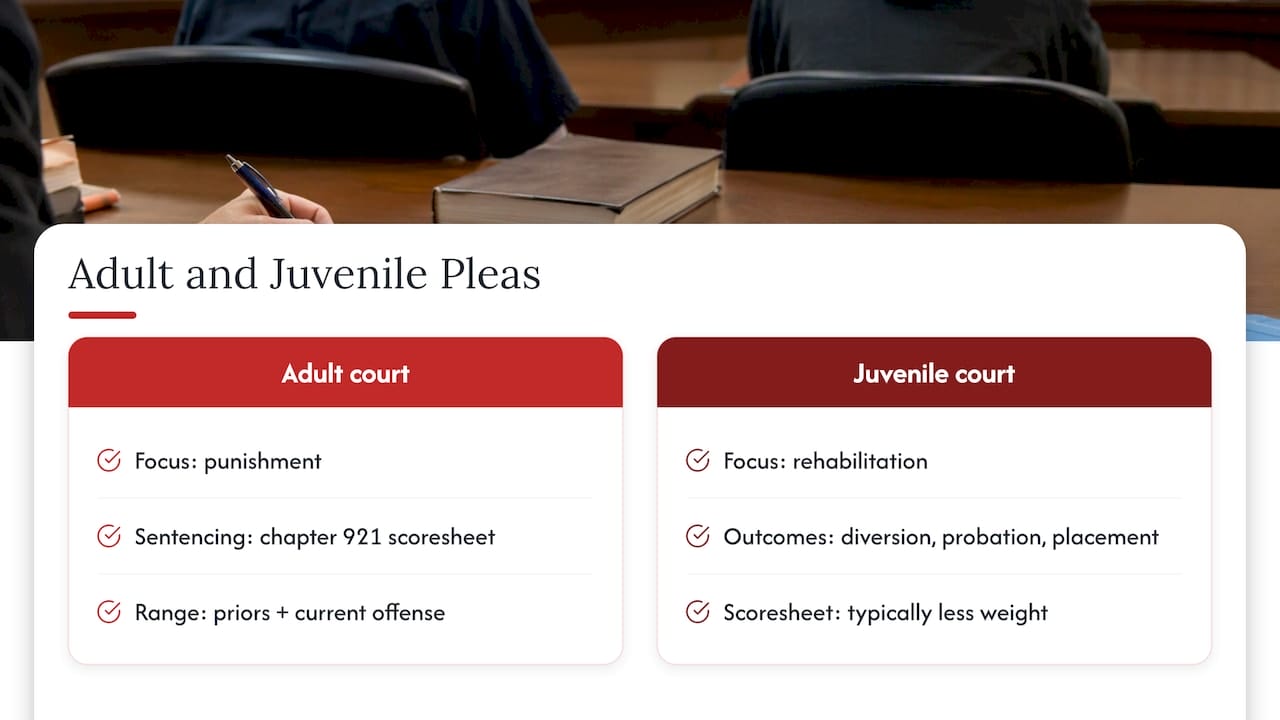
The juvenile system in Florida operates under a different framework than adult criminal court, and that affects how a no-contest plea plays out. Juvenile proceedings are generally framed around rehabilitation rather than punishment, and dispositions often include diversion programs, probation, or placement in juvenile programs rather than the sentencing alternatives available to adults. A no-contest plea in juvenile court still waives the right to a trial-like adjudicatory hearing, but the consequences that follow, such as whether the matter becomes part of a juvenile record, are governed by separate statutory provisions from those that apply to adult sentencing scoresheets.
Adult court, by contrast, ties a no-contest plea directly into the chapter 921 scoresheet system discussed earlier, where prior convictions and the current offense combine to produce a sentencing range. A juvenile adjudication typically does not carry the same scoresheet weight unless the case is later transferred to adult court or the juvenile is charged as an adult for a qualifying offense. Parents and young defendants considering a no-contest plea in juvenile court should still ask the same core questions about adjudication, record consequences, and collateral effects, since the stakes around school, college applications, and future record-sealing eligibility remain significant even outside the adult sentencing framework.
What happens after you enter a no contest plea
Once the judge accepts your no-contest plea and completes the Rule 3.172 colloquy, the court moves to sentencing, which can happen immediately or at a later hearing depending on the complexity of the case and whether a presentence investigation is ordered. If adjudication is withheld, the court enters an order reflecting that status along with any probation terms, fines, or other conditions. If the judge adjudicates guilt, the court enters a formal judgment of conviction along with the sentence.
From there, you are responsible for complying with whatever the court ordered, whether that is paying fines, completing a course, serving probation, or appearing for any follow-up hearings. For traffic infractions resolved through a conditional plea, compliance usually means paying the fine or completing a course by the deadline stated in the court’s order to keep the matter closed. Missing a deadline or failing to comply with probation conditions can lead to additional court action, including a show-cause hearing. If you later want to explore sealing a record tied to a withheld adjudication, our guide to sealing records in Florida explains what the court looks for in that process.
Why local counsel matters when choosing a plea
Plea strategy depends heavily on the facts of your case and on how your specific county’s judges and prosecutors tend to handle sentencing scoresheets, withheld adjudications, and conditional traffic pleas. That kind of local pattern recognition is hard to replace with general research. Before meeting with an attorney, gather your citation or charging document, any discovery, and correspondence from the prosecutor so the consultation can focus on your options rather than paperwork.
— John
How our firm can help with your plea decision
We handle criminal defense matters in Brevard County, and we can review a proposed plea offer with you line by line, including whether adjudication will be withheld, what the sentencing exposure looks like, and what collateral consequences might follow for your license, your immigration status, or a related civil claim.

We offer a free initial consultation to walk through your situation before you commit to anything in court.
- Bring your citation or charging document, any discovery you have received, and any plea paperwork the prosecutor has sent you.
- We will go over your criminal defense options, including DUI-specific statutory limits, before you decide how to proceed.
- If your charge touches a pending family law matter, we can also coordinate with your divorce or custody case to keep both proceedings aligned.
If you are facing a hearing where release from custody is the immediate concern, resources like Midnight Bail Bonds can help with bail logistics while we focus on your defense strategy. Reach out through Jmoorelegal to set up your consultation and talk through next steps.
This article is general information, not a substitute for advice from a qualified lawyer. Consult a qualified legal professional about your own circumstances before acting on anything here.
FAQ
Is a no contest plea a good choice?
Whether a no-contest plea is a good choice depends on your goals: it can limit the plea’s use in a related civil case under §90.410, but it does not guarantee a lighter sentence or protect you from a formal conviction if the judge adjudicates guilt. An attorney can weigh the specific facts of your charge against what you are trying to protect before recommending this option.
How long does a no contest plea stay on your record?
A no-contest plea itself does not disappear from your record on its own; what matters is whether the judge withheld adjudication or entered a conviction. A withheld adjudication may make you eligible to seal the record later, while a formal conviction is generally harder to remove, so it helps to review your record-sealing options once the case is resolved.
What is the 30-day rule for traffic pleas in Florida?
For many civil traffic infractions, Florida allows you to file a Conditional Plea of No Contest and Waiver of Appearance within 30 days of the citation instead of appearing in court. This option is not available for infractions involving a crash or for offenses that require a mandatory court appearance.
Why would an innocent person plead no contest?
Someone who believes they are innocent may still plead no contest to avoid the cost, time, and uncertainty of a trial, particularly when the prosecutor’s factual basis is strong enough that a conviction is likely either way. Florida also recognizes an Alford-style plea, which lets a defendant maintain innocence while acknowledging that accepting the plea serves their best interest under the circumstances.
Does a no contest plea affect immigration status?
A no-contest plea can still be treated as a conviction for immigration purposes, even when a Florida court withholds adjudication, which is why judges are required to give a deportation advisement before accepting the plea. Noncitizens facing any criminal charge should raise immigration consequences of their attorney before agreeing to a plea.