
The Florida Criminal Punishment Code scoresheet totals numeric points across five categories to set the lowest permissible sentence, or LPS, for a felony conviction. The state attorney prepares the digitized scoresheet, defense counsel reviews it for accuracy, and the sentencing judge signs it before it becomes part of the arraignment and bail process court record. Certain point thresholds guide sentencing outcomes: lower totals generally permit nonstate sanctions, very low totals may limit prison terms unless specific findings are made, and very high totals can permit life sentences.
TL;DR:
- The scoresheet must be signed by the judge and reviewed by defense counsel to avoid errors that can impact future sentencing or appeal outcomes.
- Points are calculated based on offense severity, victim injury, prior convictions, and legal status, with each category directly influencing the lowest permissible sentence.
- Accurate coding of prior convictions and victim injuries is crucial, as mistakes often lead to longer sentences or wrongful penalties.
- The total points then determine whether the defendant is eligible for probation, county jail, or mandatory prison terms, with thresholds at 44 and 363 points.
- Digitized, structured scoresheets are updated annually, making error detection easier and ensuring reliable records for defense and prosecution review.
Table of Contents
- What Is a Florida Sentencing Scoresheet and Who Prepares It?
- How Are Points Calculated on a Florida Criminal Scoresheet?
- How Do You Calculate the Lowest Permissible Sentence?
- How Often Do Scoresheets Get Revised and Digitized?
- What Are the Most Common Scoresheet Errors and How Do You Fix Them?
- What Does a Completed Scoresheet Look Like in Practice?
- How Do Felony Offense Levels Affect Scoring?
- How Do Concurrent and Consecutive Sentences Interact With the Scoresheet?
- Who Else Reviews the Scoresheet Besides the Judge?
- A Lawyer’s Take on Scoresheet Review
- Get Your Scoresheet Reviewed Before Sentencing
- Sources
- FAQ
What Is a Florida Sentencing Scoresheet and Who Prepares It?
Every felony sentenced under Florida’s Criminal Punishment Code needs a scoresheet, a legal requirement built into chapter 921 of the Florida Statutes and detailed further in Rule 3.704 of the Florida Rules of Criminal Procedure. The Code covers nearly all felonies committed after October 1, 1998, with narrow carve outs for capital cases sentenced to death and a handful of specialized statutes.
The paperwork itself follows a clear chain of custody. Florida law puts the job of preparing the digitized scoresheet on the office of the state attorney, not the defense and not the court. Once drafted, the prosecutor must hand it to defense counsel for review before sentencing. The defendant’s lawyer cannot be forced to prepare the document, but has every right to challenge it line by line. The sentencing judge reviews the final version and must sign it personally; an unsigned scoresheet is a red flag that something in the process got skipped.
After sentencing, the clerk of court transmits a digitized copy to the Florida Department of Corrections on a set schedule, feeding a statewide dataset that FDOC and the Office of State Courts Administrator use to track sentencing patterns and revise the form itself.
A few practical facts worth remembering about this process:
- The scoresheet is a court record, so errors on it can follow a defendant into appeals, probation reviews, and future sentencing proceedings.
- Defense counsel’s review is not a formality. It is the primary safeguard against a miscalculated LPS.
- FDOC’s role starts after sentencing, but its preparation manual shapes how prosecutors fill the form out in the first place.
- A missing judge’s signature or an unreviewed draft used at sentencing is itself a procedural error worth raising.
Getting this document right the first time saves everyone a fight later. A scoresheet built on a bad prior-record entry or a miscoded offense level does not just affect one sentencing hearing. It can distort every future calculation that references the same criminal history.
How Are Points Calculated on a Florida Criminal Scoresheet?
The Rule 3.992(a) scoresheet formCPCScoresheet.pdf) breaks scoring into five buckets: primary offense, additional offenses, victim injury, prior record, and a catch-all category for legal-status and enhancement points. Each subtotal gets added together to reach the total sentence points used in the LPS formula.
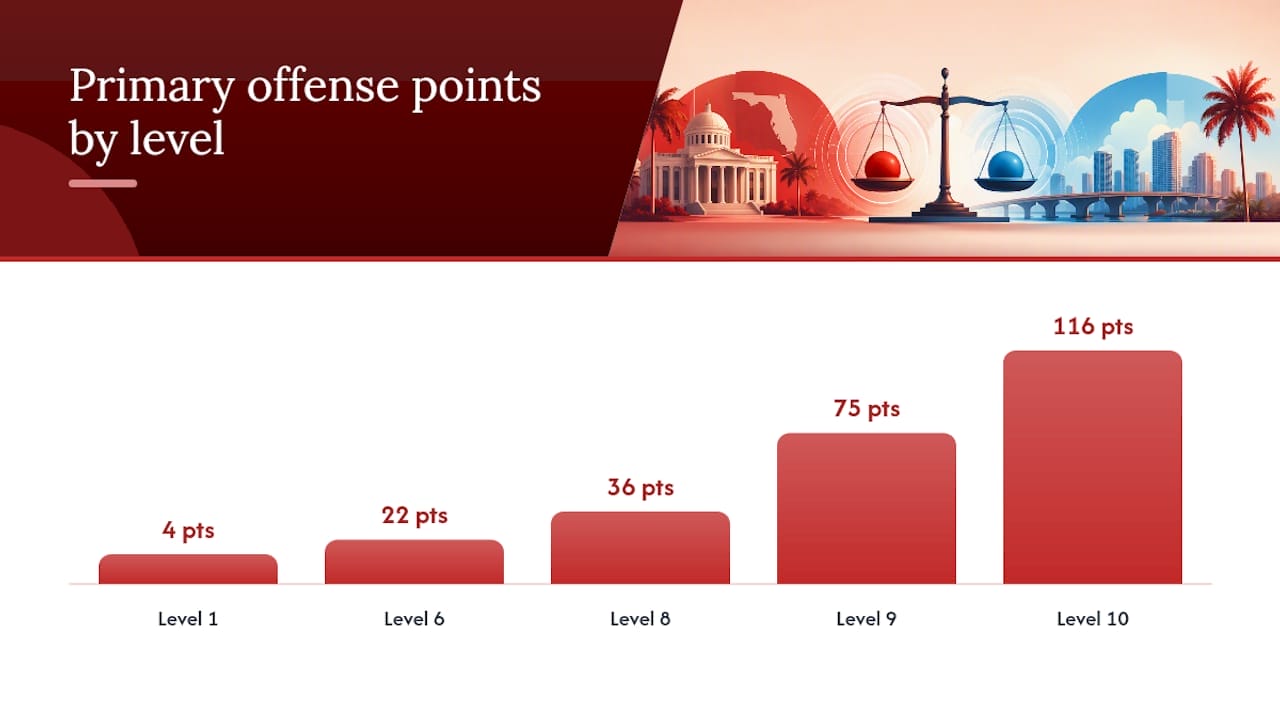
Primary offense points run on a ten-level severity scale, with each felony statute assigned a level based on how serious the legislature considers it. The point value climbs steeply as the level rises:
| Offense Severity Level | Primary Offense Points |
|---|---|
| Level 1 | 4 |
| Level 2 | 28 |
| Level 3 | 10 |
| Level 4 | 16 |
| Level 5 | 16 |
| Level 6 | 22 |
| Level 28 | 28 |
| Level 8 | 36 |
| Level 9 | 75 |
| Level 10 | 116 |
Additional offenses get scored using a separate, lower point scale tied to the same ten levels, and every additional conviction sentenced at the same proceeding adds its own points to the total. Charge someone with three level 4 offenses at once, and the additional-offense math multiplies fast, since each count after the primary offense contributes separately rather than getting averaged or capped.
Victim injury points apply on top of the offense score whenever a crime involved physical harm or sexual contact, layered in tiers: death, severe injury, moderate injury, and slight injury each carry escalating point values, with sexual penetration or contact scored under its own separate schedule regardless of physical injury.
Prior record points work like additional-offense points but pull from a defendant’s full criminal history, scored by the severity level of each prior felony conviction. A defendant with a level 10 prior conviction picks up 29 points on that entry alone, according to the scoring key in Rule 3.992(a), before any current offense is even factored in.
Pro Tip: Prior record scoring is where the most expensive mistakes happen. Old convictions get miscoded to the wrong severity level more often than any other entry on the form, and every extra point compounds directly into extra months at sentencing.
The last category sweeps in adjustment factors: points for committing a new felony while on probation or parole (legal status), points for violating community sanctions, enhanced points for possessing a firearm or semi-automatic weapon during the offense, and additional points for defendants with prior serious or capital felony convictions. These all stack directly onto the total, and stacking is exactly where scoresheets go wrong.
How Do You Calculate the Lowest Permissible Sentence?
Once every category is totaled, Rule 3.704 supplies one formula for converting points into months:
- Add all five point categories together to get total sentence points.
- If total points come to 44 or less, the LPS is any nonstate-prison sanction, meaning probation, county jail, or a similar disposition without a written finding.
- If total points exceed 44, subtract 28 from the total, then multiply the result by 0.75. That number is the LPS in months.
- Check whether the total falls at or below 22 points. Courts generally cannot impose a state prison sentence at that level unless the judge makes a written finding under section 775.082 showing the defendant is a danger to the public.
- Check whether the total reaches 363 points or higher, since that range opens the door to a life sentence as a sentencing option.
Say a defendant’s scoresheet totals 80 points. Subtract 28, leaving 52. Multiply by 0.75, and the LPS comes out to 39 months. That number is the floor, not the ceiling. Judges can sentence above the LPS up to the statutory maximum for the offense, and often do when aggravating facts exist.
Where mandatory minimums come in: if a charge carries a mandatory minimum sentence, that minimum must be recorded on the scoresheet and applied even when it exceeds the calculated LPS, according to Rule 3.704. The reverse situation matters too: when the calculated LPS itself exceeds the statutory maximum for the primary offense, the LPS controls and must be imposed instead of the lower statutory cap. Judges keep broad discretion above the LPS, but the LPS itself is rarely negotiable once the points are locked in.
How Often Do Scoresheets Get Revised and Digitized?
Florida does not treat the scoresheet as a static form. The Department of Corrections, working with courts and advocacy groups, develops digitized revisions and must submit them to the Florida Supreme Court for approval by June 15 each year, with production of the finalized version required by September 30 when changes are needed, per Florida Statutes section 921.0024.
The digitized format itself is built around structured data entry rather than free-form paper worksheets:
- Each scoring category has a dedicated field, cutting down on the transcription errors common on older paper forms.
- The system flags entries tied to mandatory minimum statutes so judges cannot overlook them.
- Fields exist for downward departure grounds, giving the record a place to capture why a sentence fell below the LPS.
- Clerks transmit completed digitized scoresheets to FDOC on a regular schedule, and FDOC runs quality control checks against that incoming data.
That digitization matters for defendants directly. A structured, time-stamped digital record is far easier to audit for errors than an old handwritten worksheet, and it gives defense counsel a cleaner paper trail to point to when arguing a scoring mistake reached the final judgment.
What Are the Most Common Scoresheet Errors and How Do You Fix Them?
Scoresheet mistakes cluster around a handful of predictable spots, and catching them before sentencing is far easier than fixing them after.
The most frequent errors involve a miscoded primary-offense severity level, prior convictions scored under the wrong level or counted from the wrong date, victim-injury points applied to a case where the injury classification does not match the medical record, double-counting the same conduct across two categories, and legal-status points added when the defendant was not actually on probation or parole at the time.
- Pull the judgment and sentence from every prior conviction listed and confirm the level matches what is actually on the scoresheet, not what the prosecutor assumed.
- Compare the victim-injury tier against police reports and medical records rather than the charging affidavit alone.
- Check the additional-offense count against the actual charging document. Dismissed or nolle prossed counts should never carry points.
- Confirm legal-status points only apply if the defendant was genuinely under active supervision when the new offense occurred.
- Raise every discrepancy on the record before sentencing, in writing when possible, so the objection is preserved for appeal.
- If the judge sentences off an uncorrected scoresheet, file a motion to correct the sentence promptly rather than waiting.
Pro Tip: Bring certified copies of prior judgments to the scoresheet review, not just the defendant’s recollection of past cases. Courts weigh certified records over memory every time, and a missing document is often the difference between a correction and a denied objection.
An accurate scoresheet also opens the door to mitigation. If the total lands at 44 points or below, defense counsel can argue directly for a nonstate sanction. If the case sits close to the 22 point threshold, pointing out that the state has not made the required section 775.082 danger finding can be enough to keep a client out of prison altogether. Gathering plea paperwork, arrest reports, and judgment records early gives counsel the ammunition to make those arguments before the scoresheet gets locked in. For clients navigating related record issues, sealing eligible records later on often depends on getting the underlying sentencing documents accurate the first time.
What Does a Completed Scoresheet Look Like in Practice?
A worked example makes the abstract math concrete. Take a defendant convicted of a single level 6 felony (22 points) with no additional offenses, moderate victim injury (adding a set number of points under that tier), and one prior level 4 conviction (16 points). Add those categories together and the total lands somewhere in the 50s, well above the 44 point nonstate-sanction line but nowhere near the 22 point prison threshold concern, since the total already clears that mark.
Run that total through the LPS formula: subtract 28, multiply by 0.75, and the result is the floor in months the judge must impose or exceed. A completed scoresheet displays this arithmetic openly, with each category subtotal listed in its own field before the grand total appears at the bottom, followed by the LPS calculation itself.
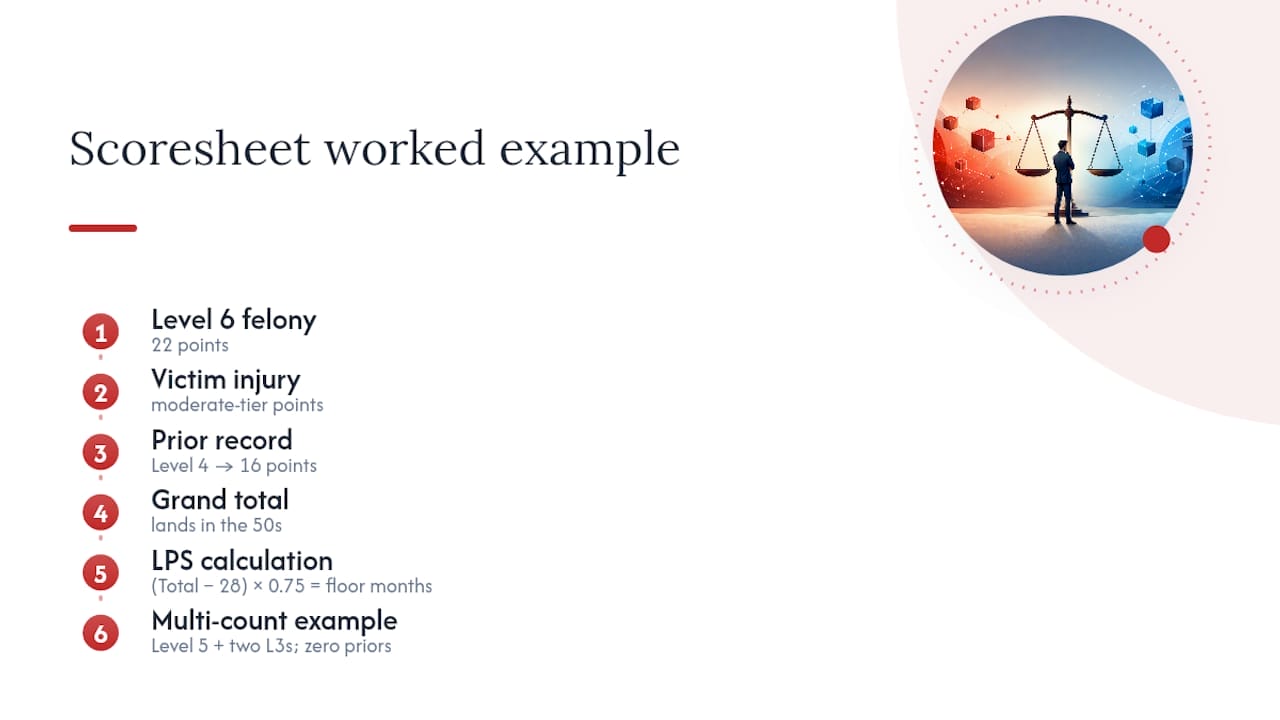
Compare that to a defendant facing three counts from one arrest: a level 5 primary offense plus two additional level 3 counts. The additional counts add their own points on top of the primary offense score, on top of no prior record at all, since the prior record score is zero for someone with a clean history. That defendant may land at a similar total to the first example despite having no criminal history, purely because multiple counts stack additional-offense points quickly.
Both scoresheets get filed the same way: state attorney draft, defense review, judge signature, then transmission to FDOC. The math is standardized. What varies is which categories drive the total, and that is exactly why counsel needs to check every field rather than just glancing at the bottom-line number.
How Do Felony Offense Levels Affect Scoring?
Florida assigns every felony a severity level from 1 to 10 under the Criminal Punishment Code, and that level, not the general “degree” label like third-degree or first-degree felony, drives most of the primary-offense point value. Two crimes both charged as third-degree felonies can land at very different severity levels depending on the specific statute, which means the “degree” a charge carries in casual conversation tells you far less than the severity level on the scoresheet.
This distinction trips up a lot of defendants and even some newer attorneys. A third-degree felony drug possession charge might score at level 3, worth 10 points, while a third-degree felony battery on specific protected victims can score much higher. The severity level, set by the legislature offense by offense, is the number that actually matters for the math, and it appears directly next to the charged statute on the Rule 3.992(a) form.
Higher severity levels do more than add points. They shift the entire scoresheet’s trajectory toward the higher thresholds. A single level 9 or level 10 conviction can push a defendant with no other criminal history well past the 44 point nonstate-sanction line on the primary offense alone, before prior record or victim injury even factor in. That is why identical-sounding charges, “felony theft” versus “felony theft from a person,” can produce wildly different LPS outcomes.
How Do Concurrent and Consecutive Sentences Interact With the Scoresheet?
The scoresheet calculates one total and one LPS for a sentencing proceeding, even when a defendant faces multiple counts or multiple cases sentenced together. Every additional offense factors into that single total through the additional-offense category, but the LPS itself represents a floor for the overall sentence structure, not a per-count minimum.
Judges then decide whether individual sentences run concurrently, at the same time, or consecutively, stacked one after another. A judge can impose the LPS as a concurrent sentence across all counts, satisfying the floor without stacking time count by count. Alternatively, a judge can order consecutive sentences on individual counts that add up to more than the LPS, since the LPS is a minimum, not a maximum, and consecutive stacking is one of the most common ways actual time served exceeds the calculated floor.
This matters enormously for defendants facing multiple charges from one incident. A scoresheet total that produces a 39 month LPS does not guarantee a 39 month sentence if the judge chooses to run counts consecutively rather than concurrently. Defense counsel negotiating a plea should always clarify, on the record, whether proposed sentences on multiple counts will run concurrently, since that single word can turn a modest LPS into years of additional custody.
Who Else Reviews the Scoresheet Besides the Judge?
The judge’s signature is the final checkpoint, but several other parties touch the scoresheet before it gets there. The state attorney’s office prepares the initial draft, pulling offense levels, prior record information, and victim-injury data from case files and criminal history databases. Defense counsel then reviews that draft specifically for accuracy, a right built into the statutory process rather than a courtesy extended by the prosecutor.
Probation officers frequently get involved when a presentence investigation report is ordered, since their independent review of a defendant’s criminal history can surface discrepancies between what the state attorney’s office listed and what actually appears in court records. Their findings often inform, though do not replace, the scoresheet review defense counsel conducts.
After sentencing, clerk-of-court staff certify that the digitized scoresheet transmitted to FDOC matches the signed version used at the hearing, and FDOC’s own quality-control process checks incoming submissions against the preparation manual’s standards for completeness. None of these additional reviewers can override the judge’s final signed version, but each one adds a layer of scrutiny that can catch an error before it becomes part of the permanent record.
A Lawyer’s Take on Scoresheet Review
Most sentencing damage happens quietly, in a form nobody argued about. Defense strategy around scoresheets is rarely about disputing guilt. It is about making sure every point on that document reflects what actually happened, not what a rushed prosecutor’s office assumed from an incomplete file. Clients who bring certified judgments, arrest reports, and plea paperwork to a scoresheet review get faster, more defensible corrections than those who rely on memory. When a total lands near a threshold like 22 or 44 points, that review can be the difference between probation and prison. If your case has a sentencing date approaching, a focused scoresheet review before that hearing is worth the conversation.
— John
Get Your Scoresheet Reviewed Before Sentencing
A miscoded prior conviction or a double-counted enhancement can add months to a sentence that a careful review would have caught. Legal offices may offer initial consultations for defendants who want a second set of eyes on their scoresheet before the sentencing hearing locks it in.

A consultation can walk through the actual scoresheet: confirming the primary offense level, checking prior record entries against certified judgments, verifying victim-injury classifications, and identifying whether the total points support an argument for a nonstate sanction or a downward departure. If mandatory minimums are involved, this also includes flagging how they interact with the calculated LPS before going into court. Visit our criminal law practice page to schedule a review and get a clear read on where your case actually stands.
This article is general information, not a substitute for advice from a qualified lawyer. Consult a qualified legal professional about your own circumstances before acting on anything here.
Sources
- Chapter 921 Section 0024 – 2026 Florida Statutes
- Fla. R. Crim. P. 3.704 — The Criminal Punishment Code
- FDOC — Scoresheet Preparation Manual 2024
FAQ
Why Does Florida Use a Scoresheet System for Sentencing?
The scoresheet standardizes felony sentencing across the state by converting offense severity, prior record, and injury factors into a single point total, reducing wide disparities between judges handling similar cases.
What Are the Current Sentencing Guidelines in Florida?
Florida sentences felonies under the Criminal Punishment Code, which uses the scoresheet’s total points to calculate an LPS through the formula (total points minus 28) times 0.75, with totals of 44 or below permitting a nonstate sanction.
What Is the Florida Criminal Punishment Code Scoresheet and How Does It Work?
It is a standardized form, adopted as Rule 3.992(a), that totals points from the primary offense, additional offenses, victim injury, prior record, and adjustment factors to calculate the lowest permissible sentence a judge can impose.
What Percentage of a Sentence Do You Serve in Florida?
Florida requires most felony offenders sentenced to state prison to serve at least 85% of their imposed sentence, a separate rule from the scoresheet calculation that determines the sentence length itself.