To change a Florida child support order, you file a petition with the court that issued it and show a substantial, permanent, involuntary change in circumstances, and the new guideline amount must differ enough from the current order. Until a judge signs a new order, the old amount stays in force. At the Law Office of John Vernon Moore, P.A., we handle modification of child support for families in Brevard County, from the first calculation to the hearing.
TL;DR
- The change must generally be substantial, permanent and involuntary, according to the Florida Department of Revenue.
- Under section 61.30 of the 2026 Florida Statutes, a guideline-based change ordinarily needs a difference of at least 15% or $50, whichever is greater.
- Your current order stays enforceable until a judge changes it, so keep paying while your request is pending.
- You file a supplemental petition with a financial affidavit and a guidelines worksheet, and the other parent must be properly served.
Table of Contents
- What counts as a change in circumstances
- The 15% and $50 threshold
- How Florida calculates the new amount
- Filing the request step by step
- Preparing for a contested hearing
- Keep paying while the case is pending
- Perspective
- Talk to us about your order
- FAQ
- Sources
What counts as a change in circumstances
Florida law lets either parent ask the circuit court to increase or decrease support when circumstances or financial ability change. The statute also allows the change to reach back to the date of filing when equity requires, according to section 61.14 of the 2025 Florida Statutes. That is why filing early matters: money owed before you file is hard to undo.
The Department of Revenue explains that the change should be substantial, permanent and involuntary. An extended illness or a layoff may qualify, and a voluntary job change generally does not. Permanence is fact-specific. A change that lasts more than a year is often treated as permanent, and a short-term dip usually is not. The same guidance notes that a severe, life-changing injury or retirement at a normal age may qualify sooner.
Common situations that lead parents to file:
- Job loss or a lasting drop in income. Our page on child support after job loss walks through the timing.
- A significant raise, bonus or new income for the other parent.
- A change in parenting time.
- Adding or removing a child, extending support while a child is still in high school, or adding or removing medical support, which the Department of Revenue lists as review grounds.
If your income is irregular, how it is counted matters. We explain this for self-employed parents and for bonuses, overtime and variable pay.
The 15% and $50 threshold
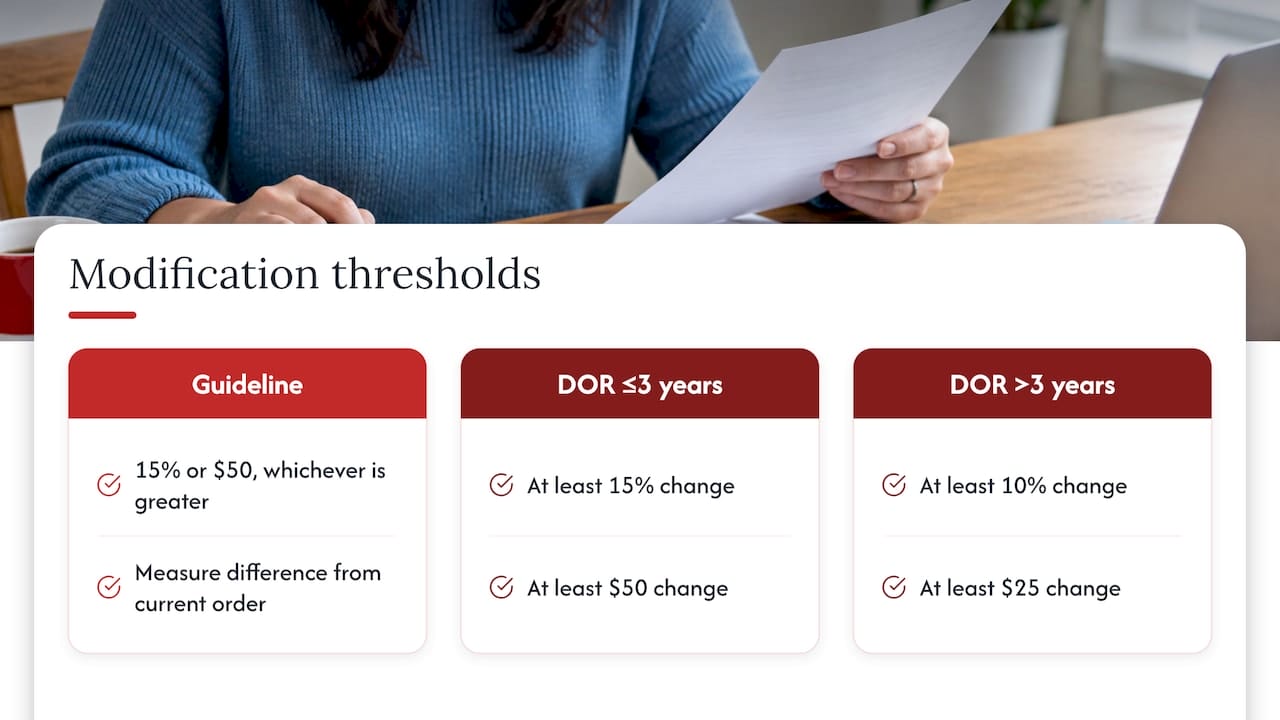
A change in circumstances is not enough alone. The new amount produced by the guidelines has to differ from the current order. Section 61.30(1)(b) sets that difference at 15% or $50, whichever is greater, for a guideline-based modification.
Here is a simple worked example. Your order is $800 a month. Fifteen percent of $800 is $120, which is greater than $50, so the guideline result would need to be at least $120 higher or lower, meaning $680 or less, or $920 or more. If your order is $200, 15% is only $30, so the $50 figure controls and the guideline amount must differ by at least $50.
Orders reviewed by the Department of Revenue have a separate test. Section 61.30(1)© says a discrepancy of at least 10% and at least $25 requires the Department to seek modification, without proof of changed circumstances. The Department’s own page describes the thresholds in terms of time: within three years of the last issuance, review or change, the amount must shift by at least 15% and $50, and after three years, by at least 10% and $25.
How Florida calculates the new amount
The court does not pick a number. It follows the guidelines in section 61.30:
- Work out each parent’s monthly net income.
- Combine the two incomes.
- Find the basic obligation on the statutory schedule for the number of children.
- Divide that need by each parent’s share of the combined income.
- Add qualifying child care, health insurance and uncovered medical costs.
The result is presumed correct. A judge may vary it by up to 5% after considering the relevant factors. A larger departure needs written findings that the guideline amount would be unjust or inappropriate. Under the 2026 statute, the guidelines also cover a dependent high school student aged 18 or 19 who is expected to graduate before turning 19.
Child care and insurance often move the total more than parents expect. Our guide to health insurance and daycare in child support shows how they are added, and Florida child support guidelines explained covers the formula in more depth.
Filing the request step by step
1. Run the numbers first. Before anything is filed, calculate the guideline amount using current incomes. If it does not clear the threshold, a petition will probably fail. Getting this wrong is the most common reason a filing goes nowhere. We run the calculation with you before you commit to a case.
2. File in the right court. A parent files a Supplemental Petition for Modification of Child Support in the county where the original order was entered, according to the Florida Supreme Court’s instructions for Form 12.905(b). If the order came from another state, jurisdiction is a threshold question. The federal Office of Child Support Enforcement explains that the issuing state generally keeps exclusive authority to modify while a parent or the child still lives there, unless the parents consent on the record to another state. Our article on UCCJEA in Florida covers related jurisdiction questions.
3. Attach the financial papers. The instructions call for a Family Law Financial Affidavit and a Child Support Guidelines Worksheet, plus a Social Security number notice if one was not filed before. Errors in the affidavit slow the case and can undercut your credibility with the judge. We prepare these documents so the numbers match your pay records.
4. Serve the other parent. The petition has to be properly served. A certificate of compliance with mandatory disclosure is due within 45 days of service unless the parents agree otherwise.
5. Settle or go to hearing. If the other parent agrees, the court can enter an agreed order. If not, and settlement fails, the petitioner files a Notice for Trial after disclosure is complete. Some circuits require mediation first. As a mediation-certified firm, we can help you reach an agreement through our family mediation service, which often costs less in time and stress than a contested hearing.
Preparing for a contested hearing
The parent asking for the change carries the burden of proof, according to the Florida Courts’ modification hearing checklist. The checklist points to these records:
- Financial affidavits from both parents
- The prior year’s tax returns
- W-2, 1099 and K-1 forms
- Pay stubs or other proof of earned income for the prior three months
For a job loss, add the termination letter and your job search records. For a medical change, add documentation of the condition and its effect on work. Bring organized, labeled copies. A judge decides on paper first, and a clear timeline of what changed and when makes your case easier to follow.
The Florida Courts’ child support resource page lists the official forms and hearing checklists. Our Florida child support FAQs answer common questions in plain terms.
Keep paying while the case is pending
The Department of Revenue stresses that an existing order stays enforceable at its ordered amount until it is changed, ended or vacated. A pending petition is not an automatic reduction. If you stop paying or pay less, arrears can build up even if the judge later agrees your income dropped. Because modification generally reaches back only to the filing date, file as soon as the change is clearly lasting. Our retroactive child support page explains how back-dated amounts work.
Perspective
Most parents come to us after months of waiting. They lost a job in the spring, hoped it would pass, and filed in the fall. The law then gives them little room to recover the months in between.
Our view is that a modification case is won on preparation: the right threshold math, an accurate financial affidavit and a clean paper trail. We bring 85 years of experience to family law, and you deal directly with your attorney. That matters most when the other parent is high-conflict, and we have particular experience with narcissistic personality disorders and military divorces, where income and orders can get complicated.
We are also mediation certified, so we can often resolve a modification without a contested trial. When a hearing is needed, you arrive with the evidence the court expects.
John
Talk to us about your order
If your income, your child’s needs or your parenting schedule has changed, we can tell you whether the new guideline figure clears the threshold and what to file. We offer free 30-minute consultations for families in Brevard County. Start with our family law practice.

FAQ
Can I modify child support if I lose my job?
A layoff may qualify as an involuntary change, while quitting voluntarily generally does not. The change should be lasting, and a temporary gap usually is not enough. File promptly, because the change generally reaches back only to the filing date.
How often can child support be modified in Florida?
There is no fixed limit, but each request must meet the threshold. The Department of Revenue also allows a review request when an order has not been reviewed or changed in three years and will not end within six months.
Does remarriage change child support?
Remarriage alone generally does not justify a modification. The court looks at the parents’ incomes and the child’s needs under the guidelines.
Can a Florida court change an order from another state?
Often not. The issuing state generally keeps authority while a parent or child still lives there, unless the parents consent otherwise. Which state has jurisdiction should be settled before anything is filed.
Sources
- Florida Child Support Program: Changing Support Orders
- Florida Department of Revenue: How to Change Support Orders
- Florida Statutes 2026, section 61.30
- Florida Statutes 2025, section 61.14
- Florida Supreme Court Form 12.905(b) instructions
- Petition to Modify Child Support Hearing Checklist
- Florida Courts: Child Support resources
- Office of Child Support Enforcement: Interstate 101