Bail is the amount of money a judge or the bond schedule sets to secure a defendant’s release. A bond is one way of posting that amount. In most Florida cases, a bail bond agent files a surety bond with the court for a non-refundable fee, so the family does not have to pay the full figure. The two words get used as if they mean the same thing, and that confusion costs families money and sleep in the first hours after an arrest. This guide explains the difference, how Florida decides who goes home before trial, what it costs, and what happens if a court date is missed.
TL;DR
- Bail is the money amount set for release. A bond is the guarantee that posts it: cash paid to the court, or a surety bond from a licensed bail bond agent.
- A judge weighs the charge, the evidence, family ties, work history, past record and flight risk before setting bail, and some capital or life-felony cases can mean no bail at all.
- A bondsman’s premium is a non-refundable fee, while cash posted with the court can come back at the end of the case, minus fines, fees and costs.
- Missing court brings a bench warrant and bond forfeiture, and it limits your release options the next time.
- A criminal defense attorney can speak up at the first appearance and ask for lower bail or different release conditions.
Table of Contents
- The difference between bail and bond in plain terms
- How Florida decides bail
- Forms of pretrial release in Florida
- What happens at a bond hearing
- Paying bail: cash, surety, or something else
- What happens if court is missed
- Our perspective on bail and bond
- A practical checklist for families
- Talk to a Brevard County criminal defense lawyer
- FAQ
- Sources
The difference between bail and bond in plain terms
Think of bail as the price tag and the bond as the way you pay it.
Bail is a financial promise that the person charged will come back to court. It is not a fine and it is not punishment. The money is held as security so the defendant returns for every hearing until the case is over.
A bond is the instrument that carries that promise. There are three common versions:
- Cash bond: you pay the whole bail amount to the court. The money is held until the case ends.
- Surety bond: a licensed bail bond agent guarantees the full amount to the court, and you pay the agent a fee, called a premium.
- Recognizance or signature release: the defendant is released on a written promise to appear, with no money paid up front.
The Florida Department of Financial Services describes a bail bond as a type of surety bond with three core parties: the court (the obligee), the defendant (the principal) and the surety. A fourth party, the indemnitor, often joins. That is the relative or friend who signs for the defendant and may put up cash or other assets to back the bond.
So when someone says, “The bail is $20,000,” that is the amount. When they say, “We posted a bond,” that is how it was paid.
How Florida decides bail
Bail is not guesswork. Florida law tells the court what to look at. Under Florida Statute 903.046, the court considers:
- the nature and circumstances of the offense and the weight of the evidence
- family ties, residence and employment
- financial resources
- past conduct, including prior convictions and any history of failing to appear
- flight risk and danger to the community
- the source of the funds used to post bail
That last factor surprises people. A court can ask where the money came from, so a family should be ready to explain it.
The bond schedule and the judge
Many people are released shortly after booking because a set amount already exists for their charge. The Florida Supreme Court has issued Administrative Order AOSC25-69, which provides for a uniform statewide bond schedule to standardize release procedures. The same order leaves individual judges with the authority to set different conditions based on the facts of a case at first appearance.
In practice, the schedule is a starting point. A judge who sees a serious history can raise the amount or add conditions. A judge who sees a stable defendant with deep roots in the community may lower it or release the person on their own recognizance.
Forms of pretrial release in Florida
Searchers often type “pretrial release Florida” when they want to know every way out of jail short of a verdict. A state review of pretrial programs describes release by recognizance, cash bond, surety bond, or a supervised pretrial release program. Eligibility for supervised programs generally depends on factors such as offense severity and community ties, and programs vary from county to county.
The same review points out why release matters. Pretrial release costs less than incarceration, reduces jail crowding, and helps defendants hold onto their jobs, housing and family connections. For a family in Brevard County, that is the practical stake: a defendant who stays employed can help with the defense and keep the household going.
Release usually comes with conditions. These can include check-ins, travel limits, no contact with an alleged victim, or no alcohol. Breaking a condition can lead to revocation and a return to custody.
What happens at a bond hearing
In Florida, the “bond hearing” most people mean is the first appearance, held shortly after arrest. Under Florida Rule of Criminal Procedure 3.131, the judge reviews the charges and decides the terms of pretrial release. The judge can set bail, change release terms, or order pretrial detention if no conditions can reasonably assure the person’s appearance or public safety.
A few things to know going in:
- It is short. Many first appearances run only a few minutes, so what you say counts.
- Information helps. Proof of a steady job, a local address, family nearby and a clean record gives the judge reasons to lower bail or release on recognizance.
- A later hearing is possible. If bail is set high or denied, an attorney can ask the court to revisit it.
When bail can be denied
Not everyone can post bond. Under Article I, Section 14 of the Florida Constitution, as explained in Thourtman v. Junior (2022), a person charged with a capital offense or an offense punishable by life imprisonment may be denied bail when the proof of guilt is evident or the presumption is great. The Florida Supreme Court also held that, at first appearance, a court that finds probable cause for such a crime may hold the defendant for a reasonable time to conduct a full hearing before ruling on release.
For most other charges, including the large majority of misdemeanors and felonies, bail is available.
Paying bail: cash, surety, or something else
This is where “bail vs bond” turns into a money decision.
| Cash bond | Surety bond (bail bondsman) | |
|---|---|---|
| Who you pay | The court (through the clerk or jail) | A licensed bail bond agent |
| Amount due up front | The full bail amount | A premium, which is a percentage of the bail |
| Is the money returned? | Possibly, after the case concludes, minus fines, fees and costs | The premium is non-refundable |
| Collateral | None required by the court | The agent may ask for collateral and a co-signer |
| Best when | You can afford the full amount and can wait for it to come back | The full amount is out of reach |
What a surety bond costs
Florida regulates the fee. Under Florida Statute 648.33, a bail bond agent may not execute a bond without charging a premium, and the premium cannot be higher or lower than the rate filed with and approved by the state. That means a licensed agent cannot legally discount the premium to win your business.
So what do you pay on a $50,000 bond? The premium is the approved rate multiplied by $50,000. Every 1 percent of rate equals $500, so you can run the arithmetic yourself once you have the rate in writing. Collateral, if the agent requires it, is separate from the premium.
Before signing anything, read the agreement closely. This guide to questions to ask a bondsman before signing covers premiums, collateral and what happens to your money afterward. The key questions are:
- What exactly is the premium in dollars?
- Is any collateral required, and when will it be returned?
- Are there any other fees or payment terms?
- What am I responsible for as the co-signer if the defendant misses court?
Getting money and collateral back
The Florida Department of Financial Services says the court normally discharges a bond within 10 business days after the bond’s condition has been satisfied. Once the bond is discharged and the agent is notified, the agent should return any collateral to the indemnitor within 21 days. Keep copies of your receipts and the discharge paperwork.
The same page notes that, under Florida Statute 903.31, a bail bond expires 36 months after it is posted. If the court has not ruled on the case by then, a new bond would be needed. Long cases can run into this, which is one reason to have counsel pushing the case forward. Our guide to speedy trial rights in Florida explains the timelines that apply.
Cash bail and court debts
Cash posted with the court is not a gift back to you automatically. Florida Statute 903.286 requires the clerk to hold back enough from a cash bond posted by someone other than a bail bond agent to cover unpaid court fees, court costs and criminal penalties. If a relative posts cash for a defendant who is later convicted, the refund may be smaller than expected.
What happens if court is missed
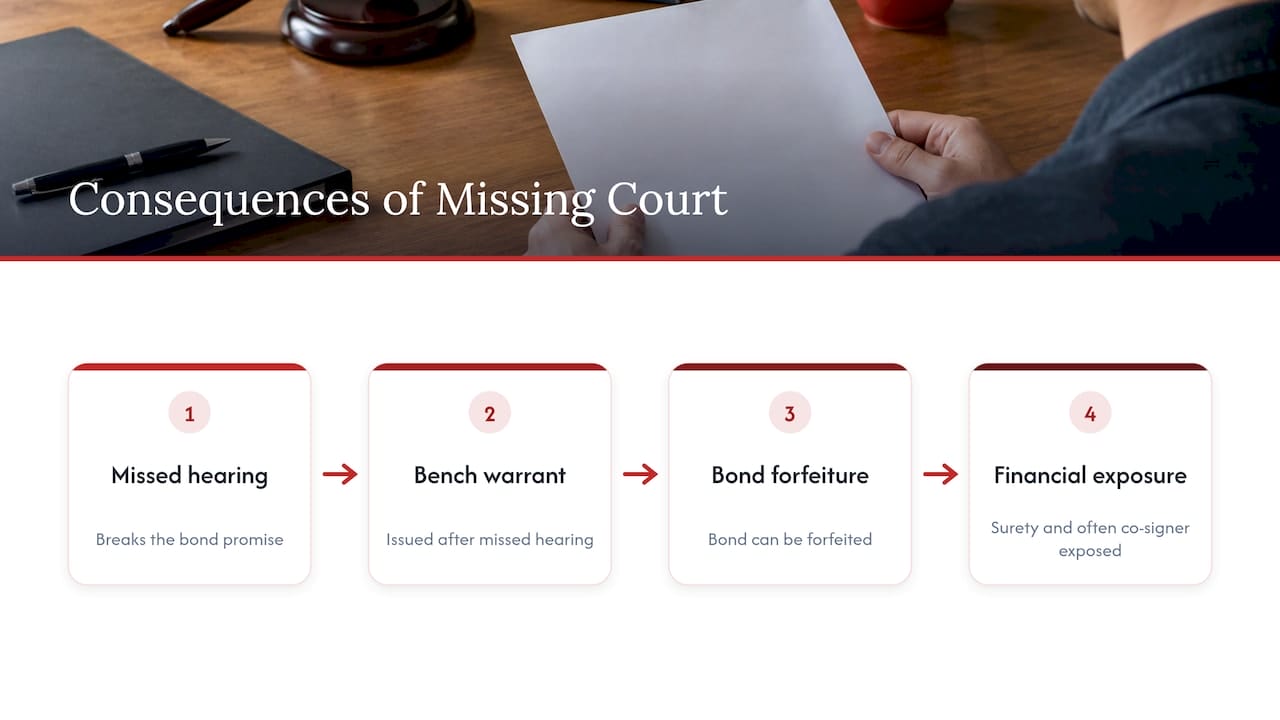
The bond is a promise, and missing court breaks it. A missed hearing leads to a bench warrant, the bond can be forfeited, and the surety, and often the co-signer, becomes financially exposed. Breaking a release condition can lead to the bond being revoked and the defendant returned to custody.
The rules also tighten afterward. Under Rule 3.131, a defendant who willfully and knowingly fails to appear and breaches a bond is ineligible for a recognizance bond if they surrender. If arrested after forfeiture, the person cannot be released on recognizance or on a bond of less than $2,000 or twice the original undertaking, whichever is greater.
The Florida Bar notes that surety bond forfeiture is strictly governed by statute, which limits a court’s discretion and exists to enforce the defendant’s appearance. For a co-signer, that means the safest course is to treat every court date as a fixed commitment. Reading up on what happens at the first court date after bail helps everyone prepare, including how a bond company responds to a missed hearing.
If a date was already missed or a condition was broken, call a defense attorney immediately. Prompt action can sometimes make the difference between a quick fix and a long fight.
Our perspective on bail and bond
We meet families at the worst moment. Someone is in the Brevard County jail, the phone is ringing, and every person on the other end has an opinion about what to do next. The first thing we tell them is that bail and bond are not the real problem. They are the first step in a case, and the decisions made in the first 24 hours shape what comes later.
We believe release should be argued, not assumed. When a client can show a judge a stable job, a local home and family who will make sure he or she is in court, the judge has real reasons to set fair terms. That is why we like to talk to the person and the family early, directly, and explain exactly what the judge will be looking at.
Once a client is home, the work shifts. Being out of custody lets you meet with your lawyer, gather records, keep your job and think clearly. It also opens up options such as pretrial diversion for eligible cases, and a calmer look at the evidence. Our free 30-minute consultation is where we map those options, and our guide to how the criminal defense process works shows what comes next.
John
A practical checklist for families
When a loved one is arrested, move in this order:
- Find out the charge and the bail amount. The jail or the clerk can tell you whether a set amount exists or the person must wait for first appearance.
- Decide cash or surety. If you can pay the full amount and wait for the court to return it, cash may be an option. If not, a licensed bail bond agent can post a surety bond for the premium.
- Gather the facts a judge will weigh. Employment letters, proof of address, family ties and a clear record all line up with the factors in the statute.
- Read before you sign. Get the premium in dollars, the collateral terms and the co-signer duties in writing.
- Calendar every court date. Set reminders and tell the defendant’s attorney if anything changes, such as a move or new job.
- Hire counsel early. An attorney can address bail at first appearance and plan the defense from the start.
If the person arrested lives outside Brevard County, the process can be harder to manage from a distance. Our page for out-of-town defendants in Brevard County explains how that works.
Talk to a Brevard County criminal defense lawyer
Bail questions are urgent, and they are only the start. At The Law Office of John Vernon Moore, P.A., we represent people charged with crimes in Brevard County, including DUI and other felony and misdemeanor cases, and you speak directly with your attorney. We offer a free 30-minute consultation so you can understand your release options and your case before you decide anything.

See our Florida criminal defense practice or reach out through our main site to schedule a consultation. If the case may end in a plea, our guide to the no contest plea in Florida lists questions worth asking your lawyer.
FAQ
Is bail or bond better?
Neither is better in the abstract, because they are two parts of one process. Bail is the amount, and a bond is how you pay it. Paying cash can be better if you can afford it and wait for the court to return it, since a bondsman’s premium is non-refundable. A surety bond is the usual route when the full amount is out of reach.
Can bail be reduced in Florida?
Yes. At first appearance, the judge sets release terms under Rule 3.131 and can set bail, modify terms or order detention. The judge looks at statutory factors like ties to the community, employment, past record and flight risk. An attorney can present those facts and ask for lower bail or a release on recognizance.
Do you get bail money back in Florida?
Cash posted with the court may be returned after the case concludes, but the clerk can withhold unpaid fees, costs and penalties under Florida Statute 903.286. A premium paid to a bail bondsman is a non-refundable fee. Collateral given to a bondsman should be returned after the bond is discharged.
Can a person be held without bond in Florida?
Yes, in limited cases. Under the Florida Constitution and Thourtman v. Junior, a person charged with a capital offense or an offense punishable by life imprisonment may be denied bail when the proof of guilt is evident or the presumption is great. Most other charges allow some form of pretrial release.
What if the defendant misses a court date?
A bench warrant is issued, the bond can be forfeited, and the people who signed for it may owe money. Release options narrow afterward under Rule 3.131. Contact a criminal defense attorney right away to discuss how to address the missed appearance.
Sources
- Bail Bonds Overview, Florida Department of Financial Services
- Florida Statute 903.046, Online Sunshine
- Supreme Court of Florida Administrative Order AOSC25-69
- Pretrial Release Programs Vary Across the State, OPPAGA
- Florida Rule of Criminal Procedure 3.131
- Thourtman v. Junior (2022), Florida Supreme Court
- Florida Statute 648.33 (2025)
- Posting Bond, Seminole County Sheriff’s Office
- A Guide to Surety Bail Bond Forfeitures, The Florida Bar
- Questions to Ask a Bail Bondsman Before You Sign
- First Court Date After Bail: What Happens and How to Prepare