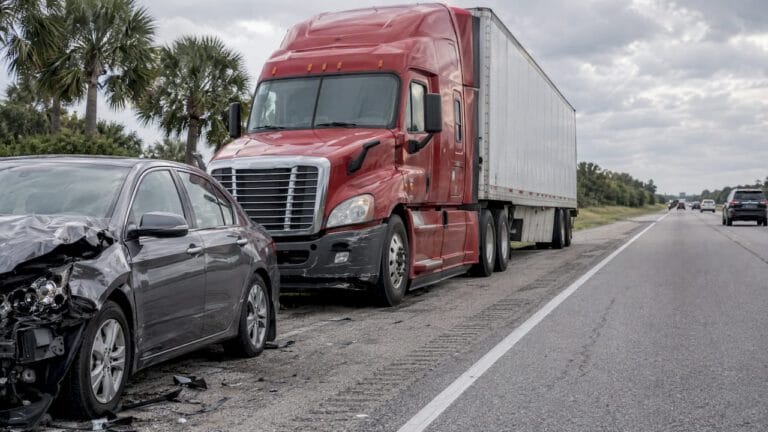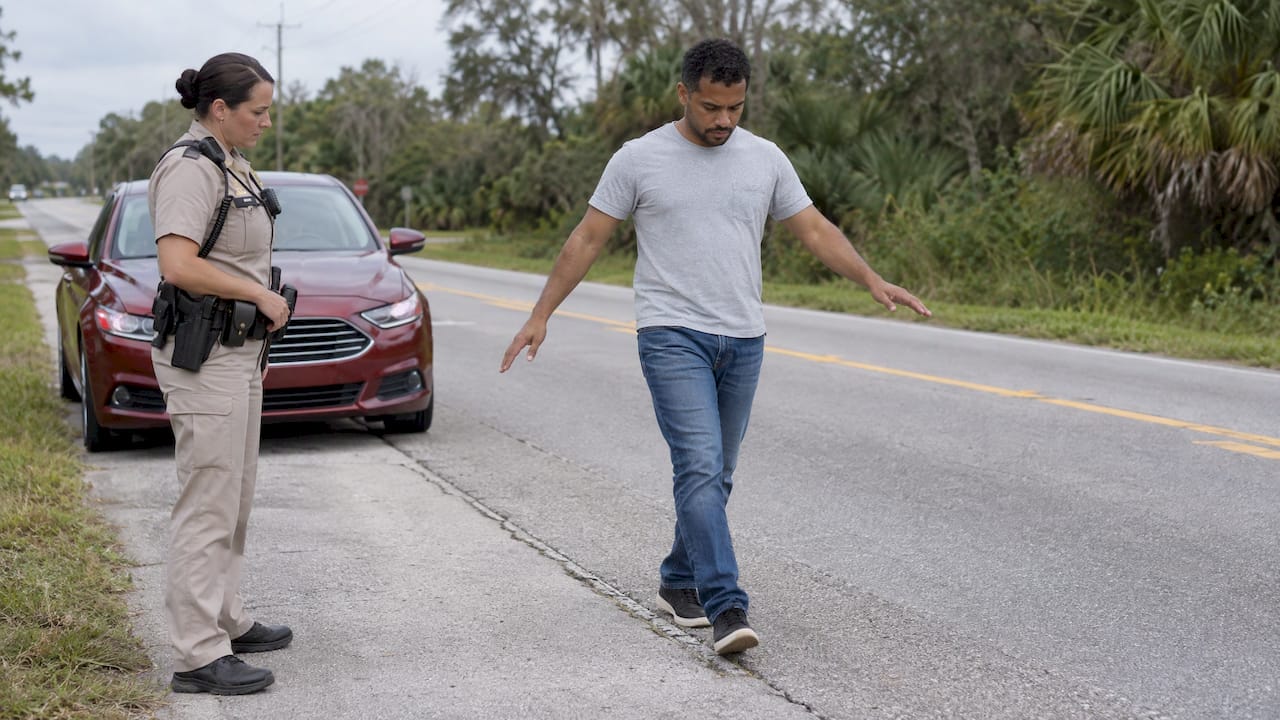
In Florida, roadside field sobriety exercises are voluntary. No statute makes you perform them, and declining them carries no license penalty of its own. A refusal can still be used as one piece of an officer’s case, and the breath test after an arrest is a different matter with real consequences. Knowing which is which before you are standing on the shoulder at night is the most useful preparation you can make. If you have already been stopped or arrested, a conversation with a DUI defense attorney is the next step, and our firm offers free 30-minute consultations.
TL;DR
- Field sobriety exercises (the roadside balance and eye tests) are voluntary in Florida. The breath test after an arrest is governed by a separate implied consent law with license penalties.
- The standardized battery has three parts: horizontal gaze nystagmus, walk-and-turn and one-leg stand. Research shows they are useful to officers, not perfect.
- A refusal is not proof of guilt, but courts allow it to be weighed with the officer’s other observations.
- Results can be challenged: the reason for the stop, the instructions, the conditions and your physical situation all matter.
- If you were arrested, deadlines for your license start running right away. Call a DUI lawyer promptly.
Table of Contents
- What field sobriety tests are and why officers use them
- The three standardized tests
- Do you have to take them in Florida?
- Refusing the roadside exercises vs. refusing the breath test
- How accurate are field sobriety tests?
- What affects your performance
- How results are challenged in a Florida DUI case
- What the penalties look like if you are convicted
- If you have been stopped or arrested
- Talk to a Brevard County DUI defense lawyer
- FAQ
- Sources
What field sobriety tests are and why officers use them
A field sobriety test is a short set of roadside exercises an officer asks you to do during a DUI investigation. Officers use them to gather evidence of impairment before deciding whether to arrest. They are not chemical tests. Nobody measures your blood alcohol concentration (BAC) at the roadside with these exercises. The officer watches how you perform and records what he or she sees.
That is why the exercises matter so much in a case. In many DUI stops they are the main evidence an officer has, next to driving pattern, odor, speech and your own statements. Courts treat the officer’s overall observations as what counts, and each exercise is one part of that picture.
Florida law separates two stages. First comes the investigation, when the officer may ask you to step out and offers the exercises. Second comes the arrest, after which the officer asks for a breath, blood or urine test. The rules for each are different, and mixing them up is the most common mistake drivers make.
The three standardized tests
The National Highway Traffic Safety Administration (NHTSA) developed a standardized battery. A U.S. Department of Justice-hosted validation report describes it as three tests: horizontal gaze nystagmus, walk-and-turn and one-leg stand. Here is what each involves.
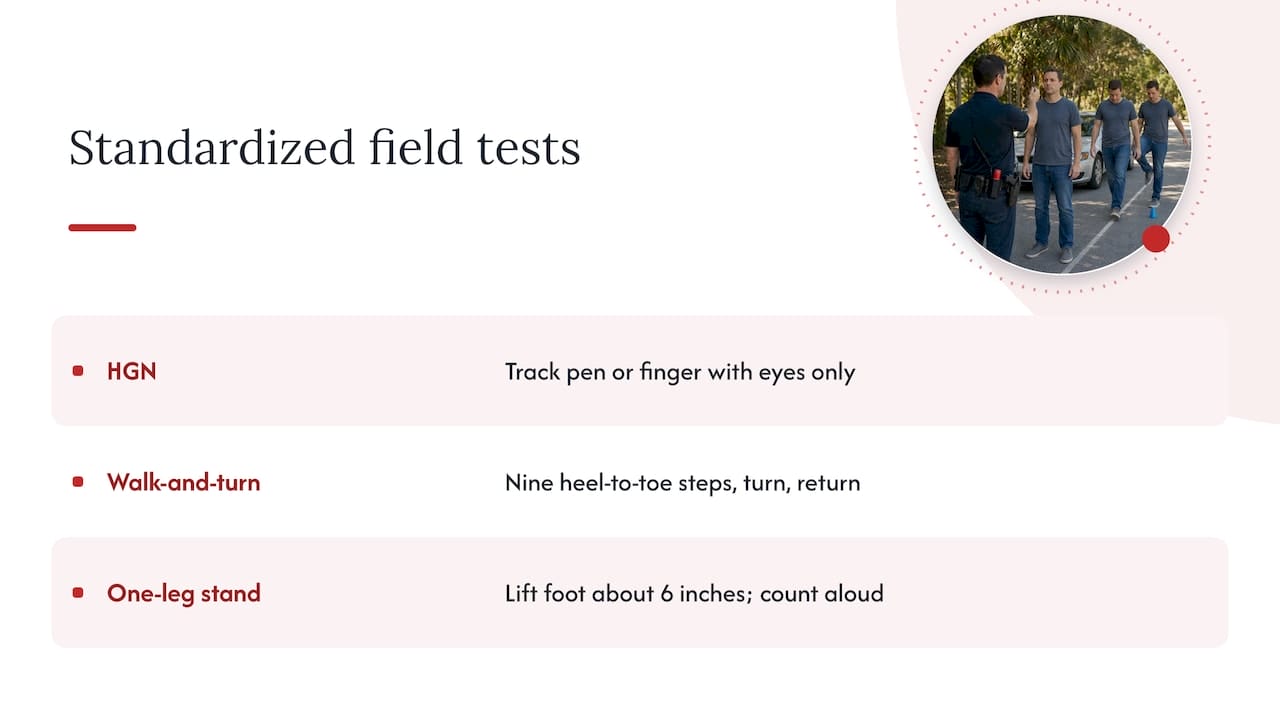
Horizontal gaze nystagmus (HGN). The officer holds a pen or finger about a foot or so from your face and moves it side to side while you follow it with your eyes only. The officer looks for involuntary jerking of the eyes. You are not asked to do anything difficult, which is why people often do not realize they are being tested.
Walk-and-turn. You take nine heel-to-toe steps along a line, turn in a prescribed way and return. The officer watches for balance during instructions, stepping off the line, using arms for balance and missed heel-to-toe contact.
One-leg stand. You raise one foot about six inches off the ground and count aloud for roughly 30 seconds. The officer watches for swaying, hopping, putting the foot down and raised arms.
Officers in Florida also sometimes use non-standardized exercises, such as the finger-to-nose and Romberg balance tests, where you tilt your head back with eyes closed and estimate 30 seconds. These are not part of the standardized battery, which is a point worth raising when a case relies on them.
Do you have to take them in Florida?
No. Florida’s statutes do not require a driver to perform roadside exercises. Florida’s DUI statute, section 316.193, defines the offense and its penalties, and the implied consent provisions in section 316.1932 attach to the breath, blood and urine tests that follow a lawful arrest. The roadside exercises are not what that law addresses.
Two practical points follow.
- Politeness matters. If you decline, say so calmly and clearly, give your license, registration and insurance, and do not argue. Arguing hands the officer more observations to write down.
- A refusal is not invisible. The Fifth District Court of Appeal’s 2025 opinion in Howard said a refusal of field exercises could factor into probable cause alongside the officer’s other observations, rather than operating alone as proof of guilt. In practice an officer who sees bloodshot eyes, an odor of alcohol and a refusal may well arrest.
The Fourth District’s 2024 decision in Sheely adds a limit on the other side. A prosecutor may argue refusal as consciousness of guilt, but crosses the line by suggesting you had to take the tests to prove your innocence or by shifting the burden of proof. The state must still prove its case.
Refusing the roadside exercises vs. refusing the breath test
This is the distinction that matters most.
| Roadside field sobriety exercises | Breath test after a lawful DUI arrest | |
|---|---|---|
| Stage | Investigation, before arrest | After arrest |
| Required by statute? | No | Implied consent applies to drivers on Florida roads |
| Penalty for refusing | No separate statutory penalty | License suspension and possible misdemeanor charge |
| Can refusal be used in court? | Yes, as one factor | Yes |
Under the 2026 version of section 316.1932, a first refusal of a qualifying breath test carries a one-year license suspension, and a refusal after a prior refusal-related suspension carries 18 months. The statute also makes the refusal a second-degree misdemeanor, or a first-degree misdemeanor if you have a prior refusal consequence. The exact conditions, including the warning an officer must give, are in the statute itself.
Because license deadlines begin quickly after a refusal, we wrote a separate page on acting within 10 days after a breath test refusal. If you hold a commercial license, the stakes are higher, and our page on keeping your CDL after a DUI walks through the steps.
How accurate are field sobriety tests?
They are useful to officers, but they are not scientific proof of impairment, and the research says so.
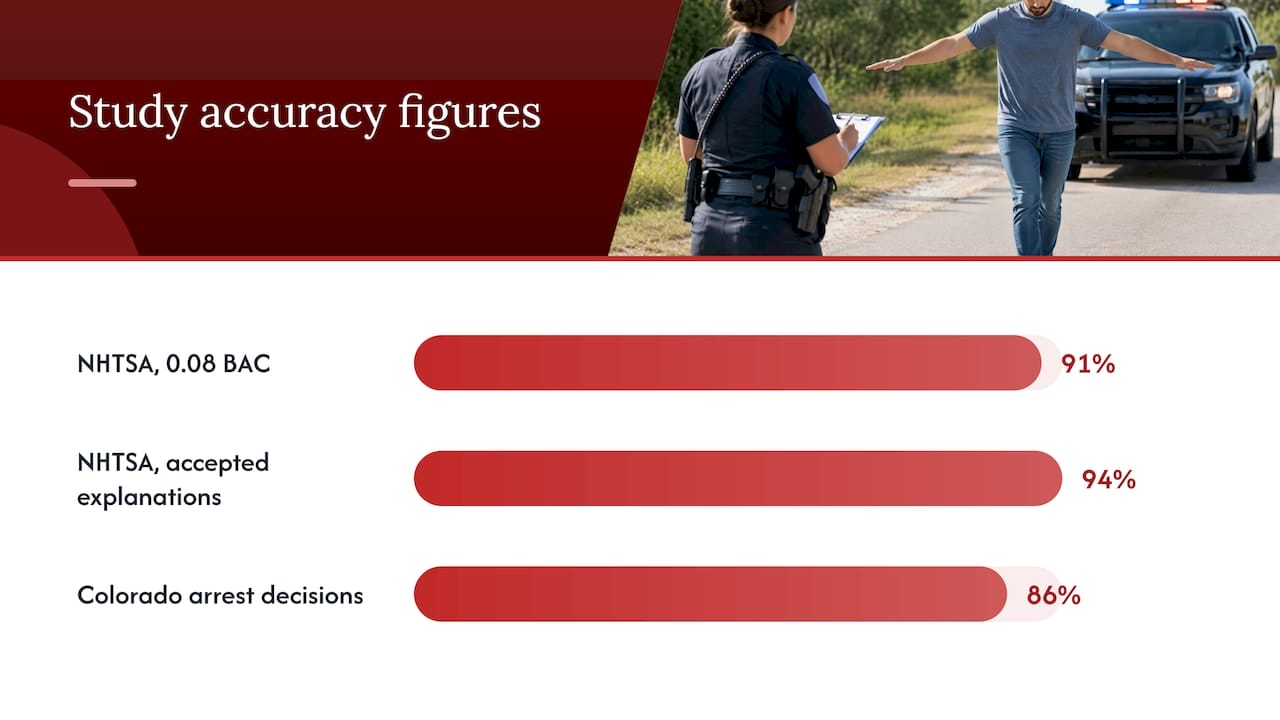
- In the NHTSA validation study hosted by the Department of Justice, officers’ estimates were 91% accurate at the 0.08 BAC decision level, rising as high as 94% under certain accepted explanations for false positives. That study used a modified scoring procedure in San Diego, California.
- The same report found HGN alone was less predictive than the three tests together: correlations with measured BAC were 0.65 for HGN and 0.69 for the full battery.
- A Colorado validation study reported 86% overall correctness in officers’ arrest-or-release decisions among drivers who gave breath or blood samples.
A figure like 91% sounds high, but read it carefully. It describes how often trained officers’ overall judgment matched a measured BAC in a controlled study, not how reliable one roadside performance is on a given night. The Colorado study also noted that balance performance can be affected by factors other than alcohol, including physical disabilities, age and nervousness, and that people who tolerate alcohol well may complete the tests with few errors even at a moderate or high BAC.
That cuts both ways for you. A sober person can look unsteady on a gravel shoulder, and an officer’s notes may record nerves or an old injury as “clues.”
What affects your performance
Before any exercise, an officer is supposed to give instructions and demonstrate. When a case goes to a lawyer, these are the details we look at:
- Footing and light. Uneven pavement, slopes, gravel, rain, wind or passing headlights from traffic.
- Footwear. Heels, sandals or work boots make heel-to-toe walking and one-leg balance harder.
- Physical conditions. Back, knee or ankle injuries, inner-ear problems, age and weight can all affect balance.
- Time and fatigue. A stop at 2 a.m. after a long shift is not a clean test environment.
- Nerves. Being questioned by an officer with lights flashing behind you raises anxiety for most people.
- Instructions. Whether the officer explained and demonstrated each exercise consistently, and whether the report matches what the video shows.
Tell the officer about any injury or medical condition, calmly, before the exercise. Do not guess at how you did, and do not describe what you drank.
How results are challenged in a Florida DUI case
A field sobriety result is evidence, not a verdict. A defense attorney can attack it at several points.
The stop itself. An officer needs reasonable suspicion to pull you over and to extend the stop into a DUI investigation. In Howard, the Fifth District described reasonable suspicion as the basis for a temporary DUI investigation and probable cause as what is needed for an arrest. It upheld the request for field exercises on the facts of that case, so the facts of your stop decide the result.
The continued detention. Even a valid stop can become unlawful if it is stretched without a reason to investigate impairment.
Probable cause for arrest. The court looks at the totality of what the officer observed, including any refusal. If the observations are thin, the arrest can be challenged.
The administration of the tests. Instructions, surfaces, lighting, footwear, medical issues and whether the exercises were scored as designed.
The use of a refusal at trial. As Sheely shows, arguments that you were obliged to prove your sobriety can be improper.
Each of these depends on bodycam or dashcam video, the arrest report and the officer’s training records, so the sooner a lawyer reviews your case, the better. After an arrest, the question of release comes up quickly, and it helps to understand how DUI bail bonds work so that nothing is signed in a rush.
What the penalties look like if you are convicted
Florida’s statute sets out the range. For a first conviction under section 316.193(2), the fine is not less than $500 or more than $1,000, and imprisonment is not more than six months. A second conviction carries a higher fine of $1,000 to $2,000. Higher blood alcohol levels, a minor in the vehicle or an accident with injury raise the penalties, and Florida amended parts of its DUI law in 2025, so read the current version of the statute or have an attorney confirm what applies to a stop in 2026.
These are statutory ranges, not predictions. What happens in your case depends on the evidence, and that is where the field sobriety results, the stop and the arrest procedures come in.
If you have been stopped or arrested
Do these things in order:
- Stay calm and be courteous. Provide your documents. You are not required to answer questions about where you were or what you drank.
- Decide on the exercises. They are voluntary. If you decline, say so politely and once.
- Understand the breath test warning. After an arrest, the implied consent law applies, and refusing has the license consequences above.
- Write down everything as soon as you can. Where you were stopped, what instructions you were given, the weather, your footwear, any medical issues, and who was present.
- Do not discuss the case on social media or with others.
- Call a DUI defense attorney the same day. License deadlines can run from the date of arrest, and evidence such as video is easier to preserve early.
If you also face charges involving drugs, our page on drug crimes and drug charges covers that area.
Our perspective
People come to us after a night they remember in pieces: flashing lights, a pen in front of their eyes, a line on the pavement they were told to walk. What strikes us is how often they believed they had no choice, and how often nobody explained the difference between the roadside exercises and the breath test.
A DUI case is built from small observations, and each can be examined. We look at why the car was stopped, how long you were held, how the exercises were explained and what the video shows. You deal directly with your attorney, not a stream of staff, and we build the strategy around the facts of your case rather than a template.
The Law Office of John Vernon Moore, P.A. serves clients in Brevard County, Florida, and criminal defense, including DUI, is one of our core practice areas. If you are unsure where you stand, the first 30-minute consultation is free.
John
Talk to a Brevard County DUI defense lawyer
If you took the roadside exercises, declined them, or refused a breath test and are wondering what comes next, our DUI and criminal defense practice handles these cases in Brevard County. We offer a free 30-minute consultation, and you will speak directly with an attorney about your stop, your arrest and your license.

If the stop happened at a checkpoint rather than from a traffic violation, read our guide to DUI checkpoints in Florida first, since different rules apply to how those stops begin.
FAQ
Can I be arrested in Florida for refusing a field sobriety test?
Refusing is not itself a crime or a license violation. But an officer may arrest you if the other observations, such as driving, odor or speech, add up to probable cause, and the refusal can be weighed alongside them, as the Fifth District said in Howard. That is why the facts of the stop matter so much.
What is the most accurate field sobriety test?
In the Department of Justice-hosted validation report, the three standardized tests together predicted BAC better than HGN alone, with correlations of 0.69 and 0.65. No single test is conclusive, and officers score them as a battery.
Can a sober person fail a field sobriety test?
Yes. Balance exercises can be affected by injuries, age, nerves and conditions on the roadside, according to the Colorado validation study. Those factors are often central when a result is challenged.
What happens if I refuse the breath test after an arrest?
Under section 316.1932, a first refusal carries a one-year license suspension and a second carries 18 months, plus possible misdemeanor charges. Deadlines to contest the suspension begin quickly, so speak with a DUI lawyer right away.
Has Florida changed its DUI law recently?
Yes, Florida amended parts of its DUI statute in 2025. The field exercises remain voluntary, but penalty details can change, so check the current statute or ask an attorney about your case.
Sources
- Florida Statutes, section 316.193, Driving under the influence; penalties (2026)
- Florida Statutes, section 316.1932, implied consent (2026)
- Fifth District Court of Appeal of Florida, Howard opinion (2025)
- Fourth District Court of Appeal of Florida, Sheely opinion (2024)
- Validation of the Standardized Field Sobriety Test Battery (NHTSA, 1998)
- A Colorado Validation Study of the Standardized Field Sobriety Test Battery (1995)
- DUI bail bonds overview