Criminal discovery in Florida is the formal exchange of evidence between the prosecution and the defense before trial, and it is governed by Florida Rule of Criminal Procedure 3.220. It does not start on its own. After the charging document is filed, the defense chooses whether to opt in by serving a Notice of Discovery. That choice sets deadlines, opens the door to depositions, and also creates duties for the defendant. Here is how each piece works.
TL;DR
- Discovery under Rule 3.220 begins when the defendant files and serves a Notice of Discovery after the charging document is filed.
- The prosecutor then has 15 days to serve a Discovery Exhibit: witness lists, the defendant’s statements, police reports, expert reports, physical evidence and more.
- Opting in is reciprocal. Within 15 days of receiving the State’s exhibit, the defense must disclose its own witnesses and certain materials.
- The State must also disclose information that tends to negate guilt, whether or not the defense has opted in.
- If either side breaks the rules, the judge holds a Richardson hearing and can choose remedies ranging from nothing to excluding a witness or granting a mistrial.
Table of Contents
- What criminal discovery means in a Florida case
- Step one: the Notice of Discovery
- What the prosecutor must disclose
- What the defense must disclose: reciprocal discovery
- Depositions in a criminal case
- Limits and protections
- When someone breaks the discovery rules
- A practical timeline
- Our perspective
- Talk to a Brevard County criminal defense lawyer
- FAQ
- Sources
What criminal discovery means in a Florida case
Discovery is how each side learns what evidence the other plans to use. In a criminal case that matters because the State controls the police file: the reports, recordings, lab results and witness contacts. Without discovery, a defendant often knows little more than what is written in the charging document.
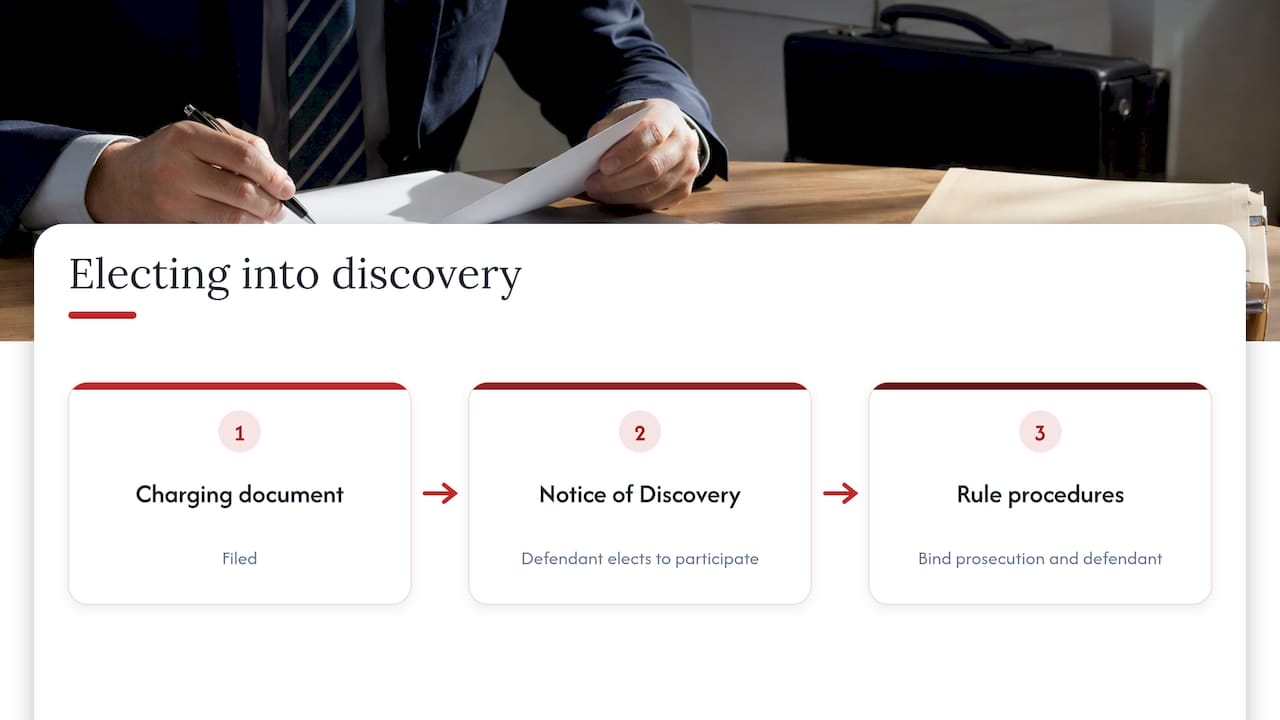
Rule 3.220 is the main rulebook. It says that after a charging document is filed, a defendant may elect to participate in discovery by filing and serving a Notice of Discovery, and that the election binds both the prosecution and the defendant to all of the rule’s procedures (Rule 3.220, Westlaw). Florida’s rules are amended from time to time, so confirm the current text of the rule before relying on any summary, including this one. A current copy is published at floridarules.net.
Why Florida is different from civil cases
People who have seen discovery in a civil lawsuit or a divorce sometimes expect the same tools. Criminal discovery has its own structure. The Florida Supreme Court has noted that, unlike parties in civil cases, the State in a Florida criminal case has a threefold obligation to provide exculpatory information, covering material usable both substantively and for impeachment (SC15-177, Appendix C). The same document notes that the defense can already seek further material, including subpoenas duces tecum for records held by witnesses or third-party custodians, under Rule 3.220(f).
If you want to see how the civil side compares, our guide to discovery in a Florida divorce explains the five tools used there. They are a different set of tools with different consequences.
Step one: the Notice of Discovery
The defense starts the process by filing the Notice of Discovery with the court and serving it on the prosecuting attorney. It can only be done after the charging document has been filed. The decision to file is strategic, because it triggers reciprocal duties, and it is one to make with your lawyer rather than alone.
Once the notice is served, the clock starts. The prosecutor has 15 days to serve a written Discovery Exhibit.
What the prosecutor must disclose
Under Rule 3.220(b), the Discovery Exhibit must disclose, and let the defense inspect, copy, test and photograph, the following (Westlaw):
| Category | What it covers |
|---|---|
| Witness list | Names and addresses of everyone known to the prosecutor to have information relevant to any charged offense or defense, sorted into Category A, B or C |
| Defendant’s statements | Statements the defendant made |
| Reports | Police and investigative reports |
| Expert material | Expert reports and scientific test results |
| Tangible items | Physical objects tied to the case |
| Electronic surveillance | Information about any surveillance, including wiretapping |
| Searches and seizures | Information about any search or seizure |
Information that points toward innocence
The rule also requires the State to disclose, as soon as practicable after the charging document is filed, material information in its possession or control that tends to negate the defendant’s guilt. This duty applies whether or not the defendant has taken on reciprocal obligations. It sits alongside the constitutional Brady duty, so a defense lawyer tracks both. Our article on a motion to suppress in Florida shows how discovery material about a stop, search or statement often feeds directly into a challenge to the evidence.
Reading the witness categories
The A, B and C labels matter because they decide how easily the defense can depose someone. Category A witnesses are the ones the defense can depose without asking the court. Category B witnesses require a court’s permission. The labels are in the rule itself, so read the precise definitions there.
What the defense must disclose: reciprocal discovery
Discovery in Florida is a two-way street. A defendant elects to participate by filing a Notice of Discovery, and also by participating in any discovery process, which the rule says includes taking a deposition or filing a public records request for law enforcement records. A defendant who knowingly or purposely shares in discovery obtained by a codefendant is also deemed to have elected in (Westlaw).
That last point catches people. A casual request for police records can bind the defense to reciprocal duties, so the order of steps deserves thought before anything is filed.
Once the State’s exhibit arrives, the defendant has 15 days to:
- Furnish a written list of the names and addresses of every witness the defendant expects to call at trial or at a hearing.
- Serve a written Discovery Exhibit disclosing statements of defense witnesses (other than the defendant’s own), reports or statements of experts the defendant intends to use, and tangible papers or objects the defendant intends to use at trial or hearing.
The defense is not required to hand over everything it knows. The duty covers what it expects to use and the witnesses it expects to call.
Depositions in a criminal case
Depositions are one of the most useful parts of Rule 3.220, and they work differently from what many people expect.
- After receiving the Discovery Exhibit, the defense may depose any Category A witness, or any unlisted witness who may have relevant information, without leave of court.
- For Category B witnesses, the defense needs permission from the court and must show good cause.
- The party taking a deposition must give reasonable written notice to every other party and make a good-faith effort to coordinate the date, time and location.
- The trial court or clerk may issue subpoenas for a deposition on application by a lawyer of record or a pro se litigant.
Sources for these points: Westlaw, Rule 3.220(a) and (h).
A deposition can later be used by any party to contradict or impeach the witness, and a person generally cannot be deposed twice unless the parties consent or the court finds good cause (Rule 3.220, floridarules.net).
Misdemeanors and traffic offenses
If the charge is only a misdemeanor or a criminal traffic offense, depositions are restricted: none may be taken unless good cause is shown to the trial court, as explained in a Florida Bar CLE presentation on Rule 3.220. That is a meaningful difference for someone charged with a first-offense DUI or a similar misdemeanor.
If you want a picture of how depositions feel from the witness chair in a civil matter, see our page on depositions in a Florida divorce.
Limits and protections
Discovery is broad but not unlimited.
- Child sexual abuse material. Material that portrays sexual performance by a child, or that is child pornography, may not be copied, photographed, duplicated or reproduced, as long as the State makes it reasonably available to the defendant or defense counsel to inspect (State Rules, Fla. R. Crim. P. 3.220).
- Protective orders. On a showing of good cause, the court must order that certain disclosures be restricted, deferred or exempted, that certain matters not be inquired into, that a deposition’s scope be limited or sealed, or that other protection be given to a witness from harassment, unnecessary inconvenience or invasion of privacy (same source).
- Non-public records. Some records are not public, and some materials may be redacted or released only under conditions.
If your case involves a sensitive allegation, the way material is reviewed can look different. Our page on sex crimes defense covers how we approach those cases.
When someone breaks the discovery rules
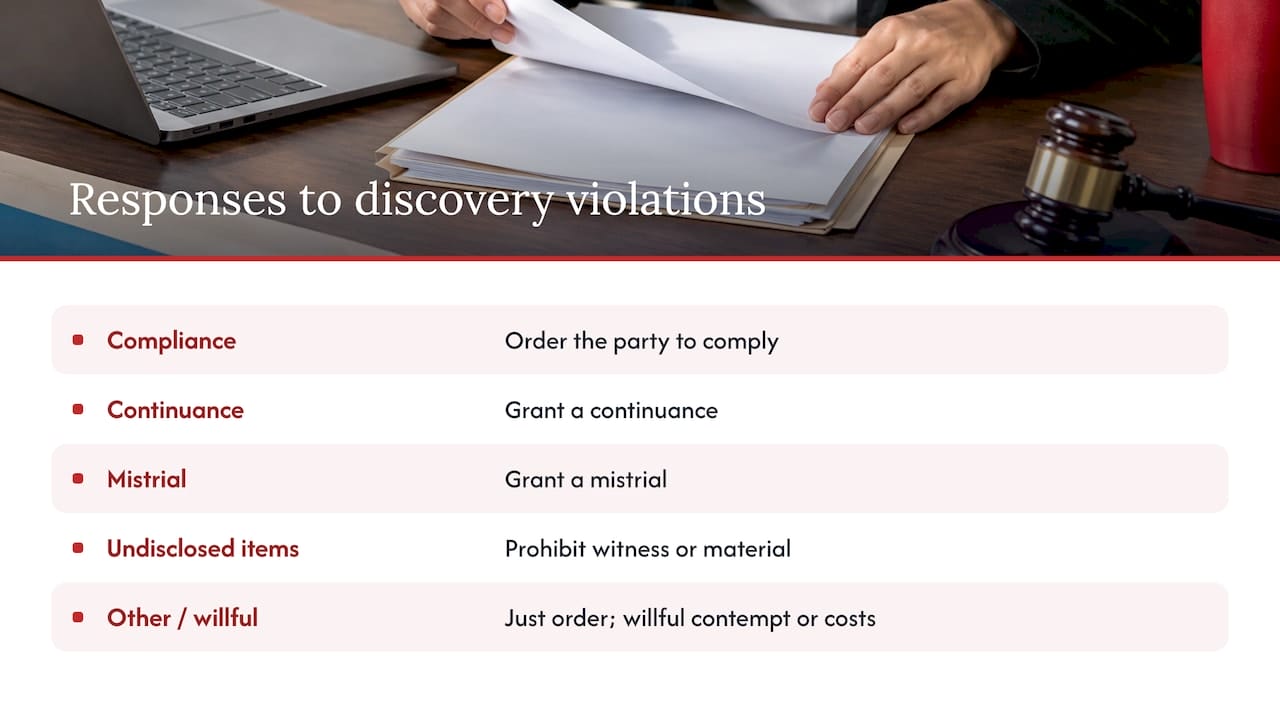
When a party fails to comply with the rule or a discovery order, the court may order compliance, grant a continuance, grant a mistrial, prohibit the party from calling an undisclosed witness or introducing undisclosed material, or enter any other order it deems just. A willful violation can bring sanctions such as contempt and costs (Westlaw, Rule 3.220(n)).
The Richardson hearing
When a violation surfaces, Florida courts must hold a Richardson hearing. The judge decides whether the violation was willful or inadvertent, whether it was substantial or trivial, and whether it hurt the other side’s trial preparation. Failing to hold the hearing is reversible error unless the reviewing court can conclude beyond all reasonable doubt that the defense was not procedurally prejudiced (same source).
The usual trigger is a surprise: a witness takes the stand whose name was never on the witness list, or a report appears that was never produced.
Two Florida Supreme Court decisions show how courts think about the remedy:
- In Smith v. State (1986), the court described the Richardson approach as flexible, with a full range of remedies, including finding no prejudice and proceeding with trial.
- In Lucas v. State (1979), the court held that a discovery violation does not automatically entitle a defendant to exclude an unlisted witness. The question is prejudice, decided by the trial judge after an adequate inquiry.
In practice, this means a discovery violation is a chance to ask for relief, not a guaranteed win. Raising it promptly and showing how it harmed your preparation is what moves a judge.
A practical timeline
- Charging document filed. Discovery rights become available.
- Notice of Discovery served. The defense opts in, and the duties become reciprocal.
- Within 15 days: the State serves its Discovery Exhibit.
- Within 15 days of receiving it: the defense serves its witness list and its own exhibit.
- Depositions. Category A witnesses without leave of court, Category B with it.
- Motions. Suppression, protective orders, compelling production or a Richardson hearing, as the file requires.
- Trial or resolution. Many cases settle after discovery clarifies the strengths and weaknesses.
The 15-day windows are short. Missing one can cost you the chance to call a witness.
Our perspective
Most people charged with a crime meet discovery as a stack of paper and a list of deadlines. We see it as the part of the case where the outcome is often shaped.
We build our defense strategy around what the State has to produce and when. We review the reports and recordings line by line, look for gaps between what a witness said and what the file shows, and decide with the client whether and when to opt in. Because opting in is reciprocal, that decision is never automatic for us.
We also work directly with each client. You should understand what is in your discovery, what it means for your options, and what comes next, from the attorney handling your case.
John
Talk to a Brevard County criminal defense lawyer
If you or a family member has been charged in Brevard County, the early weeks matter most, because the discovery clocks run quickly. The Law Office of John Vernon Moore, P.A. handles criminal defense, including DUI, and offers free 30-minute consultations. Bring the charging document and any paperwork you have received, and we will explain what happens next.

See our Florida criminal defense practice or visit our main site to get in touch.
FAQ
Is discovery automatic in a Florida criminal case?
No. The defense triggers formal discovery under Rule 3.220 by filing and serving a Notice of Discovery after the charging document is filed. That election also binds the defendant to reciprocal duties. The State’s duty to disclose information that tends to negate guilt applies regardless.
What is reciprocal discovery in Florida?
It means that once the defense takes part in discovery, it must share information too. Within 15 days of receiving the State’s exhibit, the defense must provide a list of witnesses it expects to call and disclose defense witness statements, expert reports and items it intends to use at trial or a hearing.
How long does the prosecutor have to turn over evidence?
The prosecutor must serve the Discovery Exhibit within 15 days after service of the Notice of Discovery. Material tending to negate guilt must be disclosed as soon as practicable after the charging document is filed. Exact deadlines can be adjusted by the court, so check your case file.
What happens if the State fails to disclose a witness?
The judge must hold a Richardson hearing to decide whether the violation was willful, how serious it was and whether it prejudiced the defense. Remedies range from no action to a continuance, excluding the witness or a mistrial, depending on the circumstances.
Can I take depositions in a misdemeanor case?
Only with good cause. Under Rule 3.220, depositions are not allowed when the defendant is charged only with a misdemeanor or criminal traffic offense unless the trial court finds good cause. A lawyer can tell you whether your case qualifies.
Sources
- Rule 3.220. Discovery, Westlaw
- Rule 3.220 Discovery, Florida Rules of Criminal Procedure (floridarules.net)
- Fla. R. Crim. P. 3.220: Discovery, State Rules
- Discovery requirements and obligations under Rule 3.220, Florida Bar CLE slides
- SC15-177, Appendix C to Response, Florida Supreme Court
- Smith v. State, 500 So. 2d 125 (Fla. 1986)
- Lucas v. State, 376 So. 2d 1149 (Fla. 1979)