Florida courts can no longer award permanent alimony in new divorces. In 2026 a judge can order temporary, bridge-the-gap, rehabilitative or durational alimony. The spouse asking for it must prove a real need, and the other spouse must be able to pay. Durational alimony has a hard ceiling on both amount and length. Below is how each rule works, what the numbers look like, and where a Brevard County divorce can go differently from the textbook.
TL;DR
- Permanent alimony is not available on any initial petition filed on or after July 1, 2023. Four types remain: temporary, bridge-the-gap, rehabilitative and durational.
- Every award starts with two findings: the requesting spouse has an actual need, and the other spouse has the ability to pay.
- Durational alimony is capped at the lesser of reasonable need or 35% of the difference between the spouses’ net incomes, and its length is capped by a percentage of the marriage’s length.
- For divorce instruments signed after 2018, alimony is not deductible for the payer and not taxable income for the recipient.
- Existing orders can be modified when circumstances or financial ability change, but you must ask the court. The order does not change on its own.
Table of Contents
- What changed in 2023, and what still applies in 2026
- The four types of alimony Florida courts can award
- Who qualifies: need and ability to pay
- How many years of marriage do you need?
- How much alimony will a court award?
- How long can alimony last?
- Modification, termination and cohabitation
- Are you taxed on alimony in 2026?
- Alimony and the rest of your divorce
- Our perspective: what we see in Brevard County
- Talk to a Brevard County family law attorney
- FAQ
- Sources
What changed in 2023, and what still applies in 2026
The big change is the end of permanent alimony. Section 61.08(11) of the 2026 Florida Statutes says the prohibition on permanent alimony applies to initial petitions for dissolution of marriage, or for support unconnected with a dissolution, pending or filed on or after July 1, 2023. That is the date that matters, not the date of the marriage. A couple married for 30 years who files today cannot be ordered to pay or receive indefinite support.
A 2026 opinion from Florida’s Second District Court of Appeal confirms the reading: section 61.08 applies to initial petitions pending or filed on or after that date, and the right to alimony vests only when a final judgment awards it. In practice, a spouse cannot count on the old rules because the marriage began under them.
Two things did not change. Alimony is still not automatic, and it is still decided case by case. The statute gives the judge a list of factors, and the outcome depends on your finances, your marriage and the evidence you bring.
The four types of alimony Florida courts can award
Section 61.08(1)(a) says the court may grant temporary, bridge-the-gap, rehabilitative or durational alimony, in periodic payments, a lump sum, or both. Here is how they differ.
| Type | What it is for | Key limit |
|---|---|---|
| Temporary | Support while the divorce is pending | Ends when the case ends |
| Bridge-the-gap | Short-term help moving from married to single life | Two years maximum |
| Rehabilitative | Retraining or education so a spouse can become self-supporting | Needs a specific plan |
| Durational | Support for a set period after a marriage of moderate or long length | Capped by marriage length and by income |
Temporary alimony
Temporary support covers the months or years a divorce takes. One spouse may need help with rent, utilities and groceries while the other still controls most of the household income. The court looks at the same need and ability questions, just on an interim basis. We explain how it works in temporary alimony in Florida and cover the home and daily expenses in temporary relief during a Florida divorce.
Bridge-the-gap alimony
This type covers identifiable short-term needs as a spouse transitions to single life. It cannot run longer than two years, and it is not meant to be stretched or modified into something longer. See our page on bridge-the-gap alimony for examples.
Rehabilitative alimony
Rehabilitative alimony pays for a path to self-support, such as finishing a degree, getting a license, or re-entering a career after years at home. The core of the request is the plan: what the training is, what it costs, how long it takes and what income it should lead to. A vague request is a weak one. Our guide to rehabilitative alimony explains how we build that plan.
Durational alimony
Durational alimony provides a set period of support after a marriage that ends in divorce. It is the type most people mean now when they say “alimony” in Florida, and it is the one with the most math. The next sections cover it in detail. Our durational alimony page goes further.
Who qualifies: need and ability to pay
No spouse is entitled to alimony because the marriage ended. Under section 61.08(2)(a), the court must make a specific factual finding that the spouse seeking alimony has an actual need and that the other spouse has the ability to pay. The person asking carries the burden of proving both.
That means paperwork. Courts look at:
- Each spouse’s income, from wages, business income, benefits and investments
- Monthly living expenses, shown with bills and statements rather than estimates
- Assets and debts, and how they will be divided
- Earning capacity, including health, age, education and work history
- Contributions to the marriage, including homemaking and child care
The statute also lists the duration of the marriage among the relevant factors. If the finances do not show a gap, there is nothing to bridge. If the paying spouse cannot afford support after covering their own reasonable expenses, the court has little to order.
How many years of marriage do you need?
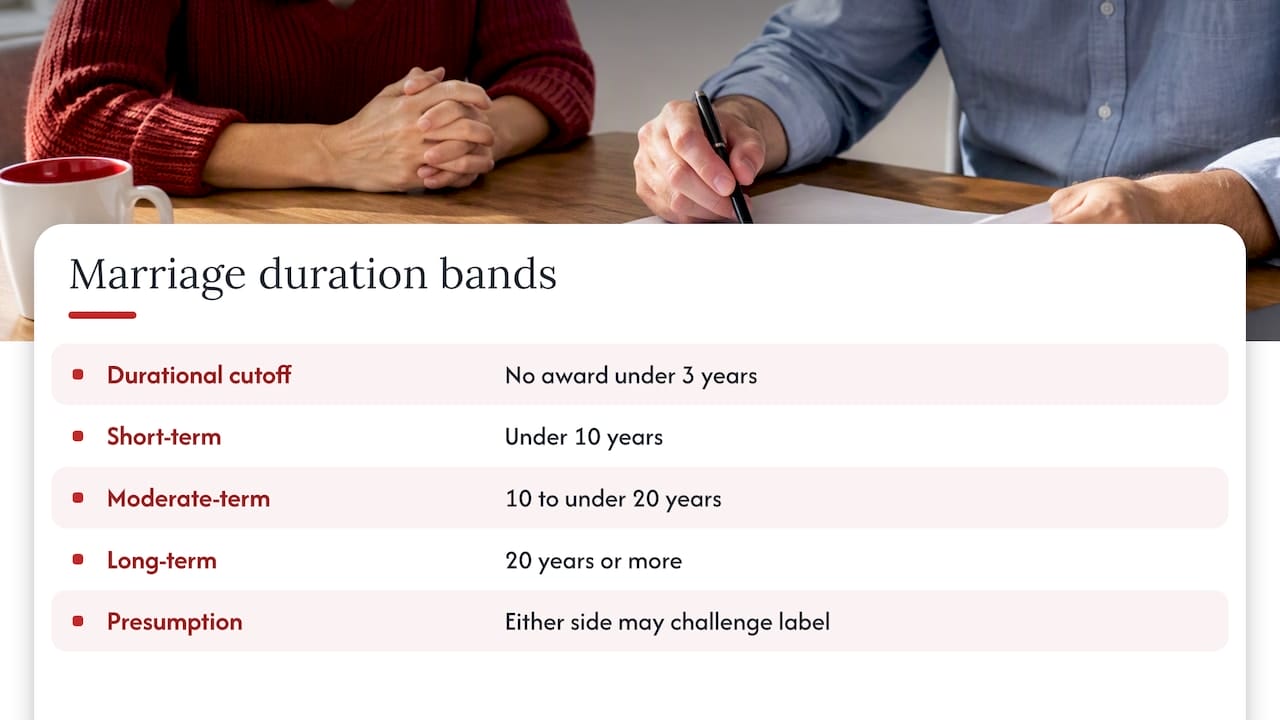
There is no single minimum for every type. The statute does say durational alimony cannot be awarded for a marriage lasting less than 3 years. Other types, such as temporary or rehabilitative support, are not tied to that threshold in the same way, though marriage length still weighs in.
Florida uses a rebuttable presumption to sort marriages into three bands. According to section 61.08(5), a short-term marriage lasts less than 10 years, a moderate-term marriage lasts between 10 and 20 years, and a long-term marriage lasts 20 years or longer. “Rebuttable” means either side can argue the label should not fit their case.
How much alimony will a court award?
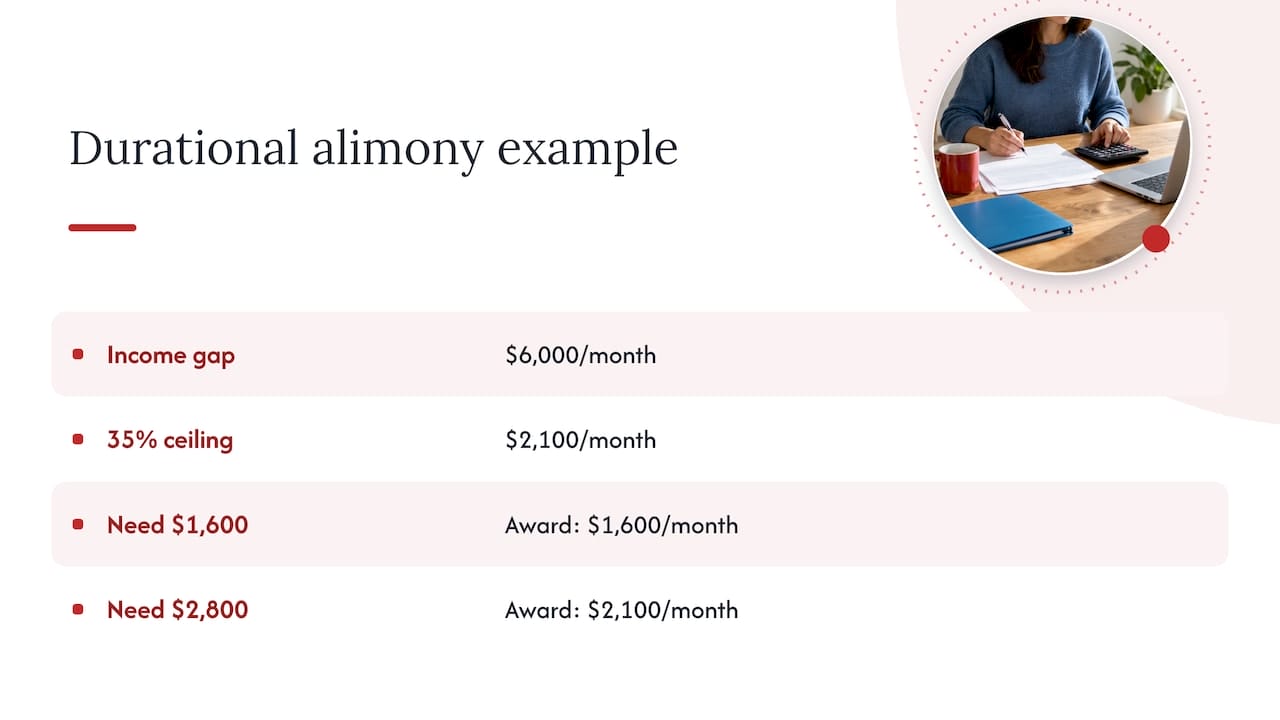
There is no calculator that gives a binding answer, but the statute sets the boundaries. For durational alimony, the amount is based on the recipient’s reasonable need, and it cannot exceed 35% of the difference between the parties’ net incomes. Whichever number is lower controls. The court must also avoid leaving the payer with significantly less net income than the recipient unless it finds exceptional circumstances.
A simple illustration, with invented numbers: suppose one spouse nets $9,000 a month and the other nets $3,000. The difference is $6,000, and 35% of that is $2,100. If the lower-earning spouse proves a reasonable need of $1,600 a month, the award is capped by need at $1,600. If the proven need is $2,800, the 35% ceiling holds the award to $2,100. This is an example of how the two limits interact, not a prediction for any case.
What moves the real figure is proof. A need supported by a clear budget carries more weight than a round number. An ability to pay that is disputed requires accurate income records, which matters most when one spouse owns a business or has irregular pay.
How long can alimony last?
The length of durational alimony is tied to the length of the marriage. As summarized by Florida divorce practitioners, durational alimony generally runs no more than 50% of the length of a short-term marriage, 60% of a moderate-term marriage and 75% of a long-term marriage, subject to exceptions. Because the statute counts length by the bands above, here is what the ceilings look like.
| Marriage length | Band | Ceiling on durational alimony |
|---|---|---|
| 5 years | Short-term | 2.5 years |
| 8 years | Short-term | 4 years |
| 12 years | Moderate-term | 7.2 years |
| 18 years | Moderate-term | 10.8 years |
| 25 years | Long-term | 18.75 years |
These are ceilings, not defaults. A judge may order less. Because the table applies the percentages to the examples above, treat it as arithmetic, not a guarantee.
Modification, termination and cohabitation
An alimony order is not frozen. Under section 61.14(1)(a), either party may ask the court to increase or decrease support when circumstances or financial ability change, and the court may make orders as equity requires. A job loss, a serious illness, a large raise or retirement can all prompt a request.
A few practical points:
- The change has to be real and provable. A bad quarter is different from a lasting drop in income.
- Only a court order changes the amount. If you simply stop paying, arrears can build, and you may face enforcement.
- A new relationship can matter. Whether a supportive relationship justifies a reduction depends on the facts, which we cover in cohabitation and alimony in Florida.
- Orders made before the 2023 reform are a separate question, since the reform turns on the date of the initial petition. If you pay or receive an older order, talk through your options in our guide to alimony modification and termination.
Are you taxed on alimony in 2026?
For most new divorces, no. IRS Topic 452 states that payments under a divorce or separation instrument executed after 2018 are not deductible by the payer and not included in the recipient’s income. Instruments executed before 2019 generally keep the older rule: deductible for the payer, taxable for the recipient.
There is a trap for older agreements. The IRS explains in Publication 504 that a modification to a pre-2019 agreement can bring in the post-2018 rules if the modification expressly says the new rules apply. Before you sign a modification, check the language with an attorney and your tax preparer. We cover the Florida side in alimony and taxes in Florida.
Alimony and the rest of your divorce
Alimony rarely stands alone. It interacts with property division, child support and the family home. When a house must be sold, the timing and proceeds shape what each spouse can afford, and that feeds directly into need and ability to pay. If you are weighing your options for selling a house during divorce, settle how the proceeds are treated in your agreement before you list.
Many couples resolve alimony by agreement rather than by trial. A settlement can be faster, cheaper and more private, and mediation is often where the figures get worked out.
Our perspective: what we see in Brevard County
Most alimony disputes we see are not about the statute. They are about proof and about the pressure on a family during the process. A spouse who walks in with a clear budget, three years of tax returns and an honest account of their earning capacity is in a stronger position than one who walks in with a feeling that the other side “makes more.”
We also see how much the type of case matters. In high-conflict divorces, including those involving a spouse with narcissistic traits, financial information is often slow to come out and the process can be used as leverage. We plan for that early, with firm discovery deadlines and a record the judge can follow. In military divorces, income can include allowances and benefits that civilian spouses do not think to list, and the rules for dividing military retired pay are separate from alimony. Both areas are ones we handle regularly.
Our advice is the same whichever side you are on. Do not wait for the other spouse to fix the numbers. Ask for a realistic result, gather your documents, and consider mediation before you spend months in litigation. We are mediation certified, and many cases settle once both sides see the statutory limits laid out plainly.
— John
Talk to a Brevard County family law attorney
If you are facing a divorce in Brevard County and alimony is on the table, either as a request or an exposure, we offer a free 30-minute consultation. You will speak directly with an attorney about your situation. Learn more on our family law page, read our Florida alimony FAQs, or see our overview of understanding alimony in Florida. If you would rather settle than litigate, look at our family mediation services.
FAQ
Is permanent alimony going away in Florida?
It is already gone for new cases. Section 61.08(11) bars permanent alimony on initial petitions pending or filed on or after July 1, 2023. A judge can still award temporary, bridge-the-gap, rehabilitative or durational alimony, depending on need and ability to pay.
How much alimony does a spouse get in Florida?
There is no fixed amount. For durational alimony, the award cannot exceed the recipient’s reasonable need or 35% of the difference between the spouses’ net incomes, whichever is less. The court also avoids leaving the payer with significantly less net income than the recipient absent exceptional circumstances.
How many years do you have to be married in Florida to get alimony?
There is no single minimum for every kind of alimony. Durational alimony cannot be awarded for a marriage of less than 3 years. Marriage length also sets the presumed band, short, moderate or long, which drives how long durational alimony can last.
Do you have to pay taxes on alimony in 2026?
Under IRS Topic 452, alimony under an instrument executed after 2018 is not deductible for the payer and not income for the recipient. Older instruments generally keep the previous rule, unless a later modification expressly adopts the new one. Check with a tax professional about your own agreement.
Can an alimony order be changed later?
Yes. Under section 61.14, either spouse can ask the court to increase or decrease alimony when circumstances or financial ability change. You need a court order to change the amount, so do not stop or reduce payments on your own.
Sources
- The 2026 Florida Statutes, Section 61.08, Alimony
- Florida Statutes, Section 61.08 (Online Sunshine)
- The 2026 Florida Statutes, Section 61.14
- Florida Second District Court of Appeal opinion, 2024-2115
- IRS Topic no. 452, Alimony and separate maintenance
- IRS Publication 504, Divorced or Separated Individuals
- Florida alimony formula and reform summary
- Options for selling a house during divorce