Florida follows the Uniform Child Custody Jurisdiction and Enforcement Act: the child’s home state, defined as a continuous period of residence lasting several months of residence or the state of birth for infants under six months, controls who may decide initial custody. Florida courts must recognize and enforce a valid out-of-state custody order under section 61.526, a duty separate from modifying that order. A 2023 amendment also expanded Florida’s emergency jurisdiction triggers.
TL;DR:
- Enforcement of out-of-state custody orders in Florida requires a valid order from a jurisdiction with proper UCCJEA compliance and the submission of Form 12.902(d).
- Florida’s home state for jurisdiction purposes is based on a child’s ongoing residence with a parent for several months or since birth if under six months, with short stays not resetting the clock.
- Emergency jurisdiction is limited to cases involving abandonment, abuse, or threats related to specific medical procedures, and is strictly temporary.
- Modification of custody orders only occurs if the original state has truly ended its jurisdiction, determined by evidence of current residence and where records now sit.
- Courts have warned against confusing enforcement with modification requests or emergency filings, emphasizing the need to follow proper jurisdictional procedures.
Table of Contents
- How the home-state and significant-connection tests work in Florida
- When Florida can issue temporary emergency orders
- How to register and enforce an out-of-state custody order in Florida
- When Florida may modify an out-of-state order
- Common pitfalls and recent Florida appellate guidance
- Practical checklist before filing in Florida
- Practitioner tips from The Law Office of John Vernon Moore, P.A.
- Our approach to interstate custody cases
- How The Law Office of John Vernon Moore, P.A. can help
- FAQ
- Sources
How the home-state and significant-connection tests work in Florida
Florida Statutes define the “home state” as the state where a child lived with a parent for at least a continuous period of residence lasting several months right before a custody case begins, or since birth for a child under six months old, under section 61.514. That rule decides which state’s court gets to make the first custody determination, and Florida courts apply it before considering any other factor.
A short absence from the state, a vacation or a temporary stay with relatives, usually does not reset the clock. What matters is where the child actually lived with a parent during that multi-month window.
- A child who lived in Georgia for five months, then moved to Florida, generally has Georgia as the home state until the Florida residence reaches six months.
- An infant born in Florida and never removed from the state has Florida as the home state from birth.
Military families face this question often. A service member’s Permanent Change of Station orders can interrupt a child’s residence pattern in ways that affect jurisdiction, and our PCS orders and custody page walks through how courts have handled those moves.
When Florida can issue temporary emergency orders
Florida Statutes section 61.517 allows a Florida court to step in on an emergency basis when a child is physically present in the state and has been abandoned, or needs protection because of mistreatment or abuse. Effective July 1, 2023, the legislature added threats involving certain sex-reassignment prescriptions or procedures as an additional trigger for emergency jurisdiction.
- Confirm the child is physically present in Florida before filing for emergency relief.
- Gather evidence of abandonment or abuse: medical records, police reports, or school documentation.
- Contact an attorney and, where safety is at risk, local child-protection authorities right away.
- Understand that an emergency order is temporary; it does not transfer long-term jurisdiction away from the home state.
If the situation does not involve abandonment or immediate danger, emergency jurisdiction is the wrong tool. Our emergency custody page covers what qualifies and what does not.
How to register and enforce an out-of-state custody order in Florida
Enforcing an order someone already has is a different legal process from asking a Florida court to change it. Florida courts have confirmed that enforcement under section 61.526 is the correct route when a parent simply wants an existing order carried out, and that temporary emergency jurisdiction is not the proper vehicle for that request, according to a Fifth District Court of Appeal opinion. Section 61.526 requires Florida courts to recognize and enforce custody orders from other states when the issuing court exercised jurisdiction consistent with UCCJEA standards.
- Complete the Florida Supreme Court Approved UCCJEA affidavit, Form 12.902(d), which discloses other pending proceedings and carries a continuing duty to update the court.
- File a petition to register or enforce the order, attaching a certified copy from the issuing state.
- Submit supporting evidence such as the parenting plan and proof the other parent received notice.
- Notify all required parties as the statute directs.
Once an order is domesticated, Florida treats it like a Florida order. Remedies include contempt proceedings, enforcement orders, and in some circumstances a pickup order or warrant under section 61.534. Our page on enforcing a parenting plan covers these remedies in more detail.
When Florida may modify an out-of-state order
Modification is a separate question from enforcement, and it turns on whether the original state still has what the statute calls exclusive, continuing jurisdiction. Under section 61.515, the issuing state keeps that authority unless the child, the child’s parents, and any person acting as a parent no longer have a significant connection to that state and substantial evidence about the child is no longer available there, or unless everyone involved has moved away.
A Florida court weighing a transfer request looks at where the current evidence actually sits: school records, medical providers, and the people who know the child best. Section 61.520 governs the more-convenient-forum analysis courts apply in close cases.
- Gather proof of current residence for the child and both parents.
- Document where the child’s school, medical, and extracurricular records now live.
- Note how long it has been since any parent or the child set foot in the original state.
Common pitfalls and recent Florida appellate guidance
Parents and even some practitioners confuse enforcement with modification, asking a Florida court to change an order when they only need it enforced, or seeking emergency jurisdiction when a straightforward domestication petition would do. Appellate opinions from 2024 through 2026 have reversed or remanded cases where trial courts required emergency jurisdiction findings instead of applying the enforcement procedure under section 61.526.
- Mistake: treating a custody dispute as a modification case without confirming whether the original state’s jurisdiction has actually ended.
- Mistake: filing for emergency relief when the real goal is to enforce an existing, valid order.
- Mistake: submitting an incomplete or outdated UCCJEA affidavit, which can delay a filing for weeks.
Florida courts are required to recognize and enforce valid out-of-state custody orders when jurisdiction criteria are met, a mandate built into section 61.526 itself. The Florida Domestic Relations Benchguide reinforces this by warning courts against blending enforcement and modification standards, and it stresses that parties have a right to participate in any interstate judicial communication between judges handling the same case.
Practical checklist before filing in Florida
Before walking into a Florida courthouse, pull together the paperwork that will answer a judge’s first questions about jurisdiction and history.
- Certified copy of the existing custody order from the issuing state.
- Parenting-time records showing actual time-sharing patterns.
- Proof of current residence for the child and each parent.
- Any safety documentation, if abuse or abandonment is part of the case.
- A completed UCCJEA affidavit, Form 12.902(d).
Choose registration and enforcement when the order is valid and simply needs to be carried out in Florida. Choose a modification petition when the facts show the issuing state’s connection has genuinely ended. Reserve emergency relief for abandonment or immediate danger, since it is temporary by design.
Pro Tip: Bring a written timeline of where the child has lived for the past two years to your first consultation. It answers the home-state question faster than anything else.
Practitioner tips from The Law Office of John Vernon Moore, P.A.
We bring extensive experience to family law matters, including cases involving military relocations and high-conflict co-parents. Our firm includes mediation representation and a focus on military divorce issues that often intersect with interstate custody questions.
Interstate custody cases succeed or fail on the quality of the record. A parent who documents residence, communication, and compliance from day one gives their attorney far more to work with than one who waits until a dispute erupts.
We recommend preserving records of every interstate communication between courts and considering mediation before litigation when both parents remain willing to negotiate a domestication agreement rather than fight one out in court.
— John
Our approach to interstate custody cases
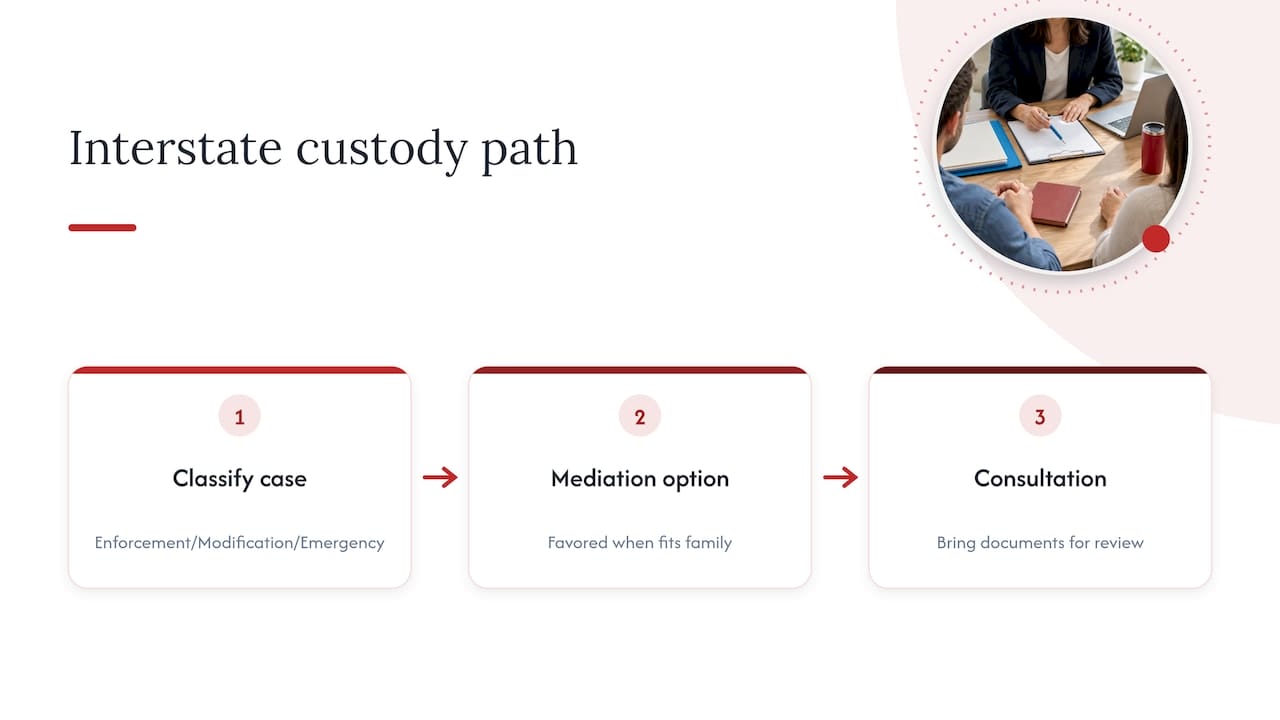
We start every interstate custody matter by identifying which statute actually governs the request: enforcement, modification, or emergency relief, because that choice shapes everything that follows. Where it fits the family, we favor mediation first. Jurisdictional outcomes depend heavily on specific facts, so we encourage anyone facing one of these situations to bring their documents to a consultation rather than guess at the right filing alone.
How The Law Office of John Vernon Moore, P.A. can help
Interstate custody questions rarely resolve themselves, and getting the statutory path wrong can cost months. We offer initial consultations where we review your order, your residence history, and your goals before recommending whether enforcement, modification, or emergency relief fits your situation.

- Enforcement and domestication of out-of-state custody orders.
- Modification petitions when jurisdiction has genuinely shifted to Florida.
- Emergency custody filings and ongoing military custody matters.
Bring your custody order, parenting-time records, and proof of residence to your consultation. Visit our family law practice page or explore our modification of child custody services to schedule a consultation and get a straight answer on where your case stands.
This article is general information, not a substitute for advice from a qualified lawyer. Consult a qualified legal professional about your own circumstances before acting on anything here.
FAQ
Has Florida adopted the UCCJEA?
Yes, Florida has adopted the UCCJEA, codified at Florida Statutes sections 61.501 through 61.542. It governs which state can decide, modify, and enforce custody determinations involving Florida families.
What states have not adopted the UCCJEA?
Every US state has adopted some version of the UCCJEA, though Massachusetts enacted a modified version with some differences from the uniform text. For case-specific questions about another state’s version, consult that state’s statutes directly or speak with a family law attorney licensed there.
Does Texas follow the UCCJEA?
Yes, Texas has adopted the UCCJEA, as have all states, so the same home-state and enforcement principles that apply in Florida generally apply to Texas custody cases as well. Specific procedural rules can still differ by state, so a Texas-specific filing should follow Texas’s own statutes.
What does a declaration under the UCCJEA mean?
A UCCJEA declaration, filed in Florida as Form 12.902(d), is a sworn affidavit disclosing the child’s residence history, other custody proceedings, and any claims of parental kinship or custody rights. Florida courts require it in cases involving parental responsibility, time-sharing, or visitation, and it carries a continuing duty to update the court if circumstances change.
Is relocating with a child abroad treated differently under the UCCJEA?
International relocation raises added legal questions beyond the UCCJEA’s interstate framework, since the Act applies between US states rather than between the United States and other countries. Readers facing a potential international move can find general background on relocation issues through resources like this overview of relocating abroad with a child, though a Florida-specific custody order still requires attention to domestic jurisdiction rules first.
Sources
- Florida Statutes Chapter 61, Part II (UCCJEA)
- Fifth District Court of Appeal opinion (2025) — Lopez/Allsot v. Latif (opinion excerpt)