
Florida law handles the divorce itself, but federal statutes decide what you keep. The Servicemembers Civil Relief Act (SCRA), the Uniformed Services Former Spouses’ Protection Act (USFSPA), and time-limited benefits like the Survivor Benefit Plan (SBP) and TRICARE can permanently lock in or lock out your rights depending on paperwork you file in the first year. Protect the deadlines first, then get a military-divorce attorney to draft order language DFAS will actually honor.
TL;DR:
- Filing deadlines for Survivor Benefit Plan and SCRA stay requests are strict, with missed SBP deadlines often leading to permanent loss of coverage.
- DFAS will only directly pay the military pension if the marriage overlapped at least 10 years with the service, otherwise payments are harder to enforce.
- The 20/20/20 rule determines if a former spouse retains TRICARE, with a one-year transitional option if the marriage or service falls short.
- Accurate, detailed order language and timely paperwork submission are crucial to ensure benefits and pension rights are enforced correctly.
- Florida residency must be confirmed six months before filing, with deployment status requiring extra coordination for service of process.
Table of Contents
- What Does Florida Military Divorce Law Actually Require?
- How Are Military Pensions Divided in a Florida Divorce?
- What Happens to Survivor Benefit Plan Coverage After Divorce?
- Will I Keep TRICARE Coverage After a Military Divorce?
- What Are Florida’s Residency and Filing Requirements?
- How Does Deployment Affect Custody and Parenting Time?
- What Does a Florida Military Divorce Attorney Actually Do for You?
- Attorney Perspective: What Actually Goes Wrong in These Cases
- Get Help With Your Florida Military Divorce Case
- Where to Find the Forms and Statutes You’ll Need
- Sources
- FAQ
What Does Florida Military Divorce Law Actually Require?
A Florida military divorce runs on two tracks at once: the state’s divorce statutes and a stack of federal rules that override them where benefits are concerned. Get either track wrong and the consequences are not always fixable later.
Start with the SCRA, which lets an active-duty spouse request a stay of at least 90 days when military duties prevent a timely response. Courts must also verify military status through the Defense Manpower Data Center before entering a default judgment, and if the servicemember can’t be reached, the court has to appoint an attorney rather than let the case proceed uncontested.
Here’s the part people miss: SCRA protections can be waived in writing, and plenty of servicemembers sign a waiver just to move an uncontested divorce along faster. That’s fine when it’s genuinely voluntary. It’s a problem when one spouse pressures the other into signing away a stay they didn’t understand they had.
Practical steps for both sides:
- Deployed respondent: file a written stay request citing your duty status and expected return date.
- Civilian petitioner: verify military status through DMDC before requesting any default judgment.
- Either party: get a written, dated waiver on file if you’re skipping the stay by agreement.
How Are Military Pensions Divided in a Florida Divorce?
Florida courts treat military retired pay as marital property to the extent it was earned during the marriage, using a coverture fraction that measures the months married during service against total months of creditable service. A 20-year career with 12 years of marriage overlap produces a very different number than a 20-year career with 4 years overlap, so this fraction usually decides the biggest financial fight in the case.
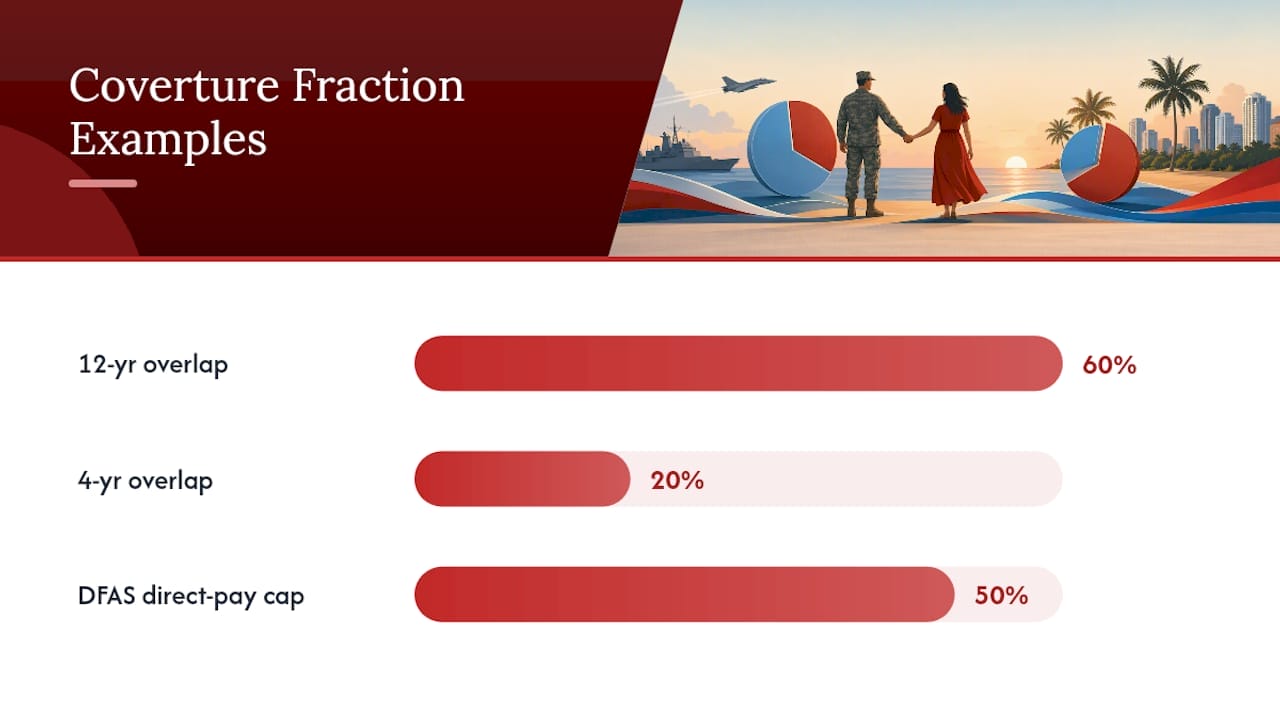
There’s a critical distinction most people never hear until it costs them money: a court order awarding you a share of the pension is not the same thing as DFAS sending you a check. DFAS will only make direct payments when the marriage overlapped at least 10 years with at least 10 years of creditable service, the so-called 10/10 rule. Fall short of that overlap and your share still exists on paper, but the servicemember has to pay you directly, which is far harder to enforce.
DFAS also caps what it will pay: 50% of disposable retired pay in direct payments, rising to a combined 65% ceiling when child support or alimony garnishments run alongside the pension award.
- Use a percentage or formula, not a flat dollar figure, so cost-of-living adjustments carry through correctly.
- Include exact marriage and retirement dates so DFAS can calculate the coverture fraction without guessing.
- File DD Form 2293 with a certified copy of the final order once judgment is entered.
- Submit a Military Pension Division Order (MPDO) when the branch or plan requires a separate qualifying order.
Pro Tip: Never let a settlement agreement say “half the pension” without a formula attached. DFAS processes numbers, not intentions, and a vague order gets kicked back for clarification while your ex-spouse’s retirement checks keep arriving in full.
What Happens to Survivor Benefit Plan Coverage After Divorce?
SBP pays a monthly annuity to a designated survivor after a retiree’s death, and divorce automatically cuts off a former spouse’s coverage unless someone files the right paperwork within one year. Miss that window, and there’s often no second chance.
Two separate one-year clocks run here, tied to different triggers: one for the member’s election at retirement, another for a former spouse’s deemed election after a divorce decree. Missing either one usually terminates former-spouse SBP eligibility permanently, with no retroactive fix available.
- Confirm the divorce decree explicitly requires former-spouse SBP coverage, not just mentions it.
- File the deemed election request with DFAS within one year of the decree date.
- Use DD Form 2656-1 or the applicable DFAS submission process, and keep certified proof of filing.
- Calendar the deadline the day the decree is signed, not the day someone remembers to look it up.
The Florida Bar has flagged missed SBP deadlines as one of the most common sources of malpractice claims in military divorce cases, precisely because the loss is invisible until the retiree dies and the survivor learns there’s no annuity coming.
Will I Keep TRICARE Coverage After a Military Divorce?
TRICARE eligibility for a former spouse hinges on the 20/20/20 rule: 20 years of marriage, 20 years of creditable service, and 20 years of overlap between the two. Meet all three and you keep TRICARE and base access much as before. Fall short and coverage generally ends the day the divorce is final.
There’s a narrower 20/20/15 category that grants one year of transitional TRICARE for former spouses who hit 20 years of marriage and service but only 15 years of overlap. Outside of those categories, the Continued Health Care Benefit Program (CHCBP) offers purchased coverage for up to 36 months, functioning as a bridge to civilian insurance rather than a permanent replacement.
- Check your exact overlap years early. A few months either way changes your eligibility category entirely.
- If you don’t qualify for 20/20/20, negotiate temporary coverage or COBRA-equivalent terms into the settlement.
- Enroll in CHCBP before TRICARE actually terminates. There’s no grace period for late applications.
- Review TRICARE continuation rules with your attorney before finalizing the decree, since the language in the order affects how the transition is documented.
What Are Florida’s Residency and Filing Requirements?
Florida requires at least six months of residency before either spouse can file for divorce, and the court needs corroborating proof, not just a sworn statement. A driver’s license, voter registration card, or a witness affidavit typically satisfies this under state filing rules.
For deployed servicemembers, Florida courts distinguish domicile (where you intend to live permanently) from duty station (where orders currently place you). A sailor stationed in California who maintains Florida as home base can usually still file here, but service of process on a deployed spouse takes extra coordination, often through military legal assistance offices or a process server working with the command.
- Confirm six months of Florida residency under Fla. Stat. § 61.021 before filing.
- Gather corroborating proof: license, voter card, lease, or affidavit from someone who can confirm residency.
- Expect a minimum 20-day waiting period between filing and final judgment.
- Factor in SCRA stay requests, which can extend the timeline well past that 20-day floor if the servicemember requests protection.
How Does Deployment Affect Custody and Parenting Time?
Deployment alone is never grounds to penalize a parent in custody decisions. Florida courts still apply the best-interest standard, but they build in flexibility for temporary duty absences that a civilian custody case would never need to address.
The practical work happens in the parenting plan itself, and vague language causes more fights than deployment does. Clauses worth including:
- A notification window requiring advance notice of deployment orders, typically 30 to 60 days when operationally possible.
- Delegation of temporary parental responsibility to a specific person during deployment, named in advance rather than decided in a scramble.
- An automatic reversion clause restoring the normal schedule once the deploying parent returns.
- A video-call or communication provision preserving contact during separation.
Coordinate this language with a Florida attorney familiar with military custody arrangements, since courts also require completion of the state’s parenting course before finalizing any plan.
What Does a Florida Military Divorce Attorney Actually Do for You?
A specialized attorney’s job in these cases is mostly about precision and timing, not courtroom theatrics. That means drafting pension language DFAS won’t kick back, preparing and filing MPDOs and DD Form 2293, calendaring every SBP deadline, negotiating TRICARE transition terms into the settlement, and handling SCRA stay requests when a client is deployed mid-case.
Some law offices bring extensive experience and mediation training to cases involving military divorces, high-conflict situations, and complex spouse dynamics.
- Call immediately if retirement is imminent. Pension valuation gets harder, not easier, once payments start.
- Call before an SBP deadline is anywhere close. There’s no fixing a missed one-year window after the fact.
- Call if jurisdiction is unclear because of PCS orders or overseas stationing.
- Call if the pension is complex: dual-military marriages, combined active and reserve time, or disability offsets all complicate the coverture math.
Pro Tip: If you’re within a year of retirement eligibility, loop in your attorney now, not after the paperwork starts. Pension valuations shift as retirement approaches, and locking in formula language early avoids a second round of negotiation.
Attorney Perspective: What Actually Goes Wrong in These Cases
The biggest mistakes I see aren’t legal arguments. They’re logistics. A pension order that says “her fair share” instead of a formula. An SBP deadline nobody put on a calendar. A residency claim with no corroborating document behind it. None of these require a hard legal fight to avoid, just discipline.
If you take one thing from this article, make it this: write down every deadline the day your decree is signed, and have an attorney submit the DFAS and SBP paperwork immediately rather than “when things settle down.” Things rarely settle down before the one-year window closes.
— John
Get Help With Your Florida Military Divorce Case
Some law firms specialize specifically in cases that many family lawyers only handle occasionally. Pension division under USFSPA, SBP filings with their one-year deadlines, SCRA stay requests, custody plans built around deployment cycles, and mediation for couples who want to avoid a courtroom fight entirely, all under one roof in Brevard County.

Some firms may offer an initial consultation, and being prepared can be helpful. Bring any existing court orders, recent Leave and Earnings Statements, your marriage certificate, and any prior settlement drafts so the attorney can spot deadline risks on day one rather than week three. If you’re weighing whether litigation or mediation makes more sense for your situation, that’s worth discussing at the same appointment.
Start by reviewing the firm’s military divorce practice page or the step-by-step Florida process guide, then schedule your consultation before any SBP or DFAS deadline gets closer.
Where to Find the Forms and Statutes You’ll Need
Keep these on hand once your case starts moving. 50 U.S.C. § 3931 covers SCRA stay rights. DFAS’s USFSPA application page has the forms for pension enforcement. Military OneSource covers TRICARE and CHCBP transitions. Veterans exploring a career change post-divorce can also look into GI Bill funded training programs. Save every deadline in writing, not memory.
This article is general information, not a substitute for advice from a qualified lawyer. Consult a qualified legal professional about your own circumstances before acting on anything here.
Sources
- 50 U.S.C. § 3931 (SCRA protections)
- DFAS — Maximum payment amount under USFSPA
- Military OneSource — Military divorce support & resources
- The Florida Bar — ‘Beat the Clock’: Deadlines in a Military Divorce Case
FAQ
Can Military Members Get Divorced in Florida?
Yes, as long as one spouse meets Florida’s six-month residency requirement under Fla. Stat. § 61.021, even if the servicemember is currently stationed elsewhere. Deployment can affect timing and service of process, but it does not block a Florida divorce filing.
What Is a Military Spouse Entitled to in a Divorce?
A former spouse may be entitled to a share of the marital portion of military retired pay, calculated using a coverture fraction, plus potential alimony and child support under standard Florida law. Direct payment from DFAS only applies when the marriage overlapped at least 10 years with 10 years of creditable service, and total garnishment cannot exceed 65% of disposable retired pay.
What Is the 20/20/20 Rule for Military Divorce?
The 20/20/20 rule grants a former spouse continued TRICARE coverage and base access when the marriage lasted 20 years, the marriage overlapped 20 years of creditable service, and the servicemember served at least 20 years total. Spouses who fall short may still qualify for one year of transitional coverage under 20/20/15, or up to 36 months through CHCBP.
Can My Ex-Wife Claim My Military Pension Years After Divorce?
Generally no, if the divorce decree already divided the pension using proper language and the required DD Form 2293 was filed with DFAS. But if the decree omitted pension division entirely or used vague language DFAS rejected, enforcement problems can surface years later, which is why precise order language matters from the start.
What Documents Should I Bring to a Consultation With a Military Divorce Attorney?
Bring your marriage certificate, current Leave and Earnings Statement, any existing court orders, and dates of military service and marriage. The Law Office of John Vernon Moore, P.A. offers a free initial consultation to review these documents and flag any approaching SBP or DFAS deadlines.