
Florida draws the line between a misdemeanor and a felony theft charge at $750, but two exceptions can drop that number fast: stealing from someone’s dwelling can trigger felony charges at a lower value, and retail theft incidents can be combined, or “aggregated,” across a set window to push a string of small thefts over the felony line. Every one of these thresholds comes from s. 812.014 of the Florida Statutes.
TL;DR:
- Theft from a dwelling can be classified as grand theft even if the value is below $750, due to the dwelling exception in Florida law.
- Retail theft aggregation allows prosecutors to combine multiple thefts within a certain window, potentially increasing the charge from petty theft to grand theft.
- Stealing firearms, motor vehicles, or law enforcement equipment automatically triggers a grand theft charge regardless of the property’s value.
- The thresholds have been periodically adjusted, with recent law changes specific to the dwelling exception and retail aggregation, emphasizing the importance of current legal statutes.
- Contact a lawyer promptly to challenge valuation disputes, aggregation, or the applicability of special exceptions that can significantly alter potential charges.
Table of Contents
- Theft Thresholds Florida: The Statutory Tiers at a Glance
- How Petit Theft and Grand Theft Actually Play Out
- Special Rules That Can Lower the Threshold or Change the Charge
- What a Conviction Can Cost You Beyond Jail Time
- Why These Numbers Keep Changing
- What to Do the Moment You’re Charged
- A Practitioner’s Note on Threshold Surprises
- How Jmoorelegal Helps With Theft Charges in Brevard County
- Where to Verify These Thresholds Yourself
- Sources
- FAQ
Theft Thresholds Florida: The Statutory Tiers at a Glance
Florida’s theft laws work almost entirely off dollar amounts. The value of the property stolen, not the circumstances of the theft, usually decides whether you’re looking at a misdemeanor citation or a felony record that follows you for years. Under Florida theft laws, section 812.014 breaks theft into brackets, and each bracket carries its own name and its own penalty ceiling.
Here’s the breakdown as written in the statute, cross-referenced against the Online Sunshine version of s. 812.014 and the Florida House statutes page:
| Value of Property Stolen | Classification | Degree |
|---|---|---|
| Less than $100 | Petit theft | Second-degree misdemeanor |
| $100 to less than $750 | Petit theft | First-degree misdemeanor |
| $750 to less than $20,000 | Grand theft | Third-degree felony |
| $20,000 to less than $100,000 | Grand theft | Second-degree felony |
| $100,000 or more | Grand theft | First-degree felony |
Those numbers look simple until you factor in the exceptions. A theft from a dwelling can qualify as grand theft even below the standard $750 mark, and certain categories of property, like firearms, motor vehicles, or law enforcement equipment, get automatic grand theft treatment regardless of dollar value. The table above covers the general rule; the sections below cover where it bends.
How Petit Theft and Grand Theft Actually Play Out
The dollar amount sets the ceiling on punishment, but it also shapes how prosecutors and judges talk about the case. Petit theft covers anything under $750, split into two misdemeanor tiers.
Petit theft, second degree applies to thefts under $100. Think of someone caught walking out of a convenience store with a $12 energy drink and a candy bar they didn’t pay for. It’s a second-degree misdemeanor, punishable by up to 60 days in jail, though most first-time cases end in a fine, diversion program, or probation rather than jail time.
Petit theft, first degree covers $100 up to $750. A common fact pattern: someone shoplifts a $200 jacket from a department store. That’s a first-degree misdemeanor, carrying up to a year in jail. A second petit theft conviction can be enhanced, and a third petit theft charge can be charged as a felony under the statute’s repeat-offender provision.
Cross $750 and you’re in grand theft territory, which changes everything about how the case is prosecuted.
- Grand theft, third degree ($750 to under $20,000): the most common felony theft charge. Someone who steals a $2,500 laptop from an unlocked car, or an employee who takes $5,000 from a cash register over several weeks, typically faces this degree. It’s punishable by up to 5 years in prison and a $5,000 fine.
- Grand theft, second degree ($20,000 to under $100,000): reserved for higher-value thefts, like stealing construction equipment worth $35,000 from a job site. Punishable by up to 15 years in prison.
- Grand theft, first degree ($100,000 or more): the top tier, covering large-scale embezzlement or theft of high-value property. Punishable by up to 30 years in prison.
Sentencing ranges are statutory maximums, not guarantees. Florida’s criminal punishment code uses a scoresheet that factors in prior record, the specific offense, and other charges, so two people convicted of the same grand theft degree can walk away with very different outcomes.
Special Rules That Can Lower the Threshold or Change the Charge
Florida law carves out several situations where the standard dollar brackets don’t tell the whole story. These exceptions come up constantly in real cases, and they’re often the difference between a misdemeanor and a felony record.
- The dwelling exception. Property taken from a dwelling or its unenclosed curtilage, meaning the yard, porch, or attached structures right around a home, can be charged as grand theft even when the value falls below the standard $750 threshold. This provision exists specifically because lawmakers treat home intrusions as more serious than street-level theft, according to the OPPAGA five-year review.
- Retail theft aggregation. Under s. 812.015, prosecutors can combine the value of multiple retail thefts committed within a statutory window into a single charge. A person who shoplifts $150 worth of merchandise three separate times can face one grand theft charge instead of three petit theft citations, if those incidents fall within the aggregation period and involve the same offender.
- Coordinated retail theft. Groups working together to steal retail merchandise for resale face felony treatment under separate statutory provisions, regardless of the per-incident dollar amount.
- Firearms, motor vehicles, and law enforcement equipment. Stealing certain categories of property, like a firearm or a fire extinguisher, automatically triggers grand theft classification no matter what the item is worth.
- Riot or declared emergency uplifts. Committing theft during a riot or a declared state of emergency can elevate the charge to a higher felony degree than the dollar value alone would justify.
What a Conviction Can Cost You Beyond Jail Time
The prison and fine ranges built into each degree only tell part of the story. Courts routinely stack financial and practical consequences on top of the base sentence.
- Petit theft (misdemeanor): up to 60 days or 1 year in jail, fines up to $500 or $1,000 depending on degree.
- Grand theft, third degree: up to 5 years in prison, up to $5,000 in fines.
- Grand theft, second degree: up to 15 years in prison, up to $10,000 in fines.
- Grand theft, first degree: up to 30 years in prison, up to $10,000 in fines.
- Restitution: courts almost always order repayment to the victim for the value of the stolen property, separate from any fine.
A conviction also follows you well past sentencing. Professional licenses, background checks for employment, and even housing applications can flag a theft conviction for years. If you want a fuller picture of how a criminal record affects daily life long after the case closes, our breakdown of collateral consequences of a criminal conviction walks through real examples. For felony cases specifically, understanding how the sentencing scoresheet factors into your exposure matters just as much as knowing the dollar threshold.
Why These Numbers Keep Changing
Florida’s felony theft threshold hasn’t always sat at $750. The OPPAGA five-year review traces a legislative pattern of periodic adjustments, including changes in 2019 that shifted the general felony threshold, and later amendments in 2022 and 2024 that refined the dwelling exception and retail aggregation rules.
- OPPAGA’s report notes Florida’s felony threshold sits lower than many other states, which is part of why lawmakers keep revisiting it.
- The report also runs a CPI-based illustration showing that inflation between October 2019 and June 2024 would suggest adjusting the $750 threshold upward by about one-fifth to illustrate the effect of inflation, not a change to the law itself.
- Because these thresholds move, the specific dollar figure that applied when an offense occurred matters more than the figure in effect today. Always confirm the version of the statute that governs your case rather than relying on secondhand summaries.
What to Do the Moment You’re Charged
The hours after an arrest often shape the entire case. Preserve receipts, photos, or anything establishing the actual value of the property in question. Don’t volunteer statements to police about the item’s worth or your intent; both become key battlegrounds later. Contact an attorney before answering questions, and understand that bail treatment differs sharply between misdemeanor and felony theft charges, a distinction explained well in this felony versus misdemeanor bail overview.
Two defense angles come up again and again: challenging the state’s valuation method (replacement cost versus fair market or retail value can swing a case across the felony line), and challenging aggregation by arguing separate incidents involved different intent or different victims.
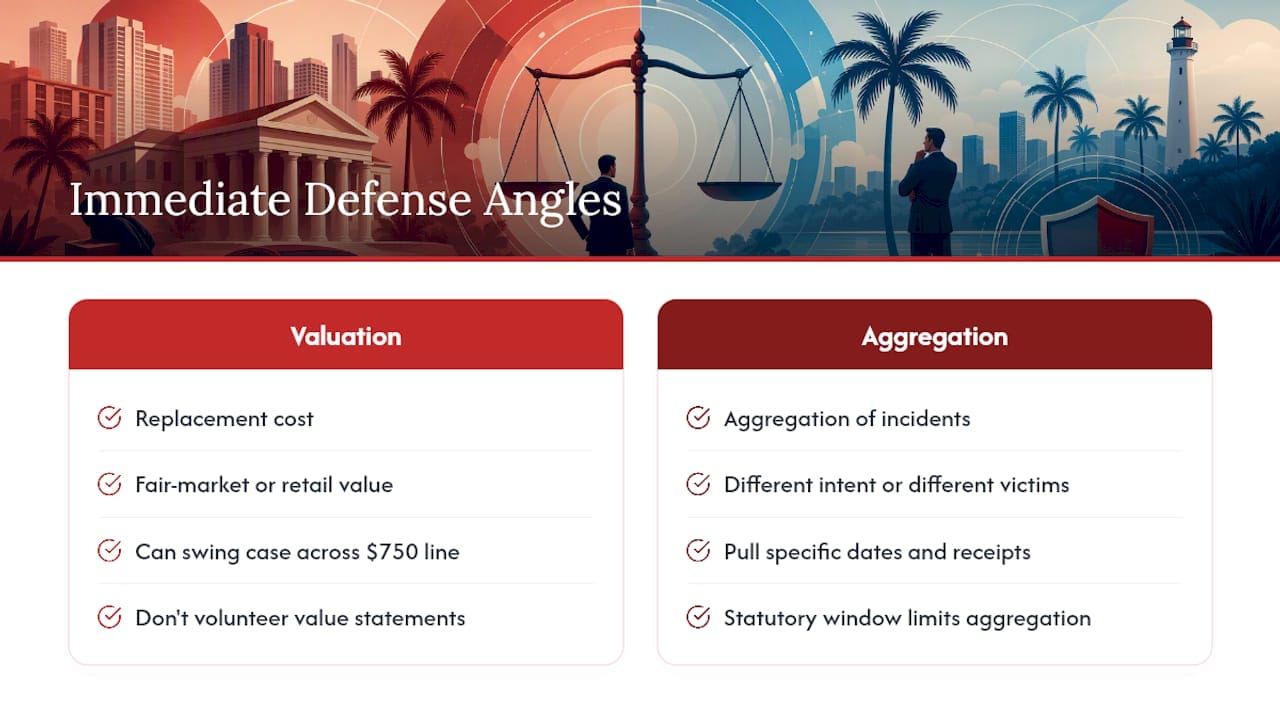
Pro Tip: If your case involves aggregated retail theft charges, ask your attorney to pull the specific dates and receipts for each incident. Aggregation only works within the statute’s defined window, and a gap or a different store location can break the state’s math.
A Practitioner’s Note on Threshold Surprises
Clients are frequently caught off guard by the dwelling exception. Prosecutors and judges weigh far more than a single number, so get advice tailored to your specific facts before assuming the dollar amount tells the whole story.
— John
How Jmoorelegal Helps With Theft Charges in Brevard County
Facing a theft charge means navigating dollar thresholds, aggregation math, and valuation disputes that can shift your case from a misdemeanor citation to a felony record in the blink of a prosecutor’s calculation. Jmoorelegal’s Florida criminal defense team handles theft crimes throughout Brevard County, and unlike larger firms that hand cases off to whoever’s available, you work directly with your attorney from the first conversation.

The firm offers an initial consultation to discuss the specific facts of your charge, whether that’s a valuation dispute, a dwelling-exception question, or a retail aggregation issue, before you decide how to proceed. With extensive experience behind the practice, the firm has seen how these dollar thresholds play out in actual courtrooms, not just on paper. If you’re facing a theft charge anywhere in Brevard County, visit the theft crimes practice page or reach out through Jmoorelegal to schedule your free consultation.
Where to Verify These Thresholds Yourself
- Read the full statute at the Florida Senate’s official page for s. 812.014.
- Cross-check the OPPAGA five-year review for legislative history and aggregation details.
- Always confirm you’re reading the current version, since amendments have adjusted these numbers before.
This article is general information, not a substitute for advice from a qualified lawyer. Consult a qualified legal professional about your own circumstances before acting on anything here.
Sources
- Chapter 812 Section 014 – 2025 Florida Statutes – The Florida Senate
- Five-Year Review of Florida’s Felony Theft Threshold Dollar Amounts
- Statutes & Constitution Online Sunshine: s. 812.014
FAQ
Is Stealing Over $500 a Felony in Florida?
Not automatically. Florida’s felony threshold sits at $750, so theft valued below that is charged as first-degree petit theft, a misdemeanor, under s. 812.014. It becomes grand theft, a felony, only once the value hits $750 or more, or if a special exception like the dwelling rule applies.
What Is the 85% Rule in Florida?
The 85% rule refers to Florida’s requirement that most felony offenders serve at least 85% of their imposed prison sentence before release, a separate sentencing rule that applies after conviction rather than a theft-specific threshold. It doesn’t change theft classification itself, but it does affect how much time someone convicted of grand theft actually serves.
What Is the 33-Day Rule in Florida?
There is no statutory rule tied to Florida’s theft thresholds in s. 812.014 or the OPPAGA review by that name; this term doesn’t appear in the governing statute or the state’s own analysis of theft classification. If you’ve heard this phrase in connection with a specific charge, it likely refers to a different statute or a local court procedure, and you should confirm the exact rule with an attorney reviewing your case.
What Are the Tiers of Theft in Florida?
Florida theft breaks into five tiers by dollar value: petit theft under $100 (second-degree misdemeanor), petit theft from $100 to under $750 (first-degree misdemeanor), grand theft from $750 to under $20,000 (third-degree felony), grand theft from $20,000 to under $100,000 (second-degree felony), and grand theft of $100,000 or more (first-degree felony). Special categories like firearms or dwelling thefts can shift a case into a higher tier regardless of the dollar amount.