
Shuttle mediation is a separated-room mediation method that helps high-conflict couples reach settlement without direct confrontation. Instead of sitting across a table from a spouse who has been abusive, controlling, or simply impossible to negotiate with, each party stays in a separate room while the mediator carries proposals back and forth. It works best when joint sessions feel unsafe or unproductive. Read on for how the process runs, what it costs, and when a lawyer needs to be in the room.
TL;DR:
- Shuttle mediation is most effective when there is a history of domestic violence, coercive control, or extreme hostility that makes joint meetings unsafe or unproductive.
- The process usually involves separate intake, private sessions, relay of proposals by the mediator, and may include later joint meetings if trust develops, with sessions typically lasting around two hours.
- Costs tend to be higher than joint sessions due to longer durations and mediator relaying work, especially when in-person rooms and attorney reviews are involved.
- Preparation should include gathering financial documents, drafting a rough parenting plan, and identifying key priorities to facilitate smoother negotiations.
- Legal counsel should review mediated terms in complex cases involving assets, benefits, or abuse, as the mediator remains neutral and does not advocate for either party.
Table of Contents
- What Is Shuttle Mediation in Divorce?
- How Does Shuttle Mediation Work Step-by-Step?
- When Is Shuttle Mediation Helpful?
- Pros, Cons, and Limits of Shuttle Mediation
- What to Expect: Timeline, Session Length, and Cost
- How to Prepare and What to Say (and Not Say)
- Attorney Perspective: When Legal Counsel Belongs in the Room
- How Jmoorelegal Supports Shuttle Mediation in Brevard County
- Sources
- FAQ
What Is Shuttle Mediation in Divorce?
Shuttle mediation puts each spouse in a separate space, in person or online, while a trained mediator moves between them relaying offers, questions, and counterproposals. It differs from joint mediation, where both parties sit together the entire time, and from a single caucus break, which is a brief, occasional separation inside an otherwise joint session. Shuttle makes separation the default mode for the whole process.
The mediator’s job is more active here than in joint sessions. According to Mediate UK’s guide to shuttle mediation, the mediator relays each party’s position, reframes hostile language into neutral terms, and filters out comments likely to derail progress. That filtering role is a genuine skill, not a formality; a mediator who softens “you always” into a specific, workable request is doing real diplomatic work.
Logistics vary by provider:
- In-person shuttle uses two separate rooms, sometimes with staggered arrival and departure times.
- Virtual shuttle uses video breakout rooms, with the mediator toggling between them.
- Some firms blend both, starting virtual and moving in-person once trust builds.
How Does Shuttle Mediation Work Step-by-Step?
Every credible shuttle mediation process starts before either party walks into a room. Here’s the typical sequence:
- Intake and safety screening. The mediator interviews each spouse separately to check for domestic violence history, coercive control, or safety concerns that would rule out joint contact altogether.
- Separate opening meetings. Each party meets privately with the mediator to explain goals, concerns, and non-negotiables.
- Shuttle rounds begin. The mediator carries proposals between rooms, translating heated demands into settlement terms both sides can actually consider.
- Draft language develops. As agreement builds on specific issues (parenting schedule, asset division, support), the mediator starts drafting written terms.
- Possible transition to joint sessions. If trust has grown and both parties agree, later sessions may bring everyone into the same room for final sign-off. Many cases never get there, and that’s fine.
- Final documentation. The process produces a memorandum of understanding, along with parenting plans and financial disclosure forms where relevant, per Mediate UK.
This phased structure mirrors how diplomatic shuttle negotiations work outside the divorce context. Building private trust through separate conversations can make face-to-face talks possible later, even when they weren’t possible on day one, a pattern documented in shuttle diplomacy research.
When Is Shuttle Mediation Helpful?
Shuttle mediation earns its keep in specific situations, not every divorce. Practitioners commonly recommend it after direct negotiation has already failed, or in cases involving a protective order or non-molestation order that makes any direct contact legally or practically unsafe, according to Mediate UK.
Situations where shuttle mediation tends to be the right call:
- A documented history of domestic violence or coercive control
- One spouse shows classic narcissistic or manipulative interpersonal patterns that make joint negotiation feel unsafe or futile
- Extreme hostility where every joint conversation escalates within minutes
- Anxiety, trauma responses, or panic triggered by being in the same room
- A significant power imbalance, financial or emotional, that silences one party in joint settings
Safety logistics matter as much as the format itself. Staggered arrival and departure times, separate building exits, neutral third-party locations, and the option for an attorney to sit in on a party’s private sessions all reduce risk. Virtual shuttle sidesteps physical proximity entirely, which is often the safest and easiest option for anxious clients.
Pro Tip: If you’re not sure whether your situation calls for shuttle mediation, ask the mediator directly during intake. A competent mediator will tell you plainly if joint sessions carry real risk, and will not push separated parties into a shared room to save time.
Mediation is not always appropriate. When there’s an active restraining order, an ongoing criminal investigation, or a spouse who refuses to negotiate in good faith, the case may need to go to court or involve protective services instead.
Pros, Cons, and Limits of Shuttle Mediation
Shuttle mediation buys de-escalation. It can preserve physical and emotional safety that joint sessions can’t, and it produces the same enforceable memorandum of understanding a joint process would, according to scholarly modeling of shuttle-style negotiation procedures, which finds these dynamic, mediator-relayed processes can reach efficient settlements that static, face-to-face bargaining sometimes can’t.
The trade-offs are real, though:
- Sessions take longer because the mediator repeats and reframes every point twice
- More mediator hours usually means a higher total cost
- The mediator’s framing choices carry real influence over how proposals land, since neither party hears the other’s raw words directly
- Settlement terms often still benefit from attorney review before signing
Weighing shuttle mediation against joint sessions comes down to a simple trade: you’re paying more time and money for safety and reduced conflict. For most people who genuinely need separation, that trade is worth making.
What to Expect: Timeline, Session Length, and Cost
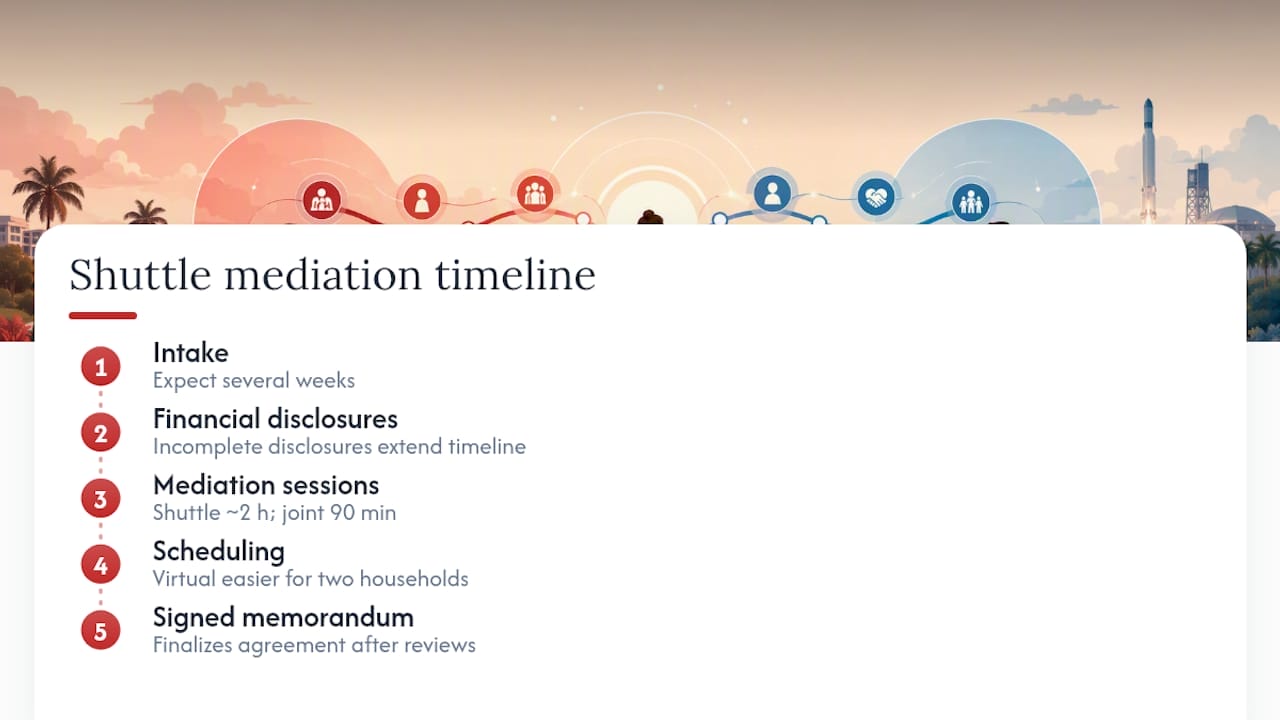
Shuttle sessions typically run about two hours, compared to roughly 90 minutes for a joint session, since the mediator is doing double the relaying and reframing work, per Mediate UK’s scheduling data.
By the numbers: In-person shuttle mediation commonly runs 2-hour sessions versus 90 minutes for joint mediation, and in-person shuttle can add room-hire fees that virtual breakout-room shuttle avoids entirely.
Parenting issues often resolve in fewer sessions than complex financial disputes, especially where retirement accounts, military benefits, or business interests are involved. Cost drivers include the mediator’s hourly rate, room rental for in-person sessions, any attorney review of draft terms, and parenting evaluations if custody is contested.
From intake to a signed memorandum, expect several weeks rather than days, longer if financial disclosures are incomplete at the start. Virtual sessions tend to compress this timeline since scheduling two households around one physical room is harder than scheduling around a video link.
How to Prepare and What to Say (and Not Say)
Walking into shuttle mediation prepared changes the outcome. Before your first session:
- Gather financial disclosures: bank statements, tax returns, debt records, retirement account balances.
- Draft a proposed parenting schedule, even a rough one, so you have a starting position.
- Write down your top three priorities in order, because trying to win everything usually means winning nothing.
- List questions you want the mediator to relay rather than raising them yourself later.
Once sessions start, keep your language factual and short. “I need the holiday schedule finalized before December” lands better than “You always ruin the holidays.” The mediator can reframe hostile language, but giving them cleaner material to work with speeds up the whole process. Pause before responding to a relayed proposal instead of reacting immediately, and let the mediator carry tone as well as content back to the other room.
Pro Tip: Write your opening statement out in advance and read from it if you need to. In high-conflict cases, having your key points on paper keeps emotion from hijacking the conversation when it matters most.
Attorney Perspective: When Legal Counsel Belongs in the Room
Mediation resolves disputes; it doesn’t replace legal advice. If your case involves military retirement benefits, complex assets, or a documented history of abuse, an attorney should review every mediated term before you sign anything. A mediator stays neutral by design, per Cornell Law School’s definition of the mediator’s role, which means no one in that room is protecting your individual legal interests unless you bring someone who does.
The mediation practice is certified, and the attorneys bring extensive combined experience, including work with military divorces and cases involving narcissistic personality disorder dynamics. That background shapes how we advise clients on when shuttle mediation fits and when it doesn’t.
— John
How Jmoorelegal Supports Shuttle Mediation in Brevard County
This service offers a direct alternative to generic mediation services for high-conflict divorces: certified mediation combined with attorneys knowledgeable about military benefit division and narcissistic personality disorder dynamics, rather than a mediator meeting your case for the first time.

Our attorneys handle mediation and family mediation with the same client-centered approach we bring to every case: direct attorney interaction, not a rotating cast of paralegals. If your situation involves military retirement pay, a spouse with narcissistic traits, or a documented safety concern, bring your financial disclosures and any prior court orders to your first meeting so we can map out whether shuttle mediation, joint mediation, or litigation fits your case best.
Free 30-minute consultations are available for Brevard County residents. Visit our mediation services page to schedule a consultation, or start at Jmoorelegal if you’re not yet sure which practice area fits your situation.
Sources
For readers who want to go deeper, Diplo’s overview of shuttle diplomacy explains the mediator’s filtering and reframing role in more technical detail. Beyond Intractability’s essay on shuttle diplomacy covers the trust-building theory behind why separation works. For the legal definition of a mediator’s neutral role in the United States, see Cornell Law School’s Legal Information Institute.
This article is general information, not a substitute for advice from a qualified lawyer. Consult a qualified legal professional about your own circumstances before acting on anything here.
- A mediator’s guide to shuttle mediation — Mediate UK
- Shuttle diplomacy — Beyond Intractability
- Shuttle diplomacy modeling — Journal article (ScienceDirect)
- Mediator — Cornell Law School Legal Information Institute
FAQ
What happens in shuttle mediation?
Each spouse stays in a separate room, in person or via video breakout rooms, while the mediator moves between them relaying proposals, reframing hostile language, and drafting settlement terms as agreement builds.
What is the downside to divorce mediation, especially shuttle format?
Shuttle sessions run longer than joint sessions, often around two hours versus 90 minutes, which increases total mediator costs, and the mediator’s framing choices carry more influence since neither spouse hears the other’s exact words.
What percentage of divorces are resolved in mediation?
Specific national resolution rates vary widely by jurisdiction and provider, so no single figure applies universally; ask any mediator you’re considering, including Jmoorelegal, about their own settlement outcomes during your consultation.
What should you not say during divorce mediation?
Avoid blaming language like “you always” or “you never,” and skip threats or ultimatums; short, factual statements about what you need and by when keep negotiations moving instead of triggering a shutdown.
Can shuttle mediation produce a legally binding agreement?
Yes. Shuttle mediation typically produces the same memorandum of understanding, parenting plan, and financial disclosure documents as joint mediation, though attorney review before signing is strongly recommended for complex cases.