
In Florida you generally have two years from the date of injury to file a personal injury lawsuit under Fla. Stat. § 95.11(5)(a). That deadline dropped from four years to two under a 2023 law change, and it is jurisdictional, not a suggestion. If your injury is recent, or you suspect a deadline is approaching, talk to a Florida attorney now rather than later.
TL;DR:
- The two-year statute of limitations for general negligence claims applies to injuries from March 24, 2023, onward, while older injuries retain the four-year period.
- Medical malpractice claims are limited to two years from discovery, but never more than four years from the malpractice date, with special rules for minors.
- Tolling provisions like minority, incapacity, concealment, or defendant absence can pause the deadline temporarily, but cannot override absolute caps like the seven-year construction defect limit.
- Filing deadlines are strictly jurisdictional, and missing them usually leads to immediate case dismissal, with limited exceptions for fraud or concealment.
- It is crucial to verify your injury date and claim type against current statutes and consult a lawyer promptly to preserve your rights before the deadline expires.
Table of Contents
- Florida Injury Statute of Limitations: What HB 837 Changed
- Deadlines By Claim Type: Which Period Applies to You
- When the Clock Pauses: Discovery Rules and Tolling
- Calculating Your Filing Deadline: Real Examples
- What Happens If You Miss the Deadline
- Steps to Protect Your Claim Right Now
- The Statutes Behind This Guide and Our Approach to Injury Cases
- Why Acting Early Beats Waiting for Certainty
- Talk to a Florida Personal Injury Attorney Before Your Deadline Closes
- Where to Verify These Deadlines Yourself
- Sources
- FAQ
Florida Injury Statute of Limitations: What HB 837 Changed
The two-year rule you’re reading about isn’t the rule Florida had for decades. Until March 24, 2023, injured people had a longer period to sue for ordinary negligence. House Bill 837, signed that day, cut the general negligence period in half, and the change applies to any cause of action that accrues on or after the effective date.
That word “accrues” matters more than most people realize. If your injury happened before March 24, 2023, you likely still have the old four-year window. If it happened on or after that date, you’re on the two-year clock under Fla. Stat. § 95.11. This is where a lot of confusion sets in, because people assume the rule they read about online applies uniformly regardless of when the injury occurred.
A few things to check before you assume which period applies to you:
- The exact date your injury occurred, not the date you filed a claim or spoke with an insurer
- Whether your claim sounds in negligence (the two-year rule) or falls into a category with its own separate period
- The current subsection numbering, since the legislature reorganized § 95.11 around the same time HB 837 passed
When in doubt, pull the actual statute text from Florida’s Online Sunshine site rather than relying on a summary you found somewhere else. Statute numbers shift, and a stale bookmark can cost you a claim.
Deadlines By Claim Type: Which Period Applies to You
Not every injury claim runs on the same clock. Florida’s statute of limitations scheme, and the practical charts built around it, break down by the kind of harm and the kind of defendant involved:
- General negligence and personal injury: Two years from the date of injury under § 95.11(5)(a), for anything accruing on or after March 24, 2023. Claims accruing before that date keep the old four-year period.
- Intentional torts: Four years. Assault, battery, and similar intentional acts get a longer window than ordinary carelessness.
- Medical malpractice: Two years from when the injury was discovered or should have been discovered with reasonable diligence, but never more than four years from the date of the malpractice itself, regardless of when it was discovered. Special extensions apply for minors, though a strict outer limit still applies. Nolo’s overview walks through how the discovery language interacts with the four-year cap.
- Wrongful death: Two years from the date of death under Florida’s Wrongful Death Act, which is often, but not always, the same date the underlying injury occurred.
- Products liability: Generally follows the same negligence framework, though claims built on strict liability or breach of warranty can carry different triggers worth reviewing with counsel.
- Written contracts: Five years, considerably longer than personal injury claims, which matters if your dispute overlaps a service agreement or warranty.
- Fraud claims: Four years, typically measured from discovery of the fraud rather than the fraudulent act itself.
- Construction defect repose: Seven years, a hard outer limit that applies regardless of when a defect is discovered, following a 2023 change that shortened the prior ten-year window, according to a current statute of limitations chart.
If you’re not sure which bucket your situation falls into, that’s normal. Slip-and-fall cases, for instance, sometimes get miscategorized as simple negligence when premises liability rules actually govern notice requirements and evidence preservation on a tighter practical timeline than the statute alone suggests.
When the Clock Pauses: Discovery Rules and Tolling
The date of injury isn’t always the date the clock starts. Florida law recognizes that some harms aren’t obvious right away, and the discovery rule accounts for that gap.
A surgical instrument left inside a patient might not surface until a follow-up scan months later. A defective product might cause harm that only reveals itself after repeated use. In cases like these, courts often start the clock when the injury was discovered or reasonably should have been discovered, not necessarily the date the underlying act occurred.
Beyond discovery, a handful of tolling provisions can pause or extend a deadline:
- Minority — if the injured person was under 18 when the claim accrued, the clock generally doesn’t start running until they turn 18, though medical malpractice claims involving minors carry their own separate caps.
- Legal incapacity — if the injured person was adjudicated mentally incapacitated at the time of injury, the limitations period can be tolled until capacity is restored.
- Defendant absence or concealment — if the at-fault party leaves Florida or actively hides to avoid service, the clock can pause during that absence.
- Fraud or concealment of the injury itself — if a defendant actively concealed facts that would have revealed the harm, that concealment can delay when the clock starts.
None of these exceptions override the hard outer caps built into certain claims, like the four-year absolute limit on medical malpractice discovery. Repose periods, like the seven-year construction defect cap, generally can’t be tolled at all, no matter the circumstances.
Pro Tip: Don’t assume a delayed-discovery argument will save your claim. Courts scrutinize these claims closely, and the burden falls on you to prove you couldn’t reasonably have discovered the injury sooner. Get that timeline documented with a lawyer as early as possible.
Calculating Your Filing Deadline: Real Examples
Accrual is the date your legal right to sue exists. Discovery is when you knew, or reasonably should have known, about the harm. Most of the time those two dates are the same day. Sometimes they’re not, and that gap changes everything about your timeline.
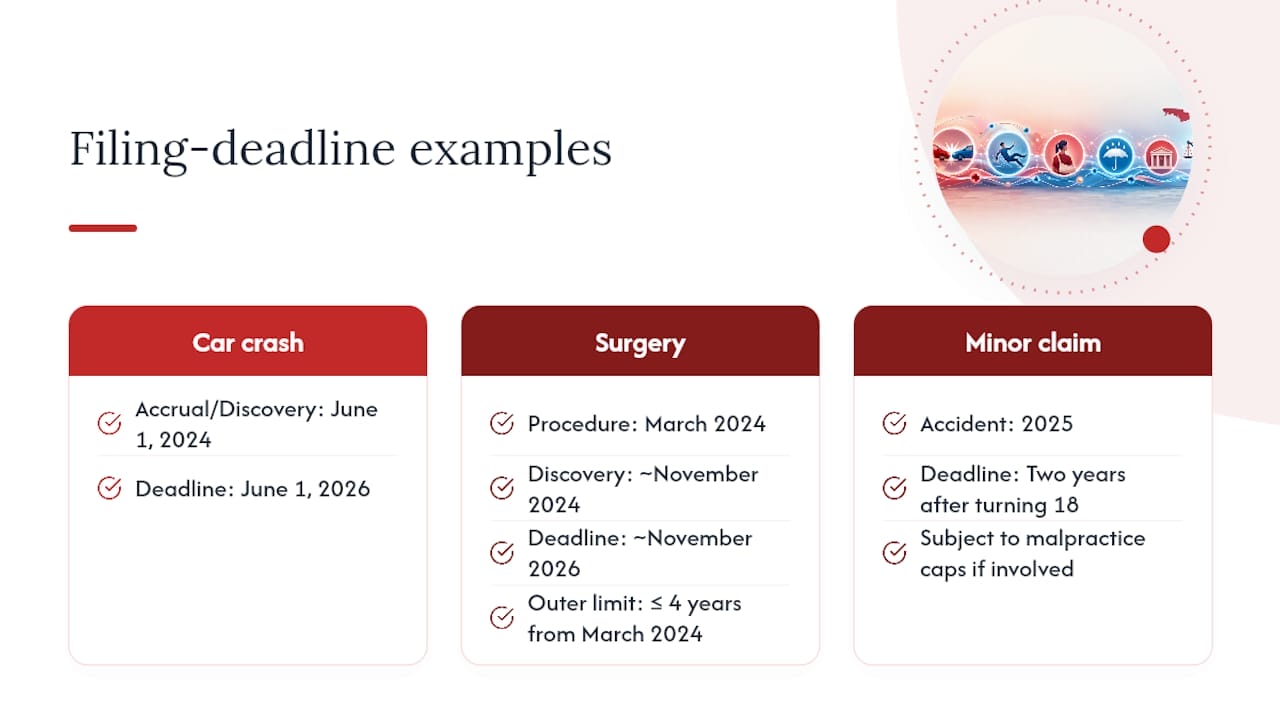
Consider a car crash on June 1, 2024. The negligence clock starts that day, and under the current rule, the claim must be filed by June 1, 2026.
Now consider a surgical complication discovered eight months after a March 2024 procedure. The malpractice clock likely starts at discovery, around November 2024, giving the patient until roughly November 2026, but never later than four years from the March 2024 surgery itself.
A minor injured in a bicycle accident in 2025 generally has until two years after turning 18 to file, subject to any applicable malpractice caps if a medical provider was involved.
Before you rely on any of these estimates for your own situation, gather the paperwork that anchors the actual date: police or incident reports, medical intake records showing the first treatment date, and, for wrongful death claims, the death certificate. Those documents settle disputes about when your clock actually started.
What Happens If You Miss the Deadline
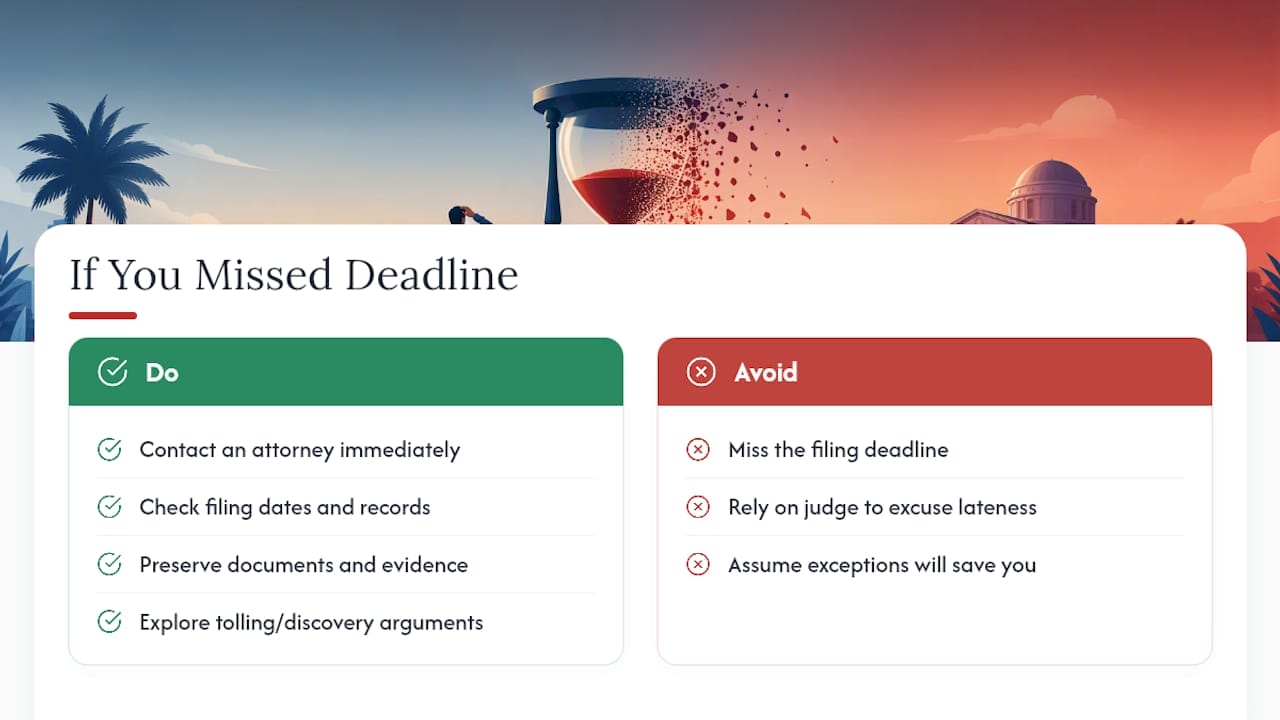
Missing the statute of limitations usually ends the claim outright. Courts treat these deadlines as jurisdictional, meaning a judge doesn’t have discretion to hear a case filed even one day late, absent a recognized tolling exception. The defense simply moves to dismiss, and in most instances, that motion succeeds.
Equitable relief exists in theory, but Florida courts apply it narrowly, and reserve it for extreme circumstances involving fraud or concealment, not simple procrastination or confusion about the rules. Don’t count on a judge making an exception for you.
If you think your deadline may have already passed, don’t guess. Contact an attorney immediately. There are narrow paths, tolling arguments, discovery-rule arguments, that sometimes apply, but identifying them requires a careful look at your specific dates and documentation.
Steps to Protect Your Claim Right Now
Preserving a personal injury claim starts long before you file anything in court. A few deliberate moves in the days and weeks after an injury can make or break your case later.
- Preserve evidence immediately. Photograph the scene, injuries, and any hazard involved. Get names and contact information for witnesses. Request a copy of the official police or incident report.
- Seek medical care and keep every record. Gaps in treatment give insurers an opening to argue your injury wasn’t serious or wasn’t caused by the incident. Request copies of your records as you go, rather than waiting until you need them for litigation.
- Be careful with recorded statements. Insurance adjusters often ask for a recorded statement early, before you’ve spoken to a lawyer. Politely decline until you’ve had that conversation.
- Talk to a Florida personal injury attorney for a free consultation. An attorney can confirm your accrual date, flag any tolling issues, and, if your deadline is close, discuss options like a tolling agreement or filing suit promptly to protect your rights.
Pro Tip: If you’re inside the last few months of your filing window, don’t wait for a “perfect” case file. Filing suit preserves your claim; you can keep building evidence and documenting damages after the complaint is on file, but you can’t do either once the deadline passes.
The Statutes Behind This Guide and Our Approach to Injury Cases
Every deadline described here traces back to Fla. Stat. § 95.11 and the changes enacted through HB 837 in 2023. Reading primary statutory text matters more in personal injury law than almost any other legal area, because a missed subsection or an outdated chart can lead someone to believe they have far more time than they actually do.
The Law Office of John Vernon Moore, P.A. has represented Brevard County residents through car accident claims, premises liability disputes, and other injury matters where the filing clock was already ticking before the client walked in the door.
Why Acting Early Beats Waiting for Certainty
People often wait to call a lawyer because they want to know exactly how their case will turn out before they commit to anything. That instinct is understandable, but it works against you here. The deadlines described in this guide don’t pause while you gather your thoughts, and by the time some clients call, options that were available three months earlier have quietly closed.
Realistic expectations matter too. Not every claim results in a large recovery, and a missed deadline usually means no recovery at all, regardless of how strong the underlying facts were. If your injury happened recently, or you’re unsure which statute applies to your situation, a free consultation costs you nothing and can clarify exactly where you stand.
— John
Talk to a Florida Personal Injury Attorney Before Your Deadline Closes
A local personal injury law office gives injury victims something the countdown clock doesn’t: a direct line to an attorney who reviews your accrual date and deadline exposure at no cost, before you commit to anything. You won’t get bounced between paralegals or wait weeks for a callback while your filing window shrinks.

A free initial consultation with our personal injury practice covers the specifics of your situation: when your claim likely accrued, whether any tolling exception applies, and what evidence you need to preserve immediately. If your case involves a vehicle collision, our auto accident injury page walks through the details specific to crash claims, and our guide on common personal injury case mistakes covers pitfalls worth avoiding before you ever set foot in a courtroom. Call our office or fill out the contact form on our site to schedule your free consultation today.
Where to Verify These Deadlines Yourself
Read the primary sources directly rather than relying on secondhand summaries. The full statute text sits at Florida Statutes § 95.11, and HB 837’s legislative history is on file with the Florida Legislature. For filing logistics and venue information, Florida Courts publishes current guidance by circuit.
This article is general information, not a substitute for advice from a qualified lawyer. Consult a qualified legal professional about your own circumstances before acting on anything here.
Sources
- Florida House Bill 837 (2023)
- Floridacourtrules
- Nolo — Florida personal injury statute of limitations
FAQ
How long do you have to sue someone for personal injury in Florida?
Generally two years from the date of injury under Fla. Stat. § 95.11(5)(a), for claims accruing on or after March 24, 2023. Injuries that occurred before that date typically keep the prior four-year period.
What are the exceptions to the statute of limitations in Florida?
Tolling can apply for minors, legally incapacitated individuals, defendants who conceal themselves or leave the state, and cases involving fraudulent concealment of the injury itself, though hard caps like the four-year medical malpractice limit and the seven-year construction repose period generally can’t be extended.
Can you sue for an injury years later?
Sometimes, if the discovery rule applies, such as a latent medical injury or a defect that wasn’t reasonably knowable right away, but most claims are still subject to an outer limit, like the four-year cap on medical malpractice discovery claims.
What is the 51% rule in Florida?
Florida uses modified comparative negligence, which bars recovery entirely if you’re found mostly at fault for your own injury. This rule affects strategy, not your filing deadline, but it shapes how much a case is worth once it’s filed.