

Yes, Florida law allows you to recover pain and suffering damages, but most motor vehicle claims must first clear the “serious injury” threshold set by Florida Statutes § 627.737. Meet that bar and you can pursue compensation for physical pain, emotional distress, and lost quality of life. Miss it, and your non-economic damages may be off the table entirely. On top of that, comparative negligence can shrink or wipe out your award if you share more than half the blame.
TL;DR:
- Most motor vehicle claims in Florida require meeting the serious injury threshold of significant and permanent functional loss, permanent injury, scarring, or death to recover pain and suffering damages.
- Defendants can challenge your injury evidence within 30 days before trial through a motion, potentially dismissing your non-economic damages if you fail to meet the threshold.
- Pain and suffering are calculated mainly via the multiplier or per diem methods, with juries ultimately deciding the final award based on injury severity, impact, and documentation quality.
- No general cap exists on non-economic damages for private defendants, but claims against government entities are limited by statutory caps of around $200,000 to $300,000 and require strict pre-suit notices.
- Building a strong claim depends on consistent medical records, daily pain logs, witness statements, and early evidence preservation to withstand defense and judicial challenges.
Table of Contents
- What Florida’s Serious Injury Threshold Actually Requires
- How Insurers and Attorneys Calculate Pain and Suffering
- Factors That Push Your Claim Higher or Lower
- Are There Caps on Pain and Suffering Damages in Florida?
- Building Proof: What Actually Wins a Pain and Suffering Claim
- What an Attorney Does and What You Should Do Right Now
- A Local Attorney’s View on Pain and Suffering Claims
- Talk to a Brevard County Attorney About Your Injury Claim
- Sources
- FAQ
What Florida’s Serious Injury Threshold Actually Requires
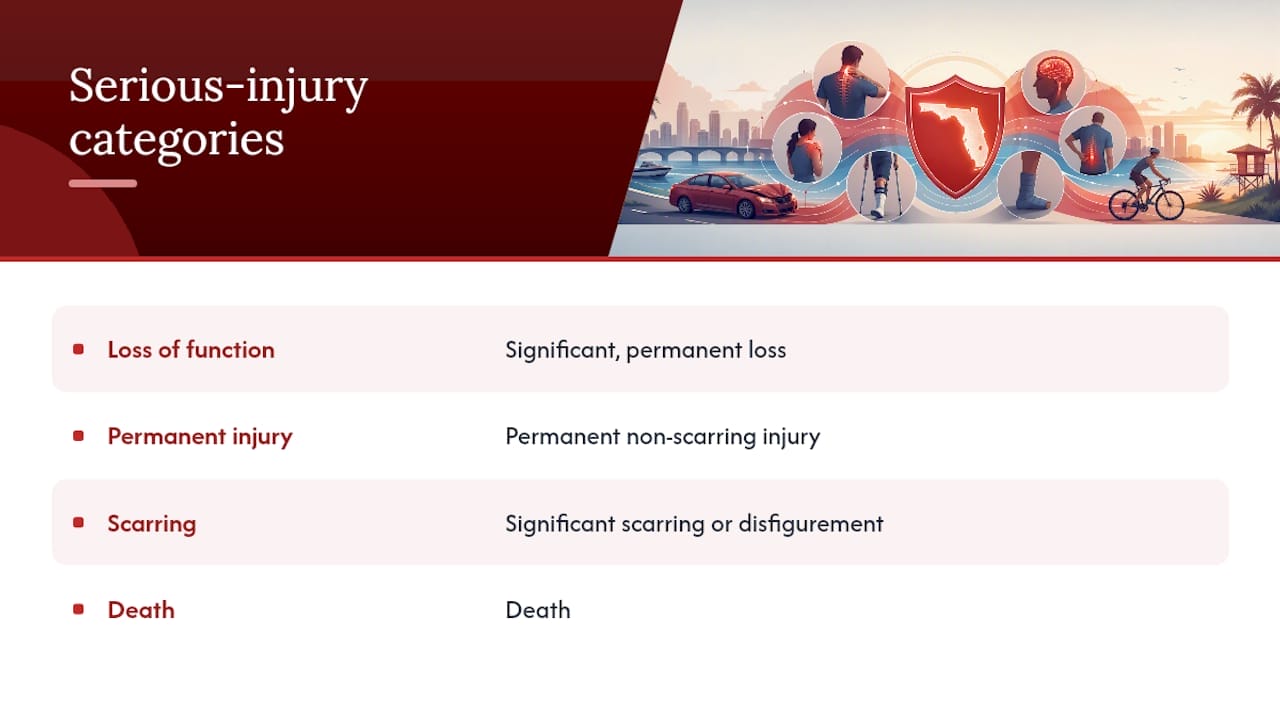
Section 627.737 spells out four categories that qualify a claimant for pain and suffering damages in a motor vehicle case: significant and permanent loss of an important bodily function, permanent injury other than scarring, significant and permanent scarring or disfigurement, or death. A broken arm that heals cleanly in eight weeks usually will not clear this bar. A herniated disc that leaves you with permanent nerve damage typically will.
This threshold applies primarily to the auto insurance context, tied to Florida’s no-fault system. Defendants get one shot at testing whether your evidence actually supports a serious injury claim. Under Florida’s statute, they can file a pretrial motion, typically around 30 days before trial, asking the court to review your medical proof. If a judge decides you cannot show admissible evidence meeting one of those four categories, the pain and suffering portion of your claim gets dismissed without prejudice. Without meeting these statutory elements, non-economic damages in a car accident case may simply not be available, no matter how much pain you are actually in.
How Insurers and Attorneys Calculate Pain and Suffering
There is no fixed formula for translating suffering into dollars. Florida courts leave that judgment to juries and settlement negotiations, which means the same injury can produce wildly different numbers depending on who is calculating it. Two approaches dominate real-world negotiations.
- The multiplier method. Add up your economic damages (medical bills, lost wages, future treatment costs), then multiply that total by a number, usually somewhere between 1.5 and 5, based on injury severity. A herniated disc requiring surgery with $60,000 in medical bills might get a multiplier of 3, producing a higher pain and suffering estimate. A soft tissue injury with $8,000 in bills might warrant a lower multiplier, resulting in a smaller estimate.
- The per diem method. Assign a dollar figure to each day you experience pain, often anchored to a daily wage, then multiply by the number of days you are expected to suffer. Someone earning a daily wage who faces chronic pain for an extended period could see a per diem calculation reflecting that timeframe multiplied by their daily rate.
Neither method is binding on a jury. They are negotiating tools insurers and lawyers use to anchor a number before the real haggling starts.
Factors That Push Your Claim Higher or Lower
Insurance adjusters and juries weigh several things when deciding whether your pain and suffering claim is worth pennies or real money.
- Severity and permanence: Surgeries, permanent disabilities, and chronic conditions carry far more weight than injuries that resolve on their own.
- Functional impact: Lost ability to work, play with your kids, or perform daily tasks strengthens the claim considerably.
- Duration and prognosis: Ongoing treatment and a documented need for future rehabilitation extend the value of the claim.
- Emotional and psychological harm: Florida still follows the Impact Rule for negligent infliction of emotional distress, meaning you generally need a discernible physical injury to recover for pure emotional harm, aside from recognized exceptions like bystander claims.
- Documentation strength: Contemporaneous treating notes, daily pain journals, photos, and witness statements often matter more than the injury itself.
Pro Tip: Start a daily symptom log the week your injury happens, not months later. Insurance adjusters and defense attorneys notice when pain journals begin conveniently close to a lawsuit filing date, and they will use that timing against you.
Are There Caps on Pain and Suffering Damages in Florida?
Florida does not impose a blanket cap on non-economic damages in private personal injury lawsuits. If your case is against another driver, a property owner, or a private company, there is generally no statutory ceiling on what a jury can award for pain and suffering.
That changes when the defendant is a government entity. Claims against Florida cities, counties, or state agencies fall under different rules entirely, with historical caps around $200,000 per person and $300,000 per incident for many claim types, along with strict notice requirements you must satisfy before suing at all.
- Private defendants: generally no cap on non-economic damages.
- Government defendants: statutory caps apply, plus mandatory pre-suit notice.
- Comparative fault: under Fla. Stat. § 768.81, your award gets reduced by your own percentage of fault, and you recover nothing if you are found more than 50% responsible.
If you share a portion of the fault for a crash, your award is reduced accordingly. If you are found more than half responsible, you cannot recover damages, regardless of injury severity.
Building Proof: What Actually Wins a Pain and Suffering Claim
Winning a pain and suffering claim comes down to evidence, not eloquence. Judges and adjusters respond to documentation, not descriptions of how bad the pain feels.
- Medical records and imaging. MRI results, X-rays, and treating physician notes anchor everything else.
- Contemporaneous journals. Daily notes on pain levels, missed activities, and sleep disruption carry weight precisely because they are not written for litigation.
- Witness statements. Coworkers, family members, and friends who watched your daily life change add credibility a medical chart cannot.
- Expert testimony. Vocational experts, life-care planners, and psychiatric specialists become essential when you need to link psychological harm to physical symptoms or project future limitations.
- Early preservation. Because a defendant can file a pretrial motion roughly 30 days before trial to challenge whether your evidence meets the § 627.737 threshold, waiting to gather proof is a real risk. The stronger your file looks on day one, the less room a defense attorney has to argue insufficiency later.
What an Attorney Does and What You Should Do Right Now
An attorney evaluates your injury against the statutory thresholds, gathers documentation, prepares a demand package, and negotiates with insurers who are financially motivated to undervalue your claim. When a case involves a government defendant or disputed fault, that legal guidance becomes even more important given the tighter notice deadlines and caps involved.
While you decide on representation, a few steps protect your claim:
- Get medical care immediately and keep every appointment.
- Start a daily log of pain, missed work, and limited activities.
- Save every bill, prescription, and treatment record.
- Avoid posting about the accident or your recovery on social media.
- Do not give a recorded statement to any insurance company before speaking with counsel.
Anyone dealing with an auto accident claim in Florida benefits from having these pieces in place before an adjuster ever calls.
A Local Attorney’s View on Pain and Suffering Claims
Most people assume the pain itself is the case. It is not. Florida’s system rewards documentation over description, and the § 627.737 threshold means a genuinely painful injury can still lose in court if the paperwork is thin. What actually moves a claim is boring: consistent medical visits, an honest daily log, and getting ahead of the defense’s pretrial motion before it gets filed. The firms that win these cases are not the ones with the best storytelling. They are the ones who started building the file on day one. That is the piece most injured Floridians underestimate until it is too late to fix.
— John
Talk to a Brevard County Attorney About Your Injury Claim
Some legal firms provide direct access to the attorney handling your case, not a rotating cast of paralegals, plus a free initial consultation before you commit to anything.

Personal injury claims involving pain and suffering move faster and stronger when the right documentation is in place from the start. A free consultation lets you walk through your medical records, timeline, and photos with an attorney who can tell you quickly whether your injury likely meets the serious injury threshold. Bring what you have, even if it feels incomplete. Visit the firm’s personal injury practice page to start the process, or call to schedule your free consultation before speaking with any insurance adjuster.
This article is general information, not a substitute for advice from a qualified lawyer. Consult a qualified legal professional about your own circumstances before acting on anything here.
Sources
- Florida Statutes § 627.737
- FindLaw: Florida Statutes § 627.737
- The Florida Bar Journal: Negligent infliction of emotional distress — Where are we now?
FAQ
Does Florida Pay for Pain and Suffering?
Florida allows recovery for pain and suffering in personal injury cases, but motor vehicle claims must meet the serious injury threshold under § 627.737 first.
What Is the 51% Rule in Florida?
Under Florida’s modified comparative negligence rule, you cannot recover any damages, including pain and suffering, if you are found more than 50% at fault for the incident.
How Much Money Can You Get From Pain and Suffering?
There is no fixed amount. Attorneys and insurers typically estimate value using the multiplier method (economic damages times a factor of roughly 1.5 to 5) or the per diem method, and juries can award different amounts entirely.
What Qualifies You for Pain and Suffering?
In auto accident cases, you generally need a significant permanent loss of bodily function, a permanent injury other than scarring, permanent significant scarring, or death, along with medical documentation supporting that diagnosis.


