You can likely seal or expunge your Florida record if you’ve never had another sealing or expunction and your case ended in a dismissal, acquittal, or a withheld adjudication. Sealing restricts public access, expungement goes further and orders the record destroyed. Either way, your first move is the same: apply to the Florida Department of Law Enforcement (FDLE) for a Certificate of Eligibility. That certificate is required, but it doesn’t guarantee a judge will grant your petition.
TL;DR:
- Only dismissals, acquittals, or withheld adjudications qualify for record sealing or expungement in Florida; convictions and certain serious offenses are ineligible.
- The process requires obtaining a Certificate of Eligibility from FDLE, which takes about 12 weeks and is valid for roughly one year before expiring.
- Judges have discretion to deny sealing even with a valid certificate based on factors like offense severity, rehabilitation, or objections from the state.
- Sealed records remain accessible to some government entities, while expunged records are destroyed, making them nearly invisible to most background checks.
- A qualified attorney can improve approval chances by auditing eligibility, preparing documents, and effectively arguing discretionary factors at court hearings.
Table of Contents
- How does the criminal record sealing process work in Florida?
- Who qualifies to seal or expunge records in Florida?
- How do you get a Certificate of Eligibility from FDLE?
- Why can a judge deny sealing even with a valid certificate?
- What’s the real difference between sealing and expunging a record?
- Are there faster routes for juvenile or special cases?
- What does it cost, and how long does the whole process take?
- How can an attorney help with sealing or expunging your record?
- A practitioner’s honest read on what actually derails these petitions
- Get Help Sealing or Expunging Your Florida Record
- Sources
How does the criminal record sealing process work in Florida?
Getting your Florida court record sealed follows a fixed sequence, and skipping a step just means starting over.
- Review your own record first. Pull your arrest reports and certified dispositions before you apply for anything. FDLE’s own guidance recommends requesting a personal review of your criminal history so you know what’s actually on file before you commit time and money to an application.
- Apply to FDLE for a Certificate of Eligibility. This is the gatekeeping step. FDLE checks your eligibility against the statute, and the full application process typically takes about 12 weeks from the day they receive a complete packet. Incomplete applications restart the clock.
- File your petition in the correct county. Once FDLE issues the certificate, you (or your attorney) file it with the court, along with a sworn affidavit, in the county where the case was resolved.
- Attend the hearing and get a certified order. If the judge grants relief, you need the certified court order in hand.
- Deliver the order to FDLE. FDLE won’t seal or expunge anything until it receives that certified order, and it then notifies the arresting agency and other criminal justice agencies of compliance.
Miss a step and you’re back at square one, sometimes with a new filing fee.
Who qualifies to seal or expunge records in Florida?
Florida law draws hard lines here, and they trip up more applicants than any other part of the process.
- No adjudication of guilt for the offense you’re sealing. A conviction with adjudication almost always blocks sealing outright.
- One-time-only rule. Fla. Stat. § 943.059 allows exactly one sealing or expunction in your lifetime, with narrow exceptions.
- Prior seals or expunctions restrict you. If you’ve already used your one shot, later relief is rare and typically limited to specific ten-year lawful self-defense scenarios.
- Certain offenses are barred outright. Fla. Stat. § 943.0584 lists categorically ineligible offenses, and serious charges like sexual offenses, child abuse, and large-scale trafficking are excluded regardless of how the case ended, a pattern that also shows up in how criminal records affect housing applications.
- Your disposition matters more than people expect. A withheld adjudication often opens the door to sealing, while expungement generally demands the case ended without any adjudication of guilt at all, whether through dismissal, nolle prosequi, or acquittal, according to the expunction statute.
Pro Tip: If you’re not sure whether your case resulted in a withhold of adjudication or an actual conviction, don’t guess. A withhold of adjudication changes your eligibility entirely, and the difference often isn’t obvious from a plea agreement alone.
How do you get a Certificate of Eligibility from FDLE?
You start with FDLE’s application, available directly through its seal and expunge process page. Before you submit anything, request a personal review of your own record so you’re not blindsided by an old arrest you forgot about.
FDLE cross-checks your application against several systems:
- The Florida Crime Information Center (FCIC)
- The National Crime Information Center (NCIC)
- Local court databases in the county of arrest
- The Department of Highway Safety and Motor Vehicles (DHSMV)
Processing takes several weeks, and FDLE has been direct about one thing: it does not expedite applications, no matter the circumstances.
Once issued, your certificate is valid for about a year. If you sit on it past that window, or if a court denies your petition, the certificate expires and you’ll need to start the FDLE application over from scratch. That single detail catches more applicants off guard than anything else in the process.
Why can a judge deny sealing even with a valid certificate?
Here’s the part official guidance tends to underplay: a valid certificate does not entitle you to relief. Fla. Stat. § 943.059 explicitly reserves sealing as discretionary with the court, and judges routinely weigh:
- The nature and severity of the underlying arrest
- How much time has passed and evidence of rehabilitation
- Objections raised by the state attorney’s office
- Whether the affidavit meaningfully addresses community ties and conduct since the arrest
If a judge denies the petition, you generally can’t simply refile the same request. Understanding how the criminal defense process works at the hearing stage matters, because a poorly argued affidavit is often the difference between approval and denial.
What’s the real difference between sealing and expunging a record?
Sealing and expungement sound similar, but they produce very different outcomes for anyone checking your background later.
Sealing keeps the record intact but restricted. Under Fla. Stat. § 943.059, the public can’t see it, but statutory exceptions still allow certain employers, licensing boards, and law enforcement agencies to view sealed records.
Expungement goes further. Agencies physically destroy their copies, though FDLE keeps a confidential record on file that can only be unsealed by court order. For nearly every practical purpose, an expunged arrest doesn’t exist to the outside world.
- Sealed records: hidden from the public, visible to select government and licensing entities.
- Expunged records: destroyed by most agencies, retained confidentially only by FDLE.
Pro Tip: On most job and rental applications, you can truthfully answer “no” if asked about a sealed or expunged arrest, unless the application specifically asks about sealed or expunged records or you’re applying for a position, like law enforcement or certain state licenses, where statutory exceptions require disclosure.
Are there faster routes for juvenile or special cases?
Juvenile records follow a different clock. Many qualify for automatic expungement at age 21, or age 26 if the person was still under Department of Juvenile Justice custody. Some juveniles can also apply for early expungement before that age if they meet specific statutory criteria tied to a single, non-serious offense.
Outside the juvenile system, a few narrower paths exist:
- Administrative expungement for arrests made contrary to law, meaning no charge was ever properly authorized.
- Human trafficking victim relief, allowing survivors to clear arrests tied to their trafficking.
- Lawful self-defense certificates, a separate track from the standard FDLE certificate process.
Each route demands its own documentation, so confirm which one actually applies before filing anything.
What does it cost, and how long does the whole process take?
Budget for two separate timelines: FDLE’s eligibility review, which runs about 12 weeks, and court processing afterward, which varies by county and caseload. Because your certificate expires after 12 months, plan your court filing well before that window closes.
Costs typically include an FDLE application fee, a court filing fee, and service costs, which vary by county, so confirm current amounts with your local clerk before filing.
Once you have a certified order, don’t assume you’re done:
- Keep the certified order somewhere safe, permanently.
- Confirm FDLE actually processed the compliance notification to arresting agencies.
- Search your name on common background check and data broker sites, and request removal where a sealed or expunged record still appears.
How can an attorney help with sealing or expunging your record?
An eligibility audit catches problems before they cost you a filing fee. That means checking your exact disposition dates, confirming you’ve never used a prior seal or expunction, and pulling certified copies of every relevant document before FDLE ever sees the application.
On the court side, an attorney drafts the affidavit to address the discretionary factors judges actually weigh, rehabilitation, community ties, time elapsed, rather than a bare recitation of the statute. That’s often the entire difference between a granted petition and a denial with no clear path to refile.
- Auditing eligibility and gathering certified dispositions and arrest records
- Drafting the FDLE application and the court petition together, consistently
- Appearing at the hearing and arguing the discretionary factors directly to the judge
- Handling denials, appeals, or a lapsed certificate that needs refiling
Pro Tip: If your certificate is about to expire, don’t wait for the mail to confirm it. Contact the clerk’s office directly to check your petition’s filing status and avoid restarting the entire FDLE process.
A practitioner’s honest read on what actually derails these petitions
Most denied petitions don’t fail because of the law. They fail because of paperwork: a missing certified disposition, a certificate that expired while someone waited on a court date, or an affidavit that recites the statute instead of making a real case for the judge.
Timing is the piece people underestimate most. That 12-month certificate window feels generous until a court’s calendar backs up, and by the time you get a hearing date, you’re refiling with FDLE from zero. Keep every certified copy permanently, not just until the case closes. You’ll likely need them again for a licensing application, a background check dispute, or a future legal matter you can’t predict yet.
— John
Get Help Sealing or Expunging Your Florida Record
Jmoorelegal handles the whole sealing and expungement process from a Brevard County office, not a call center, so the attorney reviewing your eligibility is the same one drafting your affidavit and standing in front of the judge.
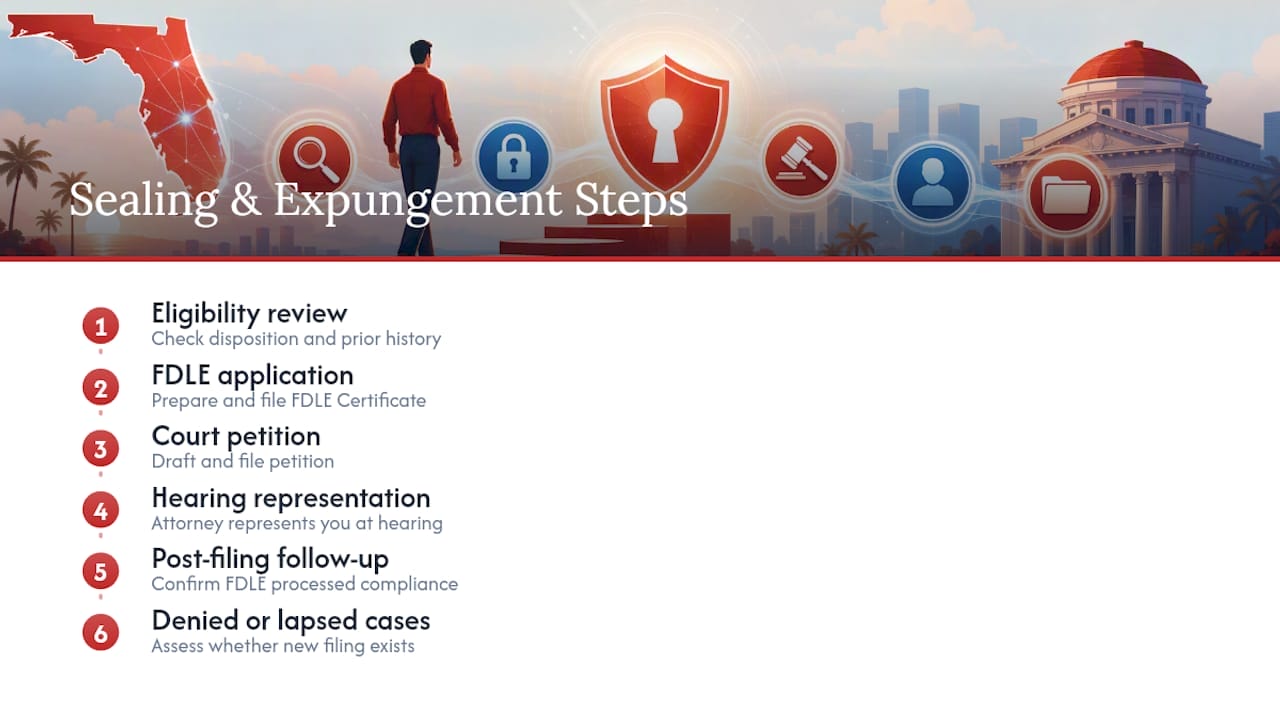
That matters most at the discretionary hearing stage, where a generic petition gets denied and a well-argued one gets granted. Jmoorelegal reviews your disposition and prior record history for eligibility, prepares and files your FDLE Certificate of Eligibility application, drafts and files your court petition, represents you at the hearing, and follows up afterward to confirm FDLE actually processed compliance. If your certificate lapsed or a prior petition was denied, the firm can assess whether a new filing path exists.
Every initial consultation is free. If your case involves a domestic violence charge or drug offense tied to the record you’re trying to seal, visit the criminal law practice page to see the full range of defense services, then call to schedule a consultation and get a straight answer on where your case stands before you file anything with FDLE.
This article is general information, not a substitute for advice from a qualified lawyer. Consult a qualified legal professional about your own circumstances before acting on anything here.
Sources
- Seal and Expunge – Certificate of Eligibility Instructions (FDLE)
- 943.0585 Court-ordered expunction of criminal history records (Florida Statutes)
- 943.059 Court-ordered sealing of criminal history records (Florida Statutes)