
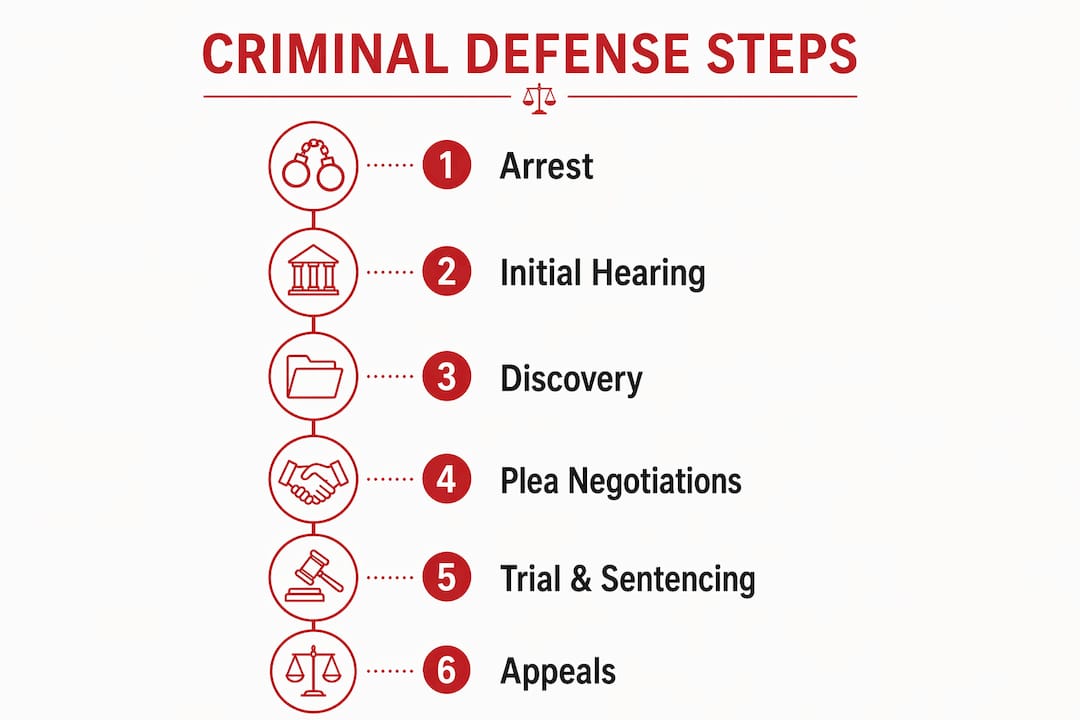
The criminal defense process is the series of legal stages through which an accused person defends against criminal charges to protect their rights and secure fair treatment under the law. Understanding criminal defense means knowing that each stage, from arrest through potential appeal, carries real consequences for your freedom, your record, and your future. The presumption of innocence and the prosecution’s burden of proof are the two constitutional pillars that shape every decision your attorney makes. Knowing how the criminal defense process works before you face a courtroom puts you in a far stronger position than learning it under pressure.
How does the criminal defense process work from arrest to arraignment?
The moment of arrest triggers a sequence of events that moves faster than most people expect. Initial appearance before a judge typically happens within 48 hours of arrest, and in some jurisdictions like Washington D.C., within 24 hours. That first hearing sets bail conditions and determines whether you walk out or stay in custody while your case develops.

Bail is not arbitrary. Judges weigh factors including the severity of the charge, your criminal history, ties to the community, and flight risk. A skilled defense attorney can argue these factors aggressively at this stage to secure your release. Release matters because a defendant who is free can actively participate in building their defense.
Arraignment follows shortly after. The court reads the formal charges against you, and you enter a plea. The standard move at arraignment is to plead not guilty, even if you are considering other options later.
Entering a not guilty plea preserves every defense available to you and forces the prosecution to prove its case. It also buys your attorney time to review evidence, investigate facts, and identify weaknesses in the government’s position. Pleading guilty at arraignment surrenders all of that leverage before the fight has even started.
Key criminal defense steps at this stage:
- Invoke your right to remain silent immediately after arrest
- Request an attorney before answering any questions
- Avoid consenting to searches of your person, vehicle, or home
- Attend the initial appearance with counsel if at all possible
- Enter a not guilty plea at arraignment to preserve your options
Pro Tip: Invoking your right to silence and requesting counsel immediately after arrest is the single most protective action you can take. Voluntary statements made before an attorney arrives can and do damage cases that might otherwise be winnable.
How does discovery and motion practice build your defense?
Discovery is the formal process by which both sides exchange evidence. The prosecution must hand over police reports, witness statements, lab results, surveillance footage, and any other material relevant to the case. Your attorney then analyzes everything to find gaps, contradictions, and constitutional violations.
Defense attorneys at this stage act as investigators as much as advocates. Early attorney involvement allows the defense to gather exculpatory evidence, interview witnesses before memories fade, and challenge the foundations of the police case before the prosecution has time to reinforce them. The earlier your attorney gets to work, the more leverage you have.
Motion practice is where discovery findings become legal weapons. The most powerful tool is the suppression motion, which asks the court to throw out evidence obtained through an illegal search, an unlawful stop, or a Miranda violation. Suppression motions lead to dismissal or charge reduction in 15–20% of cases before trial. That is a significant number. It means that in roughly one out of every six or seven cases, the right motion at the right time ends or dramatically changes the case without a trial.
Common defense motions and their purposes:
- Motion to suppress evidence — challenges evidence obtained through Fourth Amendment violations like illegal searches
- Motion to dismiss — argues the charges lack legal basis or the prosecution cannot meet its burden
- Motion for change of venue — seeks a different location when local publicity makes a fair jury impossible
- Motion in limine — requests that certain prejudicial evidence be excluded from trial
- Motion for discovery — compels the prosecution to turn over materials it has withheld
The admissibility of evidence is one of the most consequential issues in any criminal case. Evidence that cannot be admitted cannot convict you.
| Defense action | Primary purpose |
|---|---|
| Discovery review | Identify weaknesses in prosecution’s evidence |
| Suppression motion | Exclude unconstitutionally obtained evidence |
| Witness interviews | Lock in testimony and expose inconsistencies |
| Expert consultation | Counter forensic or technical prosecution claims |
Pro Tip: Do not assume the prosecution’s evidence is solid just because it exists. Lab results contain errors, witness identifications are frequently unreliable, and police procedures are often flawed. Your attorney’s job is to find every one of those cracks.
What are plea negotiations and how do they affect case outcomes?
Plea negotiations are the process by which the defense and prosecution reach a mutually acceptable resolution without going to trial. Most criminal cases resolve through plea deals, with only 2–3% of cases actually reaching a jury. That statistic does not mean defendants are weak. It means that skilled negotiation, backed by strong pretrial work, often produces better outcomes than rolling the dice at trial.
A plea deal typically involves the defendant agreeing to plead guilty to a lesser charge or to the original charge in exchange for a reduced sentence. The strength of your negotiating position depends almost entirely on the quality of your pretrial preparation. A defense attorney who has filed strong suppression motions, identified credible witnesses, and exposed holes in the prosecution’s case negotiates from a position of power.
Before accepting any plea offer, you need to weigh several factors:
- Strength of the prosecution’s evidence — how likely is conviction at trial?
- Severity of the potential sentence — what is the worst realistic outcome if you go to trial and lose?
- Collateral consequences — will a conviction affect your professional license, immigration status, or custody rights?
- Rights waived by the plea — you give up your right to trial, to confront witnesses, and to appeal most issues
- Judicial approval — a judge must accept the plea and is not bound by the prosecution’s sentencing recommendation
Collateral consequences are the hidden costs of a plea that many defendants do not fully consider until it is too late. A drug conviction can affect federal student loan eligibility. A felony plea can strip voting rights. A sex offense plea triggers registration requirements that follow you for decades. Your attorney must walk through every one of these consequences before you sign anything.
What happens if the case goes to trial and sentencing?
Trial is the stage where the prosecution must prove every element of the charge beyond a reasonable doubt, the highest standard of proof in American law. This standard is constitutionally required under the Due Process Clause. The defense does not have to prove innocence. The prosecution has to prove guilt, and it has to do so completely.
You and your attorney choose between a jury trial and a bench trial, where a judge decides the verdict alone. Jury trials are generally preferred when the facts are sympathetic or the charges carry strong emotional weight. Bench trials work better when the legal issues are technical and a judge is more likely to apply the law dispassionately.
Trial unfolds in distinct stages:
- Opening statements — both sides outline what the evidence will show
- Prosecution’s case in chief — the government presents witnesses and physical evidence
- Cross-examination — the defense challenges prosecution witnesses to expose inconsistencies and create reasonable doubt
- Defense case — the defense may present its own witnesses and evidence, though it is not required to
- Closing arguments — each side summarizes the evidence and argues why the verdict should favor them
Effective cross-examination is one of the most underrated tools in a criminal trial. A single inconsistency in a key witness’s testimony can be enough to create reasonable doubt in the minds of jurors.
If the verdict is guilty, the case moves to sentencing. The sentencing phase gives the defense one final opportunity to reduce the penalty. Judges weigh the nature of the offense, your prior record, and any mitigating factors your attorney presents. Mitigation can include evidence of rehabilitation, family circumstances, mental health history, or cooperation with authorities. A well-prepared sentencing memorandum can be the difference between probation and prison.
What comes after trial: appeals and post-conviction options?
An appeal is not a second trial. It is a review of the trial record to determine whether legal errors occurred that affected the outcome. Appeals require showing a specific legal error or prejudice. Appellate courts do not re-weigh evidence or reconsider witness credibility. They ask whether the trial was conducted fairly and according to the law.
Common grounds for appeal include improper admission of evidence, prosecutorial misconduct, ineffective assistance of counsel, and incorrect jury instructions. Not every error qualifies. The error must be significant enough that it likely changed the outcome. This is a high bar, and defendants should enter the appellate process with realistic expectations.
Post-conviction remedies beyond direct appeal include habeas corpus petitions, motions for new trial based on newly discovered evidence, and sentence modification requests. These options are limited and procedurally demanding, which is why the quality of representation at trial matters so much. Winning at trial is always better than winning on appeal.
Pro Tip: Preserve your appellate rights during trial by ensuring your attorney objects to improper evidence and rulings on the record. An issue not raised at trial generally cannot be raised on appeal. The criminal law decisions made during trial determine what options exist afterward.
Key Takeaways
The criminal defense process requires early attorney involvement, strategic motion practice, and informed decision-making at every stage to protect your rights and achieve the best possible outcome.
| Point | Details |
|---|---|
| Act immediately after arrest | Invoke your right to silence and request counsel before answering any questions. |
| Plead not guilty at arraignment | This preserves all defenses and forces the prosecution to prove its case. |
| Use motions strategically | Suppression motions lead to dismissal or charge reduction in 15–20% of cases. |
| Evaluate pleas carefully | Consider collateral consequences and rights waived before accepting any offer. |
| Preserve appellate rights | Object on the record at trial to keep post-conviction options open. |
What I’ve learned after years of criminal defense work
The single biggest mistake I see defendants make is waiting. They get arrested, they think the situation will sort itself out, and they spend the first critical days without legal counsel. Those days are often the most important in the entire case. Evidence disappears. Witnesses’ memories shift. Prosecutors build momentum. Early attorney involvement can prevent charges from being filed at all in some cases, and it almost always improves the outcome when charges do proceed.
The second mistake is treating the criminal process as something that happens to you rather than something you actively navigate. Every stage has leverage points. Bail hearings, arraignments, discovery deadlines, and motion filing windows all represent opportunities to shape the case in your favor. Miss them and you lose ground that is very hard to recover.
What I tell every client is this: the law is on your side in ways you may not realize. The prosecution carries the entire burden of proof. You do not have to explain yourself, testify, or prove anything. Your job is to hold the government to its constitutional obligations. My job is to make sure it cannot meet them.
— John
Facing criminal charges? Jmoorelegal is ready to help
Facing a criminal charge in Brevard County, Florida is serious. The stages move quickly, and the decisions made in the first days after arrest shape everything that follows.

Jmoorelegal provides direct attorney access at every stage of your case, from the initial appearance through trial and beyond. The firm offers free initial consultations, so you can get a clear picture of your situation before committing to anything. With a client-centered approach built on personalized strategy, Jmoorelegal treats your case as the unique set of facts it is. Visit the criminal law practice page to learn more about how the firm defends clients across the full range of criminal charges in Florida.
FAQ
What is the first thing I should do after being arrested?
Invoke your right to remain silent and request an attorney immediately. Do not answer questions, consent to searches, or make voluntary statements before counsel arrives.
How long does the criminal defense process take?
The timeline varies widely depending on charge severity, court backlog, and whether the case goes to trial. Misdemeanor cases may resolve in weeks; felony cases routinely take six months to two years or longer.
Should I accept a plea deal?
A plea deal is worth accepting only after your attorney has fully evaluated the prosecution’s evidence, the realistic trial outcome, and all collateral consequences. Only 2–3% of cases go to trial, but that does not mean a plea is always the right choice for your specific situation.
What is the burden of proof in a criminal trial?
The prosecution must prove guilt beyond a reasonable doubt, the highest standard in American law. The defense does not have to prove innocence.
Can charges be dropped before trial?
Yes. Charges can be dismissed through successful suppression motions, prosecutorial discretion, or lack of evidence. Suppression motions alone contribute to dismissal or charge reduction in 15–20% of cases before any trial begins.
Recommended
- How Family Court Process Works: Your Clear Guide – The Law Office of John Vernon Moore, P.A.
- Criminal Law – The Law Office of John Vernon Moore, P.A.
- Divorce Procedure in Florida: Complete Legal Guide – The Law Office of John Vernon Moore, P.A.
- How Admissibility Of Evidence Is Important For A Criminal Case? – The Law Office of John Vernon Moore, P.A.