
A domestic violence injunction is a court-ordered legal protection available to family or household members who face abuse or imminent danger from someone close to them. In Florida, the official term is “injunction for protection,” not “restraining order,” though both phrases describe the same legal tool. Many people searching for a domestic violence injunction guide use the informal term without realizing the distinction matters when filing paperwork. Florida Statute §741.30 governs this process, and understanding it correctly from the start saves time, prevents errors, and gets you protected faster.
What are the legal requirements for a domestic violence injunction?
Florida law defines who qualifies to file under §741.30 with specific precision. You must be a family or household member of the person you are filing against. That category includes spouses, former spouses, blood relatives, relatives by marriage, people who currently live together or have lived together, and parents who share a child. This relationship requirement is the most common reason petitions get denied or delayed.
Qualifying acts of violence include assault, battery, stalking, kidnapping, sexual assault, and any criminal act that causes physical injury or death. You do not need to have been physically harmed yet. The law also covers situations where you face imminent danger, meaning a credible threat that abuse is about to occur.
Florida law recognizes five distinct types of civil injunctions for protection: domestic violence, repeat violence, dating violence, sexual violence, and stalking or cyberstalking. Filing under the wrong category causes delays or outright denials. A domestic violence injunction specifically requires that family or household member relationship. If you dated someone but never lived with them and share no children, a dating violence injunction applies instead.
- Domestic violence injunction (§741.30): Requires a family or household relationship
- Repeat violence injunction (§784.046): Requires two incidents of violence; no specific relationship needed
- Dating violence injunction (§784.046): For current or former romantic partners without a qualifying household connection
- Sexual violence injunction (§784.046): Covers sexual offenses regardless of relationship
- Stalking injunction (§784.0485): Covers stalking and cyberstalking patterns
Greyson’s Law, effective since 2023 and continuing through 2026, expanded the legal grounds courts use to evaluate petitions. Codified under §741.30(6)(b)10, it directs courts to consider coercive control and patterns of abusive behavior, not just isolated violent incidents. This is significant because many abuse situations involve psychological manipulation, financial control, or intimidation that leaves no visible marks.
Pro Tip: If your abuser has never physically struck you but controls your finances, isolates you from family, or monitors your every move, Greyson’s Law gives courts the authority to recognize that pattern as grounds for protection.
How do you file a domestic violence injunction in Florida?
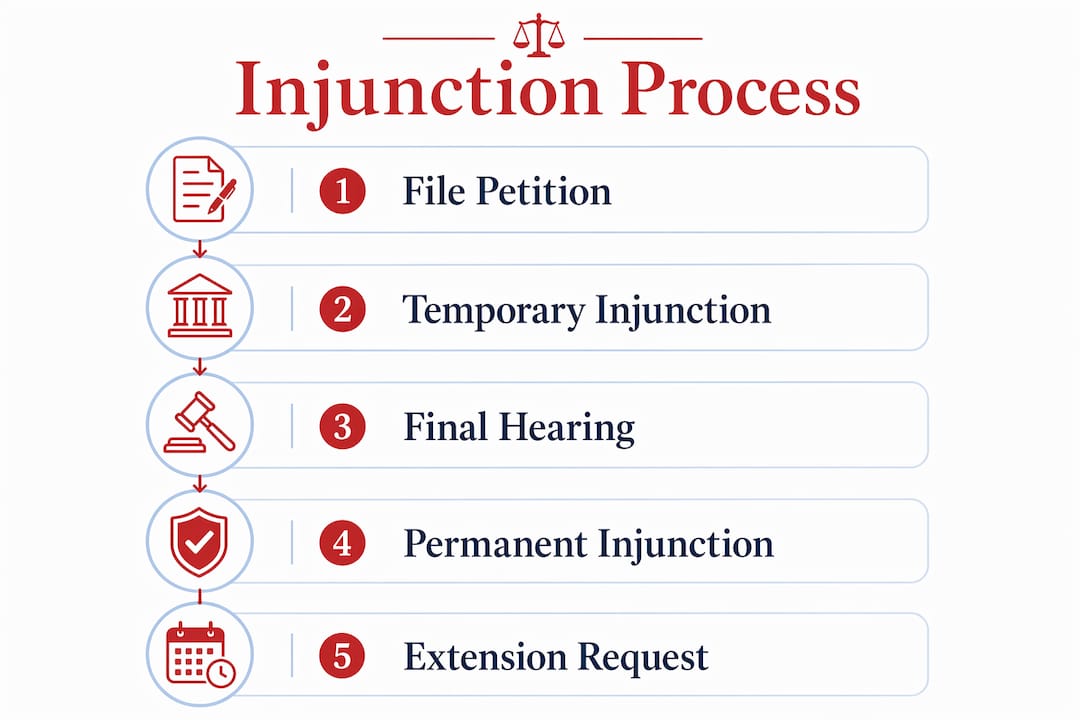
The filing process follows two distinct stages: the ex parte temporary injunction and the final hearing. Both are free to file. You pay no court fees for a domestic violence injunction petition.
Stage 1: Filing the petition
- Go to the clerk of court in the county where you live, where the abuser lives, or where the abuse occurred.
- Request the petition for injunction for protection against domestic violence. Free self-help forms are available at the clerk’s office and online through the Florida Courts website.
- Complete the petition in full. Describe specific incidents with dates, locations, and details. Vague statements weaken your case.
- Submit the petition to the clerk. A judge reviews it the same day or the next business day.
- If the judge finds sufficient grounds, they issue a temporary injunction without notifying the respondent first. This is called an ex parte order.
Stage 2: The final hearing
The temporary injunction lasts up to 15 days by statute. Within that window, the court schedules a final hearing where both parties appear and present their cases. The respondent receives notice of this hearing through law enforcement service of the temporary order.
| Stage | Timeline | Key Action |
|---|---|---|
| Petition filed | Day 1 | Clerk receives and forwards to judge |
| Temporary injunction | Same day or next business day | Judge reviews ex parte; order issued if grounds exist |
| Law enforcement service | Within days of issuance | Respondent served; order becomes enforceable |
| Final hearing | Within 15 days of temporary order | Both parties present evidence to judge |
| Final injunction | At hearing or shortly after | Judge issues permanent order or dismisses |
One procedural fact surprises many people: the respondent’s first notice of the entire proceeding often comes when law enforcement shows up at their door to serve the temporary order. Under that order, law enforcement can also require the respondent to leave a shared residence immediately. That is the law working as intended, prioritizing your safety before the respondent even knows a petition exists.
Pro Tip: Bring a trusted person with you to the clerk’s office. Filing the petition can be emotionally difficult, and having someone present helps you stay focused and complete the forms accurately.
What evidence supports a domestic violence injunction petition?
Strong evidence makes the difference between a temporary order that becomes permanent and one that gets dismissed at the final hearing. Courts look for credible, specific proof of abuse or imminent danger.
The most effective types of evidence include:
- Sworn affidavits: Your written, signed statement describing abuse in detail. Be specific about dates, locations, and what was said or done.
- Police reports: Any prior calls to law enforcement, even if no arrest was made, create an official record.
- Medical records: Documentation of injuries treated after incidents of abuse.
- Text messages and emails: Screenshots of threatening or controlling communications from the respondent.
- Photographs: Images of injuries, damaged property, or any physical evidence of violence.
- Witness statements: Statements from neighbors, family members, or coworkers who witnessed abuse or its aftermath.
Under Greyson’s Law, courts now accept evidence of coercive control patterns as grounds for protection. This means you can present a documented history of financial control, isolation tactics, surveillance, or repeated intimidation even without a single physical assault on record. Keep a written log with dates and descriptions of every controlling or threatening incident.
Successful permanent injunctions require consistent, credible sworn testimony supported by evidence showing ongoing danger or a pattern of abuse. A single isolated incident, without context or corroboration, is harder to sustain at the final hearing. That is why documentation over time matters so much.
Organize your evidence chronologically before the hearing. Label each item clearly. Courts respond better to petitioners who present their case in a clear, logical order rather than a disorganized collection of documents.
What protections does a domestic violence injunction provide?
A final injunction for protection against domestic violence carries real legal weight. The court can order the respondent to have no contact with you by any means, including phone, text, email, and social media. The respondent can be ordered to vacate a shared home even if their name is on the lease or mortgage.
The injunction can also address child custody considerations, restricting the respondent’s access to your children during the injunction period. Courts take the safety of children seriously in these proceedings, and a domestic violence injunction can directly influence temporary custody arrangements.
A final domestic violence injunction triggers mandatory firearm prohibitions for the respondent under both federal and Florida state law. The respondent must surrender any firearms they possess. This prohibition remains in effect for the duration of the injunction and carries serious legal consequences if violated.
Violating any term of a final injunction is a first-degree misdemeanor in Florida, punishable by up to one year in jail. Repeated violations or violations involving violence escalate to felony charges. Law enforcement is required to arrest a respondent who violates an active injunction.
Injunctions are not necessarily permanent. You can request an extension before the current order expires. You can also request a modification if circumstances change, such as the respondent moving closer to your home or making new threats. The family law process in Florida gives courts ongoing authority to adjust these orders as needed.
Key Takeaways
A domestic violence injunction in Florida is a two-stage legal process governed by §741.30, and filing correctly the first time is the fastest path to protection.
| Point | Details |
|---|---|
| Use the correct injunction type | Filing under the wrong category causes delays; domestic violence injunctions require a family or household relationship. |
| File at no cost | Florida charges no filing fees for domestic violence injunction petitions; free forms are available at the clerk’s office. |
| Document patterns, not just incidents | Greyson’s Law allows courts to consider coercive control, so a written log of controlling behavior strengthens your case. |
| Temporary orders act fast | A judge can issue a temporary injunction the same day you file, before the respondent is even notified. |
| Final injunctions carry serious consequences | Respondents face firearm prohibitions, no-contact orders, and potential arrest for any violation. |
What I’ve learned after years of handling these cases
After working with clients on domestic violence injunctions in Brevard County for many years, the pattern I see most often is this: people wait too long to file because they are not sure their situation “qualifies.” That hesitation costs them time and, in some cases, safety.
The law is broader than most people realize. Greyson’s Law changed the game for victims of psychological and coercive abuse. Courts are now equipped to recognize what abuse actually looks like in many relationships, not just the physical version. If you have been controlled, isolated, or threatened, you likely have grounds to file.
The second mistake I see is underestimating the final hearing. Many petitioners treat it as a formality after getting the temporary order. It is not. The respondent shows up with their own account of events, and sometimes with an attorney. Showing up unprepared, without organized evidence and a clear narrative, puts your permanent protection at risk.
The third thing I tell every client: the official term matters. Walking into a clerk’s office asking for a “restraining order” can create confusion. Ask specifically for a petition for injunction for protection against domestic violence under §741.30. That precision signals to court staff that you know what you need, and it gets you the right forms immediately.
Getting legal help is not a sign that your case is complicated. It is a sign that you take your safety seriously. The process has real procedural requirements, and meeting them correctly the first time is always better than correcting errors later.
— John
Jmoorelegal is ready to help you file and enforce your injunction
Facing a domestic violence situation is one of the most difficult legal and personal challenges anyone can experience. Jmoorelegal, the Law Office of John Vernon Moore, P.A., has served Brevard County families for decades with direct, personalized legal representation in exactly these situations.

The firm offers free initial consultations for individuals seeking family law protection, including injunction filing, final hearing preparation, and enforcement of existing orders. You speak directly with an attorney, not a paralegal or a call center. Whether you need help organizing your evidence, understanding what Greyson’s Law means for your case, or preparing for a final hearing, Jmoorelegal provides the guidance you need to move forward with confidence.
FAQ
What is a domestic violence injunction in Florida?
A domestic violence injunction is a court order under Florida Statute §741.30 that protects family or household members from abuse or imminent danger. It is the official legal term for what many people call a restraining order.
How long does a temporary injunction last?
A temporary injunction lasts up to 15 days by statute. Within that period, the court schedules a final hearing where both parties present their cases and a judge decides whether to issue a permanent order.
Does filing for an injunction cost money in Florida?
Filing a domestic violence injunction petition in Florida is free. No court fees apply, and self-help forms are available at no cost through the clerk of court or the Florida Courts website.
What does Greyson’s Law change about domestic violence injunctions?
Greyson’s Law, codified under §741.30(6)(b)10, directs Florida courts to consider coercive control and patterns of abusive behavior, not just physical violence, when evaluating injunction petitions. This gives victims of psychological and financial abuse stronger legal grounds for protection.
What happens if the respondent violates the injunction?
Violating a domestic violence injunction is a first-degree misdemeanor in Florida, and law enforcement is required to make an arrest. Repeated violations or violations involving violence can result in felony charges.
Recommended
- Domestic Violence – The Law Office of John Vernon Moore, P.A.
- Divorce Procedure in Florida: Complete Legal Guide – The Law Office of John Vernon Moore, P.A.
- Tips and Information on Military Divorces in Florida – The Law Office of John Vernon Moore, P.A.
- Understanding Alimony in Florida – The Law Office of John Vernon Moore, P.A.