Send a spoliation letter the moment you suspect a claim, not after you’ve hired an attorney. Written notice puts the other side on record, blocks routine deletion policies from becoming an excuse later, and gives a court something concrete if evidence vanishes anyway. Florida’s “reasonably foreseeable” standard rewards speed. Send it by certified mail with return receipt, keep every proof of delivery, and contact an attorney promptly.
TL;DR:
- Sending a preservation letter within days of suspecting a claim is crucial because evidence like dashcam footage can be overwritten quickly and deadlines for preservation are separate from statutes of limitations.
- A properly detailed letter should specify exact evidence, such as camera locations and time frames, and demand preservation of original electronic files with metadata intact to withstand later disputes.
- Proof of delivery, preferably via certified mail with a return receipt, is essential to establish the recipient’s awareness and enforceability and must be documented immediately.
- Evidence destruction must meet the three-prong test in Florida law, requiring proof that it existed, the party had a duty to preserve it, and it was critical to the case, or sanctions may not occur.
- If a preservation letter is ignored, escalating to subpoenas or emergency motions becomes necessary to legally compel compliance or prevent evidence loss.
Table of Contents
- What Is a Spoliation Letter Florida Courts Take Seriously?
- When Does the Duty to Preserve Evidence Kick In?
- Who Can Send a Preservation Notice, and Who’s Bound by It?
- What Should the Letter Actually Demand?
- How Do You Prove the Letter Was Actually Delivered?
- What Happens Under Florida Law If Evidence Disappears Anyway?
- What If the Letter Gets Ignored?
- Preservation Letter Checklist Before You Hit Send
- How Our Attorneys Handle Preservation in Real Florida Cases
- Why Most Spoliation Advice Skips the Part That Actually Matters
- How The Law Office of John Vernon Moore, P.A. Can Preserve Your Evidence Before It’s Gone
- Sources
What Is a Spoliation Letter Florida Courts Take Seriously?
A spoliation letter, also called a preservation letter or litigation hold notice, is a formal-written demand telling a person or business to stop destroying, altering, or losing materials tied to a potential Florida legal dispute. It does one job: it puts the recipient on notice. Courts weigh that notice heavily when deciding, months or years later, whether missing evidence should cost the other side.
What it does not do is force compliance. A letter carries no subpoena power and no court order behind it. It creates a paper trail and leverage, nothing more.
- Establishes notice, which anchors the timeline courts use when evaluating a spoliation claim
- Documents your diligence, showing you acted promptly rather than waiting until litigation was filed
- Creates leverage, since ignoring a documented request looks bad if the matter later reaches a judge
A preservation letter functions as a formal demand to stop destroying or altering materials relevant to a Florida dispute, and sending one early protects your ability to prove the case down the road.
When Does the Duty to Preserve Evidence Kick In?
Florida courts use a “reasonably foreseeable” standard: the duty to preserve arises once litigation becomes reasonably foreseeable, not necessarily once a lawsuit is filed. That threshold is fact-specific. A serious car crash with visible injuries and a police report on scene often crosses that line immediately. A minor slip with no reported injury might not, until a demand letter or claim surfaces.
- Send preservation notice as soon as you suspect a claim, ideally within days of the incident
- Don’t wait for a diagnosis, a settlement demand, or a lawyer to formally get involved
- Assume surveillance systems, dashcams, and telematics data overwrite on relatively short cycles
Timing confusion is common. Florida’s statute of limitations for negligence claims and your insurer’s notice deadline are separate clocks from the preservation duty. You can be well within your time to file suit while critical footage has already been overwritten. Waiting on either of those other deadlines before sending a preservation letter is one of the most costly mistakes an injured person can make.
Who Can Send a Preservation Notice, and Who’s Bound by It?
Anyone with a plausible claim can send a preservation letter. Whether the recipient has a legal duty to comply is a separate question, and it depends on their role and any independent obligation they already carry.
- A defendant or potential party in the case generally has the strongest duty once notice is reasonably foreseeable
- Businesses with regulatory recordkeeping duties (hospitals, trucking companies, common carriers) often must retain records regardless of your letter
- Private nonparties, like a neighbor with a doorbell camera, typically have no automatic legal obligation to preserve footage absent a statute or contract requiring it
The consequences track that distinction. If a party to the case destroys evidence after notice, the court handling that case can sanction them directly. If a nonparty destroys footage, your remedies are narrower, often limited to a separate claim or none at all, since the party spoliation sanctions covered under Florida Rule of Civil Procedure 1.380(e) apply within an active case rather than against outside custodians.
What Should the Letter Actually Demand?
A vague request gets a vague response, or none at all. An enforceable preservation letter needs three parts: a short summary of who you are and what happened, a specific list of items to preserve, and clear instructions covering electronic data and metadata, not just printed copies.
- State the incident plainly. Date, time, location, and a one or two sentence description of what occurred.
- List exact evidence categories. Surveillance footage by camera and time window, incident or accident reports, maintenance logs, employee schedules or rosters on shift, photographs, relevant emails and texts, and telematics or GPS data if a vehicle was involved.
- Demand native-format preservation. Ask that electronically stored information be preserved in its original file format with metadata intact, including timestamps, geolocation data, and email headers, and that any auto-deletion policy affecting these items be suspended immediately.
Pro Tip: Name the exact camera location and a tight time window, like “the rear parking lot camera between 2:00 PM and 4:00 PM on the incident date,” instead of asking for “all surveillance footage.” Specific requests are harder to dismiss as overbroad and easier to enforce later.
How Do You Prove the Letter Was Actually Delivered?
The date the other side received notice often decides whether a later sanctions motion succeeds. Delivery method and documentation matter as much as the letter’s content.
- Send by certified mail with return receipt requested; it’s the gold standard for proving delivery date
- Use a courier service with signature confirmation as a backup or alternative
- Follow up by email to the same recipient and preserve the full email headers, not just the visible text
- Keep the physical return receipt, the courier’s proof of delivery, screenshots of sent emails, and dated notes of any phone calls
Pro Tip: Scan and date every proof of delivery the same day you receive it. A folder with a certified mail receipt, a courier confirmation, and a saved email thread is far more persuasive to a judge than your recollection of “I sent it in March.”
What Happens Under Florida Law If Evidence Disappears Anyway?
Florida courts apply a specific three-prong test from Golden Yachts, Inc. v. Hall before awarding any spoliation remedy: the evidence must have existed, the party accused of destroying it must have had a duty to preserve it, and the evidence must have been critical to the other side’s case. Miss any one prong, and the sanctions motion fails.
For electronically stored information specifically, Florida Rule of Civil Procedure 1.380(e) sets up a two-tier framework:
- Tier one: if a party failed to take reasonable steps to preserve ESI and it’s now lost, the court can order curative measures no greater than necessary to fix the prejudice
- Tier two: if the court finds the party acted with intent to deprive the other side of the evidence, it can go further, up to an adverse inference instruction or outright dismissal
Courts don’t jump to the harshest remedy. A judge assesses prejudice only after confirming a diligent search was actually made for the missing evidence, then weighs whether it can be replaced through other means, whether bad faith is present, and how severely the loss actually hurts the case. An adverse-inference instruction is treated as strong medicine, reserved for situations where discovery has seriously gone wrong, not routine oversights.
What If the Letter Gets Ignored?
A preservation letter has no enforcement teeth on its own. When a custodian refuses to confirm compliance, evidence faces imminent deletion, or ESI is on a short overwrite cycle, escalation becomes necessary.
- File suit and issue a subpoena, which carries actual legal force a letter lacks.
- Seek an emergency motion or temporary restraining order if you can show irreparable harm and no other way to protect the evidence in time.
- Complete a meet-and-confer and, where required, a Rule 1.202 certificate before filing most discovery motions, documenting every attempt at voluntary compliance along the way.
Court relief carries a higher burden of proof than a letter, so build your record of good-faith outreach before you file.
Preservation Letter Checklist Before You Hit Send
Before sending, confirm the letter includes the incident date, a specific evidence list with precise time ranges (not “all records”), instructions to preserve native files and metadata, your delivery method, and a firm deadline for the recipient to confirm they’re complying.
- Skip vague, catch-all demands. They’re easier to ignore and harder to enforce
- Never request privileged material like internal attorney communications; it undermines the letter’s credibility
- After sending: save every delivery receipt, request written confirmation of preservation, and contact an attorney the same week
How Our Attorneys Handle Preservation in Real Florida Cases
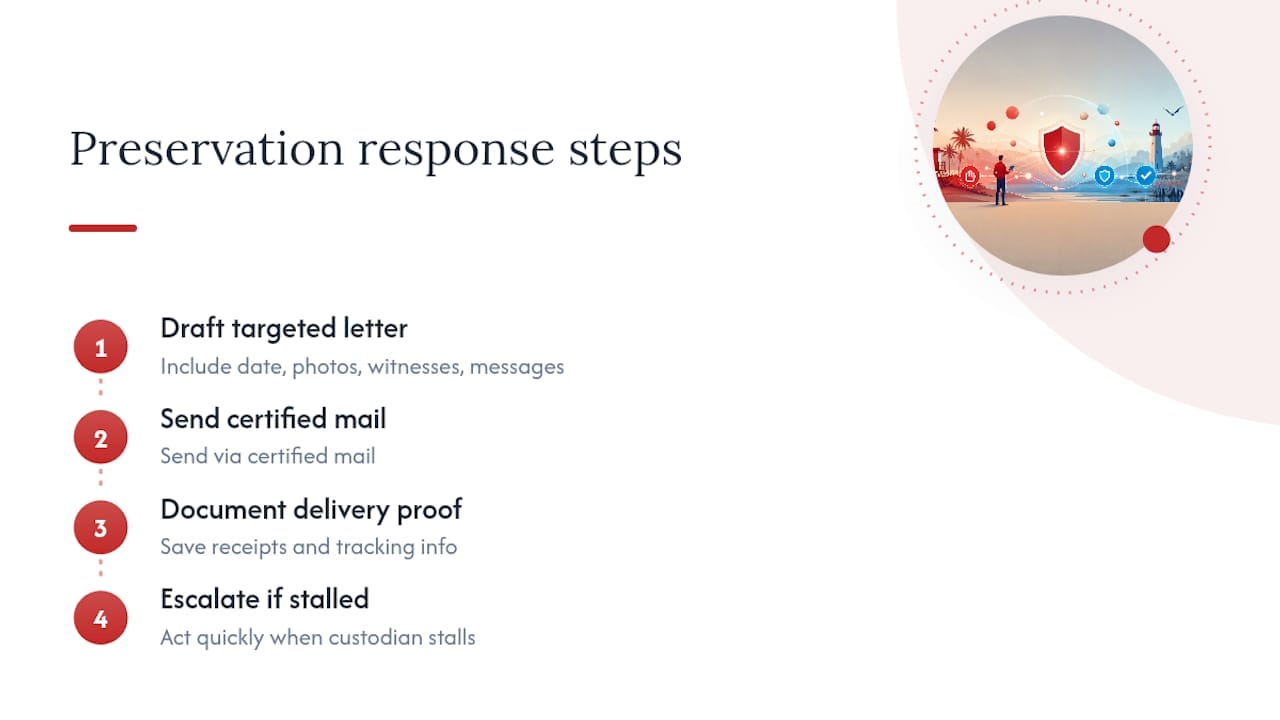
Our approach: draft a targeted letter, send it certified mail, document every proof of delivery, then escalate fast if a custodian stalls. Free consultations apply here too. Bring the incident date, photos, witness names, and any messages you’ve already exchanged.
Why Most Spoliation Advice Skips the Part That Actually Matters
Most articles on this topic spend their word count explaining what spoliation is and barely touch what happens after you send the letter. That’s backwards. The letter itself is the easy part. The proof of delivery, the specificity of your evidence list, and how fast you moved after the incident are what actually decide whether a judge grants sanctions two years from now.
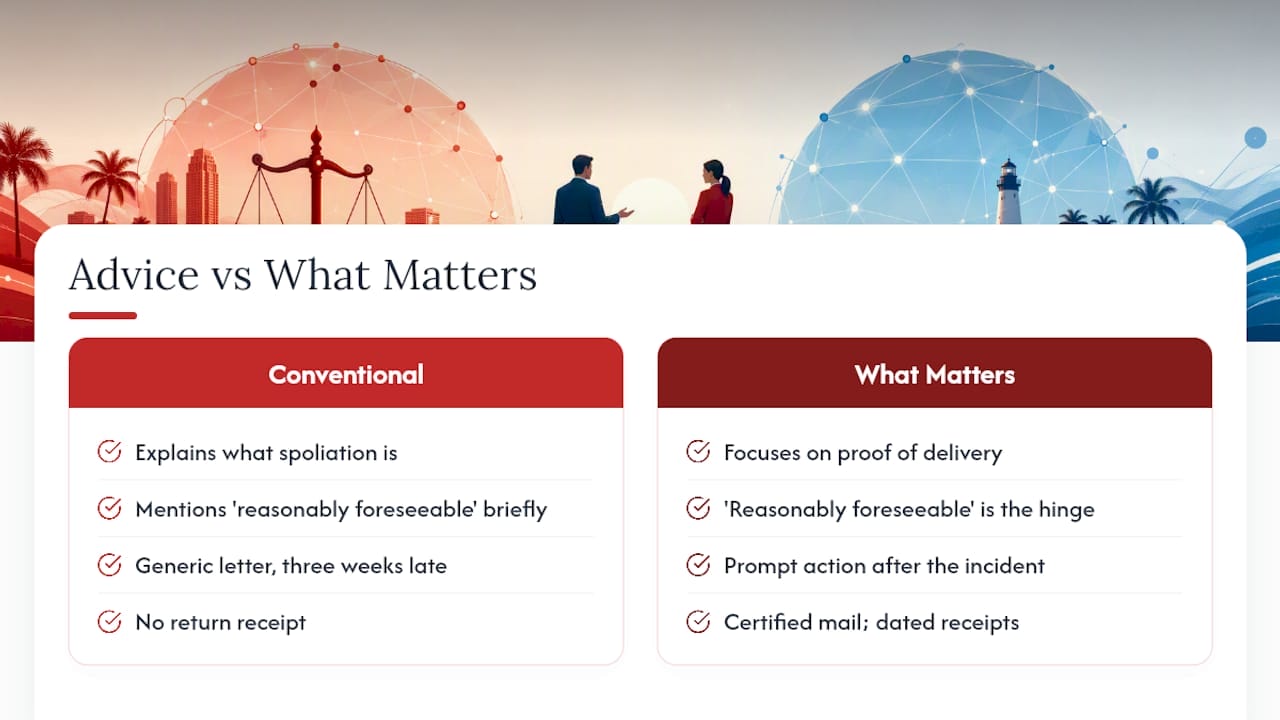
Here’s where conventional advice falls short: it treats the “reasonably foreseeable” standard as a formality to mention in passing, when it’s actually the hinge the whole case turns on. A generic letter sent three weeks late, with no return receipt and a vague request for “all footage,” gives a defense attorney every argument they need to say notice never really happened.
Prioritize the boring parts. Certified mail. A dated folder of receipts. Specific camera locations and time windows instead of blanket requests. None of that feels like the dramatic part of a legal claim, but it’s the difference between a spoliation motion that works and one that gets laughed out of a hearing.
— John
How The Law Office of John Vernon Moore, P.A. Can Preserve Your Evidence Before It’s Gone
Experienced attorneys draft and send targeted preservation letters promptly, not after a lawsuit is already underway. That speed matters more than almost anything else in a spoliation case. Our office handles the certified mail, tracks every return receipt, and, when a custodian stalls or evidence faces imminent deletion, moves straight into emergency motion work and coordinates with ESI specialists to recover what’s recoverable.

A letter alone won’t always be enough, and we tell clients that upfront rather than overselling it. Some cases need a follow-up subpoena or court order to force compliance, and we handle that escalation directly rather than leaving you to figure it out. If you were injured in Brevard County and worry that footage, logs, or records tied to your case are at risk right now, contact our personal injury team today for a free initial consultation and get a preservation letter moving before that evidence disappears.
This article is general information, not a substitute for advice from a qualified lawyer. Consult a qualified legal professional about your own circumstances before acting on anything here.
Sources
- How to Write a Preservation of Evidence Letter in Florida – LegalClarity
- Cool Change: Evolution and Explanation of New Florida Rule of Civil Procedure 1.380(e) – The Florida Bar
- Florida discovery handbook (Ninth Circuit) — Preservation and spoliation chapters