
Legal custody determines who makes major decisions about a child’s life — education, healthcare, religion. Physical custody determines where the child lives. Joint custody means both parents share one or both of those pillars; sole custody gives one parent the primary rights while the other typically retains visitation. U.S. courts apply the “best interests of the child” standard when choosing between arrangements, and modern courts generally prefer shared arrangements when parents can cooperate. Sole custody tends to come into play when safety concerns, severe conflict, or practical barriers make sharing unworkable.
Here is the short version of the trade-offs:
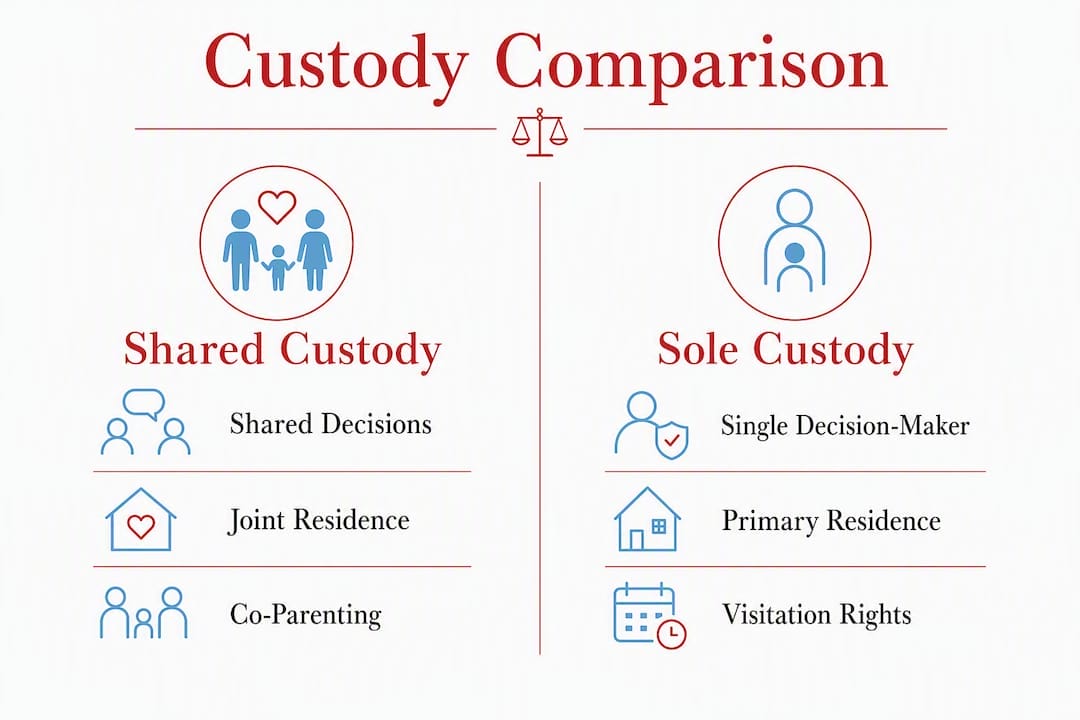
- Shared/joint custody keeps both parents actively involved and can support better outcomes for children, but it requires genuine cooperation and workable logistics.
- Sole custody provides clear decision-making authority and a stable routine, and it is the protective option when one parent poses a risk or the two cannot communicate at a basic level.
- Research published in Child & Youth Care Forum found that children in shared care showed good mental health at a rate of 79.8% compared to 67.9% for children in sole care — though the study notes that co-parenting quality shapes those outcomes significantly.
- Family law is state-based. Florida, for example, uses the term “time-sharing” rather than physical custody, and its courts apply 20 statutory factors when evaluating the child’s best interests.
Table of Contents
- What do “legal custody” and “physical custody” actually mean?
- How do U.S. courts decide between shared and sole custody?
- What are the real pros and cons of shared versus sole custody?
- When do courts actually award sole custody?
- What do typical parenting-time schedules look like?
- How do you request, defend, or modify custody?
- Key Takeaways
- Why the label on your custody order matters less than you think
- Jmoorelegal handles custody cases in Brevard County from parenting plan to final order
- Authoritative sources for further reading
What do “legal custody” and “physical custody” actually mean?
These two terms are the building blocks of every custody order, and mixing them up leads to real confusion when parents try to read a court order.
Legal custody is the authority to make major decisions: which school the child attends, which doctor treats them, what religion they are raised in, and whether they get mental-health services. A parent with sole legal custody makes those calls alone. With joint legal custody, both parents must consult each other and, ideally, agree before acting.
Physical custody (sometimes called “residential custody” or “time-sharing” in Florida) is simpler: it describes where the child sleeps and who handles day-to-day care. Joint physical custody means the child spends substantial time in both homes. Sole physical custody means the child lives primarily with one parent.
Courts can and regularly do split these two dimensions. The most common hybrid order is joint legal custody with sole physical custody: both parents share decision-making authority, but the child lives mainly with one parent and visits the other on a defined schedule. Courts may give one parent sole physical custody and both parents joint legal custody — and the label on the order tells you almost nothing until you read the parenting plan attached to it.
A few terms worth knowing:
- Parenting plan: — the written document that spells out schedules, exchange procedures, holiday splits, and dispute-resolution steps. This document does the real work.
Pro Tip: When you receive or review a custody order, skip straight to the parenting plan. Look for the decision-making clauses (who decides what, and whether consultation is required), the exchange instructions, and the dispute-resolution ladder. The label “joint” or “sole” at the top of the order matters far less than those specifics.
How do U.S. courts decide between shared and sole custody?
Courts do not flip a coin or default to mothers. Every state uses some version of the “best interests of the child” standard, which directs a judge to weigh a set of statutory or case-law factors and choose the arrangement most likely to serve the child’s welfare.
Typical factors courts evaluate include:
- The child’s age, developmental stage, and any special health or educational needs
- The quality of the relationship between the child and each parent
- Each parent’s fitness, including any history of domestic violence, substance abuse, or neglect
- The stability of each parent’s home environment and daily routine
- The child’s own preference, when the child is old enough to express a reasoned view
- The distance between the parents’ homes and the feasibility of frequent exchanges
- Each parent’s willingness to support the child’s relationship with the other parent
- Any prior custody arrangements and how well they worked
When parents cannot agree, courts often require mediation before scheduling a hearing. If mediation fails, a judge may order a custody evaluation conducted by a licensed mental-health professional who interviews both parents, the child, and sometimes teachers or other relevant parties. That evaluator’s report carries significant weight at trial. Joint custody is frequently the preferred outcome unless the factors above make it unsuitable.
State law shapes every step of this process. Florida courts, for instance, apply 20 specific statutory factors and use the term “shared parental responsibility” rather than joint legal custody. The presumption in Florida favors shared parental responsibility unless it would be detrimental to the child. Other states weight factors differently or carry different presumptions, which is why local counsel matters.

What are the real pros and cons of shared versus sole custody?
Each model has genuine trade-offs. Neither is universally better; the right fit depends on the specific family, the level of conflict, and the child’s needs.
Shared (joint) custody
Pros:
- The child maintains a meaningful relationship with both parents, which most child-development research supports.
- Children in shared care show higher rates of good mental health than those in sole care in multiple studies, when co-parenting cooperation is present.
- Both parents share the caregiving load, reducing burnout for either one.
- Major decisions benefit from two perspectives rather than one.
Cons:
- Frequent transitions between homes can be disruptive, especially for young children or those with anxiety.
- It requires a baseline level of communication and cooperation that high-conflict parents often cannot sustain.
- Logistics become complicated when parents live far apart or have incompatible work schedules.
- When cooperation breaks down, the benefits largely disappear. Research confirms that the success of joint custody depends heavily on co-parenting quality.
Sole custody
Pros:
- One parent holds clear decision-making authority, which eliminates deadlock on education, healthcare, and other major choices.
- A consistent daily routine in one home can provide stability, particularly for children who struggle with transitions.
- It is the protective option when one parent has a history of abuse, neglect, or substance misuse.
Cons:
- The child has less day-to-day contact with the non-custodial parent, which can affect that relationship over time.
- The custodial parent carries the full weight of daily caregiving, financially and emotionally.
- Without court oversight, a sole-custody parent may make decisions that disadvantage the other parent’s relationship with the child.
Comparison at a glance
| Dimension | Joint/Shared Custody | Sole Custody |
|---|---|---|
| Who makes major decisions | Both parents jointly | One parent alone |
| Where the child primarily lives | Both homes (substantial time in each) | One primary home |
| Typical parenting-time pattern | 50/50 or significant split (e.g., 60/40) | Defined visitation for non-custodial parent |
| When it is appropriate | Parents can cooperate; no safety concerns | Safety risk, high conflict, or impractical logistics |
| Impact on child well-being | Strong when co-parenting is cooperative | Stable routine; limits contact with one parent |
| Enforcement and modification | Both parents must comply with plan; modifications require showing changed circumstances | Same process; non-custodial parent may seek modification if circumstances change |
Pro Tip: Sole custody does NOT end the other parent’s parental rights. A non-custodial parent almost always retains the right to visitation — ranging from a flexible “reasonable” schedule to supervised visits. Total termination of parental rights is a separate legal process, requires clear and convincing evidence of serious harm, and is genuinely rare.
When do courts actually award sole custody?
Sole custody is generally awarded when shared parenting would endanger the child or is practically impossible given the circumstances.
Common triggers courts recognize:
- Substantiated domestic violence. In many states, a finding of domestic violence creates a rebuttable presumption against shared custody. A judge will weigh domestic violence findings and may include custody provisions directly in a restraining order.
- Child abuse or neglect, documented through CPS findings, medical records, or prior court orders.
- Severe substance abuse that impairs a parent’s ability to provide safe care.
- Persistent parental absence or inability to care for the child, such as incarceration or severe untreated mental illness.
- Parental kidnapping risk, particularly when one parent has threatened to remove the child from the jurisdiction.
- Chronic inability to co-parent, where the level of conflict is so high that any shared arrangement would expose the child to ongoing harm.
Courts look for documented evidence, not just allegations. Restraining orders, criminal convictions, CPS investigation reports, medical records, and prior supervised-visit requirements all carry weight. Allegations alone rarely move a judge; documentation does.
One important distinction: a court can award sole physical custody while maintaining joint legal custody, or vice versa. Sole custody does not automatically mean the other parent loses all say. And terminating parental rights entirely is a different legal process, one courts reserve for the most extreme circumstances.
What do typical parenting-time schedules look like?
Physical custody determines where the child lives; the parenting plan determines the schedule. Under joint physical custody, the split can range from a true 50/50 to a 60/40 or 70/30 arrangement. Sole physical custody typically pairs with a defined visitation schedule for the non-custodial parent.
Common shared custody schedules
- Alternating weeks (50/50): the child spends one full week with each parent, exchanging on a set day. Works well for school-age children when both parents live in the same school district.
- 2-2-3 rotation: the child spends two days with Parent A, two days with Parent B, then three days with Parent A, rotating the following week. Reduces the longest stretch away from either parent; popular for younger children.
- 4-3 split: four days with one parent, three with the other, repeating weekly. Gives one parent slightly more time while still maintaining substantial contact.
- Banked weekday time: one parent has the child during the school week; the other has every weekend plus one or two weekday evenings.
Common sole custody schedules with visitation
| Schedule Type | Typical Pattern | Best For |
|---|---|---|
| Every other weekend | Non-custodial parent: Fri–Sun, alternating | High-conflict cases; long distances |
| Every other weekend + midweek | Fri–Sun alternating + one weekday evening | School-age children; moderate distance |
| Extended summer | Non-custodial parent: 4–6 weeks in summer | Long-distance arrangements |
| Holiday splits | Alternating major holidays each year | All arrangements; reduces conflict |
Distance is the biggest practical constraint. A 50/50 schedule that requires a child to commute 45 minutes each way to school every other week is not workable. Courts and parenting plans account for school calendars, extracurricular commitments, and each parent’s work schedule. Florida’s time-sharing framework addresses these logistics directly and provides sample schedule language that parents can adapt.
How do you request, defend, or modify custody?
To get or change a custody arrangement, you file a petition or motion in family court and work through the court’s procedural ladder. Here is how that typically unfolds:
- Prepare your documents and a proposed parenting plan. Gather school records, communication logs, calendars showing your involvement, and any relevant evidence. Draft a parenting plan that addresses schedules, decision-making, exchanges, holidays, and dispute resolution. A structured custody agreement guide can help you identify what to include.
- File the petition or motion in the correct county. For initial custody orders, this is typically where the child has lived for the past six months. For modifications, it is usually the county that issued the original order.
- Serve the other parent. Proper service is a procedural requirement; failure to serve correctly can delay your case.
- Attend mandatory mediation or case-management conferences. Most Florida courts require mediation before a contested hearing. Attorney-led mediation can resolve many disputes without a trial, saving time and money.
- Participate in a custody evaluation if ordered. A court-appointed evaluator interviews both parents and the child, reviews records, and submits a report. This step adds time and cost but is common in contested cases.
- Attend hearings or trial. If mediation does not resolve the dispute, a judge hears evidence and issues a final order. Contested custody trials can take 6–12 months or longer from filing to resolution.
- Enforce or modify the order post-judgment. Violations can be addressed through a motion for contempt. Modifications require showing a substantial, material, and unanticipated change in circumstances since the last order.
Timeline and cost: Negotiated agreements can be finalized in weeks to a few months. Contested cases in Florida typically run 6–12+ months. Court filing fees vary by county; attorney fees depend on hourly rates and case complexity; custody evaluation fees add a separate cost. Jmoorelegal can provide specific estimates for Brevard County cases.
Pro Tip: Start documenting now, even before you file. A calendar showing your parenting time, a log of communications with the other parent, and copies of school and medical records are the three most useful pieces of evidence in any custody proceeding. Courts respond to patterns, and patterns require documentation.
Until a court order exists, both parents generally have equal rights to make decisions and spend time with the child — but that equal footing is not always enforceable without an order in place. Getting an order on record protects both parents.
Key Takeaways
Shared custody and sole custody are not binary opposites — they are combinations of legal and physical custody components that courts mix and match based on the child’s best interests and the family’s specific circumstances.
| Point | Details |
|---|---|
| Legal vs. physical custody | Legal custody controls decisions; physical custody controls residence. Both can be joint or sole. |
| Shared custody trade-offs | Promotes involvement and better child outcomes when co-parenting works; requires cooperation and practical logistics. |
| Sole custody triggers | Courts award sole custody when safety, severe conflict, or practical barriers make sharing harmful or impossible. |
| Research on child outcomes | Children in shared care showed good mental health at 79.8% vs. 67.9% in sole care, per Springer research, when co-parenting quality is adequate. |
| Jmoorelegal’s role | Jmoorelegal drafts parenting plans, represents clients in contested hearings, and handles modifications in Brevard County, Florida. |
Why the label on your custody order matters less than you think
Most parents walk into a custody dispute focused on winning “joint” or “sole” custody as if those words settle everything. They do not. A joint custody order with vague parenting-plan language will generate more post-divorce litigation than a well-drafted sole custody order with clear schedules, defined communication rules, and a step-by-step dispute-resolution process.
The cases that come back to court repeatedly are almost never about the label. They are about the gaps: who decides when the child needs therapy, what happens when one parent wants to relocate 50 miles away, how school pickup works when a parent is deployed. A parenting plan that addresses those specifics up front is worth more than any custody designation.
There is also a common misconception worth addressing directly. Many parents believe that fighting for sole custody is the way to protect their child from a difficult co-parent. Sometimes that is true. But in high-conflict cases where both parents are fit, courts often resist sole custody precisely because it tends to escalate the conflict rather than reduce it. A parenting coordinator or a structured communication protocol can do more practical good than a custody label change.
Military families face a layer of complexity that civilian cases do not: deployment can make a 50/50 schedule physically impossible, and custody orders need built-in modification language to handle that reality. Deployment-related custody modifications require specific statutory protections, and getting that language right before deployment orders arrive is far easier than litigating it after.
The most durable custody arrangements are the ones both parents actually follow. That usually means a plan they had some hand in shaping, through mediation or negotiation, rather than one a judge imposed after a contested trial. Courts know this, which is why mediation is required in most jurisdictions before a contested hearing. Use that process seriously.
Jmoorelegal handles custody cases in Brevard County from parenting plan to final order
Custody disputes are not just legal problems. They are logistical, emotional, and sometimes safety-related problems that need an attorney who understands the full picture. Jmoorelegal provides local, practical family-law representation for parents in Brevard County, Florida, covering parenting-plan drafting, contested custody hearings, mediation, and post-judgment modifications.

The firm’s work includes cases involving high-conflict co-parenting, narcissistic personality dynamics, and military families navigating deployment-related schedule changes. Mediation certification means the firm can represent you in mediation or serve as mediator, depending on what your case needs. Free initial consultations are available, so you can get a clear picture of your options before committing to a course of action.
If you are facing a custody dispute or need to modify an existing order in Brevard County, contact The Law Office of John Vernon Moore, P.A. to schedule your consultation. For military families at Patrick Space Force Base or elsewhere in Brevard, the firm’s military family law services address the specific custody and support issues that come with service.
This article is general legal information, not legal advice. Custody law varies by state and by the specific facts of your case. Consult a qualified family-law attorney for guidance on your situation.
Authoritative sources for further reading
- Custody: Definitions and Court Overview | WomensLaw — practical guide to custody types, hybrid orders, and domestic violence considerations.
- Custody and Parenting Time | Michigan Legal Help — explains visitation rights, parenting-time schedules, and what happens without a court order.
- Child Custody and Parenting Time | California Courts Self Help — state self-help resource covering parenting-plan content and procedural basics.
- Child Custody | North Carolina Judicial Branch — plain-language explanation of legal and physical custody distinctions from a state court.
Family law is state-based. The sources above provide general U.S. guidance, but statutes, presumptions, and procedures differ by state. For Florida-specific rules and Brevard County filing requirements, consult a local family-law attorney.