A no-contact order in Florida is a criminal court condition that bars any contact with a named person, enforceable immediately under Fla. Stat. § 903.047. Violating it can trigger arrest, bond revocation, or new criminal charges before your original case even goes to trial. It’s separate from a civil injunction, sometimes called a Florida restraining order, which follows its own rules and timeline covered below.
TL;DR:
- Violating a no-contact order can result in immediate arrest, bond revocation, or new criminal charges, often before the original case concludes.
- Contact includes calls, texts, social media interactions, indirect messages through third parties, and physical proximity within 500 feet, which prosecutors actively enforce.
- No-contact orders usually last only until the criminal case is resolved unless incorporated into probation or combined with a civil injunction.
- Civil injunctions are separate from criminal orders, can last years, and remain enforceable even if the criminal case drops; both can coexist with distinct breach penalties.
- Only a court can modify or lift a no-contact order, and attempting to rely on informal communication or victim’s permission does not legally alter the order’s enforceability.
Table of Contents
- No Contact Order Florida Basics: Statute, Duration, and When Courts Issue One
- No Contact Order vs Florida Restraining Order: The Difference That Trips People Up
- What Actually Counts as Contact (And the Mistakes That Get People Arrested)
- Penalties for Violating a No Contact Order in Florida
- How to Modify or Lift a No Contact Order in Florida
- Does a Florida No-Contact Order Follow You to Another State?
- Accused of Violating a No Contact Order? Do This First
- Why Trust This Guidance on Florida No-Contact Orders
- What Most Advice on This Topic Gets Backwards
- Get Help With a No-Contact Order or Injunction in Brevard County
- Sources
No Contact Order Florida Basics: Statute, Duration, and When Courts Issue One
Judges impose no-contact conditions under Fla. Stat. § 903.047 as part of pretrial release or, later, as a probation term. It’s a tool for controlling risk while a criminal case moves through the system, not a punishment handed down after conviction.
You’ll typically see this condition attached at a first-appearance or bond hearing following:
- A domestic violence arrest, even a first-time allegation with no prior record
- Assault or battery charges involving a specific victim
- Stalking or cyberstalking accusations
- Sexual offense charges where the alleged victim needs protection during prosecution
The order generally lasts as long as the criminal case is open. Once the case resolves through dismissal, plea, or trial, the no-contact condition usually ends unless the judge folds it into a probation sentence or the alleged victim separately petitions for a civil injunction that outlives the criminal matter.
No Contact Order vs Florida Restraining Order: The Difference That Trips People Up
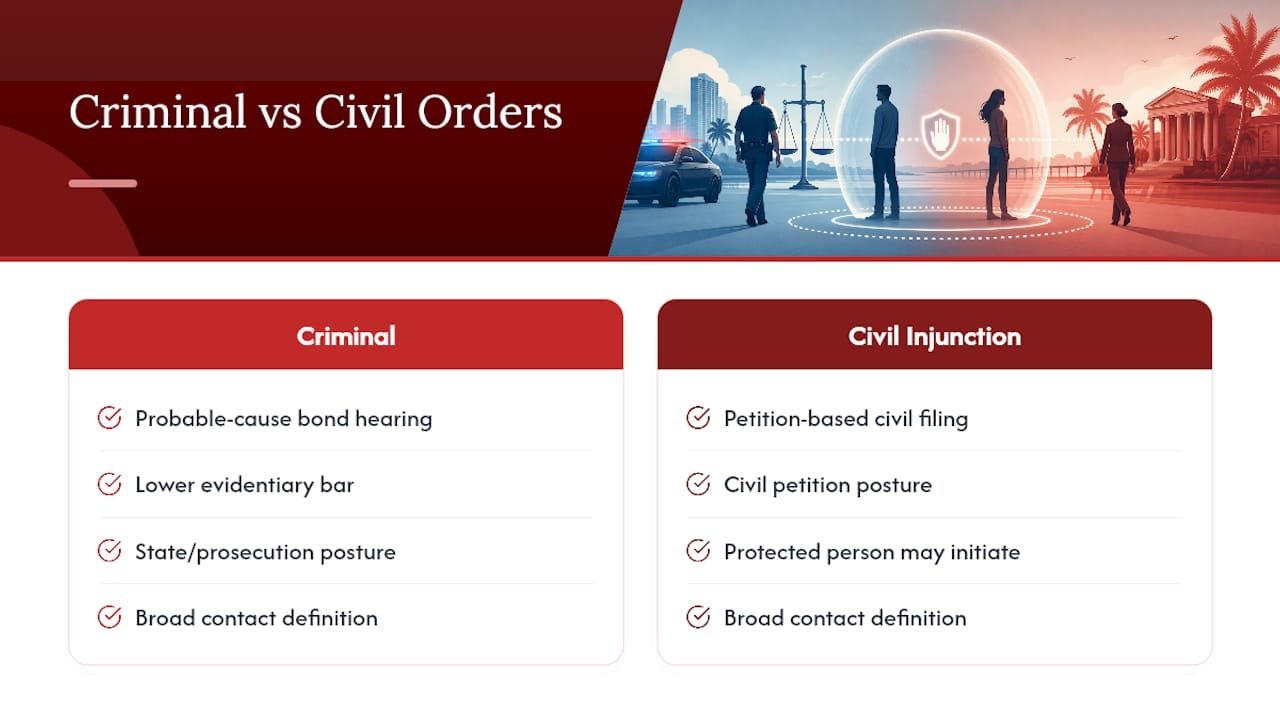
These two things get confused constantly, and the confusion causes real damage. A no-contact order comes from a criminal case and a criminal judge. A civil injunction, what most people mean when they say “restraining order,” is a separate lawsuit the alleged victim files through the clerk of court, independent of any criminal charges.
Florida recognizes five distinct injunction categories:
- Domestic violence injunctions under § 741.30
- Repeat violence injunctions under § 784.046
- Dating violence injunctions under § 784.046
- Sexual violence injunctions under § 784.046
- Stalking and cyberstalking injunctions under § 784.0485
Civil injunctions can last months or years, can address custody and temporary residence, and survive even if the criminal case gets dropped. Both orders can exist on you at once, each with its own violation penalties.
Pro Tip: If you’re facing both a criminal no-contact condition and a civil injunction petition, treat them as two separate legal fights requiring two separate strategies. Winning one doesn’t touch the other.
What Actually Counts as Contact (And the Mistakes That Get People Arrested)
Florida courts and prosecutors interpret “no contact” broadly, and that’s where good people end up back in handcuffs over something that felt harmless at the time.
- Direct communication — calls, texts, emails, direct messages on any platform, even a “just checking you’re okay” text counts.
- Indirect contact through third parties — asking a mutual friend, relative, or coworker to relay a message is treated the same as contacting the person yourself.
- Social media activity — liking a photo, commenting, or even viewing a story on some platforms has been used as evidence of contact in Florida cases, according to practical guidance on how these orders play out.
- Physical proximity — the statute’s actual language prohibits going within a 500-foot distance of the protected person’s home, vehicle, or workplace, regardless of intent.
- Deliveries and gifts — sending flowers, packages, or having someone else drop something off still qualifies as contact.
Prosecutors don’t need a confession to prove a violation. They build cases from phone records, text and app message logs, GPS location data, security camera or doorbell footage, and statements from whoever witnessed the contact. A single screenshot forwarded by a mutual friend has been enough to support an arrest warrant in cases across Florida.
One carve-out matters here: the statute allows communication through an attorney. If you need to reach the protected person for a legitimate reason, your lawyer is the channel, never a text from your own phone.
Penalties for Violating a No Contact Order in Florida
Breaking a no-contact condition doesn’t wait for a hearing. It can put you back in jail the same day, often before you’ve had any chance to explain.
Here’s what typically happens:
- Immediate arrest, either from a warrant or a responding officer’s on-scene finding of probable cause
- Bond revocation on your original charge, meaning you lose pretrial release entirely
- Probation or community control revocation if the condition was tied to a sentence rather than pretrial release; see details on probation modification and early termination for comparative context.
- New criminal charges for the violation itself, commonly filed as a first-degree misdemeanor commonly punishable by jail time and fines
The typical sequence runs: someone reports contact, law enforcement investigates or arrests on the spot, you go before a judge at first appearance, and the judge decides whether to detain you, set new bond conditions, or add stricter restrictions. Defense attorneys frequently challenge these cases on service and notice issues (did the defendant actually know the order existed and its exact terms), mistaken identity, or lack of intent to violate.
How to Modify or Lift a No Contact Order in Florida
Only the court can change a no-contact condition. Your attorney files a motion, the state attorney’s office gets notice, and a judge decides based on safety, the case’s posture, and how the underlying charge is progressing.
- Your defense attorney files a written motion requesting modification, specifying exactly what change you want.
- The court schedules a hearing, giving the alleged victim and prosecutor a chance to weigh in.
- The judge evaluates specific requests, which commonly include allowing communication solely about shared children, permitting a single supervised property-retrieval visit with law enforcement present, or downgrading a full no-contact order to a “no violent contact” standard.
One point defense attorneys stress constantly: a private agreement with the protected person changes nothing legally. If she or he texts you first and says it’s fine, that doesn’t erase the order, and prosecutors have charged violations even when the alleged victim initiated contact. Judges are also aware that no-contact conditions get imposed on probable cause at a bond hearing, a lower bar than trial, so they tend to be cautious about lifting them early even when the protected person requests it themselves.
Pro Tip: Never rely on a text message, voicemail, or verbal “okay” from the protected person as legal cover. Get the change in writing from the judge, or assume the order still fully applies.
Does a Florida No-Contact Order Follow You to Another State?
Federal law backs enforcement of valid protection orders across state lines. Under the Violence Against Women Act’s full faith and credit provisions, a properly issued Florida order generally remains enforceable if you move to or travel through another state.
- Register the order with the new state’s court or law enforcement agency if you relocate, even though many jurisdictions will enforce an unregistered order on request
- Carry a certified copy of the order any time you cross state lines
- Understand that enforcement mechanics (how quickly local police respond, what proof they require) vary by state even though the underlying legal obligation doesn’t
On timelines: temporary civil injunctions in Florida can issue the same day a petition is filed and typically last up to 15 days pending a full hearing. Other specific day counts mentioned in some online forums are not supported by standard statutory timelines and should not be relied on for planning.
Accused of Violating a No Contact Order? Do This First
Panic leads to bad decisions here. A clear plan in the first hours after an accusation protects your rights and your case.
- Stop all contact immediately, including through third parties and social media, even if you believe the accusation is false or exaggerated.
- Say nothing to police without counsel present. Anything you say to explain yourself can become evidence used against you.
- Preserve your own records — location data, timestamps, call logs, anything showing where you actually were and what you actually did.
- Call a no contact order attorney before your first appearance, not after.
Once retained, your lawyer investigates whether you were properly served and had actual notice of the order’s exact terms, whether the order’s language is ambiguous about what counts as prohibited contact, whether this is a mistaken-identity situation, and whether an exception (like child-related communication) actually applied to your situation. From there, counsel can move fast: filing motions to challenge the violation, requesting an emergency hearing, gathering exculpatory evidence, and negotiating release conditions before you lose more time in custody than the underlying charge would ever justify.
Pro Tip: Document everything the moment you’re accused, not weeks later when memories and phone records get harder to pull. A timestamped note of your location matters more than you’d think.
Why Trust This Guidance on Florida No-Contact Orders
The Law Office of John Vernon Moore, P.A. brings 85 years of combined legal experience to family law and criminal defense matters across Brevard County, including cases where no-contact conditions and civil injunctions overlap. John Moore holds mediation certification, which shapes how the firm approaches modification requests and negotiated outcomes rather than defaulting straight to contested hearings.
Before a consultation, gather what you have:
- A copy of the order or arrest paperwork, if you have one
- A timeline of key dates: arrest, bond hearing, any alleged contact
- Any messages, call logs, or documents relevant to the accusation
A free initial consultation gives the firm a chance to review your specific situation and outline realistic next steps.
What Most Advice on This Topic Gets Backwards
Most articles on no-contact orders treat the criminal condition and the civil injunction as interchangeable, and that’s the single biggest source of bad decisions I see. People assume that because the alleged victim didn’t show up to court, or texted them first, the order somehow lifted itself. It didn’t. Courts impose these conditions on probable cause at a bond hearing, a far lower bar than trial, which is exactly why judges are slow to unwind them even when the protected person wants contact restored.
The conventional advice, “just don’t contact them,” is technically correct and practically incomplete. It skips the part where a forwarded text from a mutual friend, a liked Instagram post, or driving past a shared workplace can count as contact. Readers need to hear that the standard is broader than common sense suggests.
If you take one thing from this guide, prioritize documentation over persuasion. Don’t try to explain your way out of an accusation to police. Get a lawyer, preserve your records, and let the paperwork do the talking. That approach protects you whether you’re the one accused or the one seeking protection.
— John
Get Help With a No-Contact Order or Injunction in Brevard County
Facing a no-contact order violation or navigating a civil injunction isn’t something to handle alone, and generic legal advice online won’t account for your specific case file, judge, or charging decisions. The firm offers direct attorney access from the first call, backed by extensive family law and criminal defense experience and mediation-certified negotiation when a modification is realistic.
If you’re facing a criminal no-contact violation, the firm’s criminal law practice team evaluates your charges, service issues, and bond status right away. If you’re dealing with a civil injunction, whether filing for protection or defending against a petition, the family law practice group handles filings, hearings, and modification requests, including cases involving military families or high-conflict co-parenting situations. Bring a written timeline to your initial consultation, and the firm will explain what happens next in your case.
Sources
Readers who want to verify statute text directly can review Fla. Stat. § 903.047 on the Online Sunshine statute database and the Florida Courts petitioner overview on domestic violence injunctions for procedural steps. Local clerk of court offices, including the Polk County Clerk’s injunction guidance, typically post intake forms and instructions specific to that county, so check your own county clerk’s site for the exact petition forms you’ll need.
This article is general information, not a substitute for advice from a qualified lawyer. Consult a qualified legal professional about your own circumstances before acting on anything here.
- Florida Statutes § 903.047 (2023) — Conditions of pretrial release
- Florida Statutes (index) — Section 903.047 penalties and conditions
- Florida statutes (Chapter 784) — Assault; Battery; Criminal Mischief; Sexual Battery; Stalking (2024)
- LegalClarity — No contact order in Florida: how it works and what to expect (2026)