If the estate left behind more than the current statutory threshold in nonexempt assets, or the person died within the last two years, formal administration is likely the required path under Florida Statutes Chapter 733. The process runs in three phases: opening the case with the court, administering the estate through notices and claims, and closing it with a final accounting and distribution. Two deadlines matter from day one: a 3-month window to object to a will and a 4-month creditor claims period.
TL;DR:
- Estates with assets exceeding the statutory threshold or involving recent deaths typically require formal administration, which takes about six months to a year.
- Filing a complete petition, original death certificate, and properly completing notices and proof-of-service forms are critical to avoiding rejection delays.
- The three-month objection window and four-month creditor claims period originate from the date of notice service and first publication, respectively, with claims due within one year.
- Personal representatives must follow a strict payment order and seek legal advice before paying claims that could threaten estate solvency or lead to personal liability.
- Closing requires a final inventory, accounting, and order from the court, with diligent use of checklists reducing the risk of filing rejections or oversights.
Table of Contents
- Quick opening checklist: documents and filings to open a formal administration
- Timeline: month-by-month expectations for formal administration
- Notices, creditors, and statutory deadlines you cannot miss
- Personal representative duties and the statutory order of payment
- Closing the estate: inventory, final accounting, and obtaining discharge
- How to use county checklists and avoid common filing rejections
- Attorney perspective: when hiring counsel helps and what to expect in a consult
- What the checklists and deadlines actually mean for your estate
- How our firm can help with formal administration
- FAQ
- Sources
Quick opening checklist: documents and filings to open a formal administration
Before you file anything, gather the paperwork the clerk and the judge will expect to see together, not piecemeal. Florida courts are strict about completeness, and a missing signature or an unattached death certificate can send a filing back to the bottom of the queue.
- File a Petition for Administration that meets Florida Probate Rule 5.200, including venue, beneficiary information, and a signed verification.
- Submit the original death certificate with the clerk, along with certified copies if the court or any institution requests them.
- Prepare proposed orders and Letters of Administration, plus any required proof-of-service forms.
- Complete the oath of personal representative and, where applicable, a designation and acceptance of resident agent under Rule 5.320.
- Determine whether a bond is required, since a will can waive it or beneficiaries can consent to a waiver; otherwise file a petition to set the bond amount.
- Attach a completed county checklist to your filing packet to avoid rejection in the court’s ePortal system.
Timeline: month-by-month expectations for formal administration
Formal administration rarely wraps up in a matter of weeks. Most straightforward estates take roughly six months to a year, and that window stretches further when real property, contested claims, or ancillary proceedings in another state get involved.
- Month 0 to 1: File the petition, receive letters of administration from the clerk, and serve the notice of administration on interested parties.
- Months 1 to 3: Gather and value estate assets, prepare the inventory, and begin publishing notice to creditors in a county newspaper.
- Month 3: The 3-month window to object to the will, venue, or jurisdiction closes for anyone who received proper service.
- Months 3 to 6: The 4-month creditor claims period runs its course, and the 5-month protective period shields the personal representative from being compelled to pay debts early.
- Months 6 to 12 and beyond: Resolve any disputed claims, file the final accounting, and petition for discharge once remaining assets are ready for distribution.
One personal representative must pay all valid claims within 1 year of the first publication date, a deadline that anchors nearly every other step in the timeline. Estates that involve a contested will, a home sale, or assets held in another state commonly add several months to this schedule; see this guide on how to sell an inherited house in Miami during probate. Ordering appraisals early and serving known creditors directly, rather than relying only on publication, tends to shave real time off the back half of the process.
Notices, creditors, and statutory deadlines you cannot miss
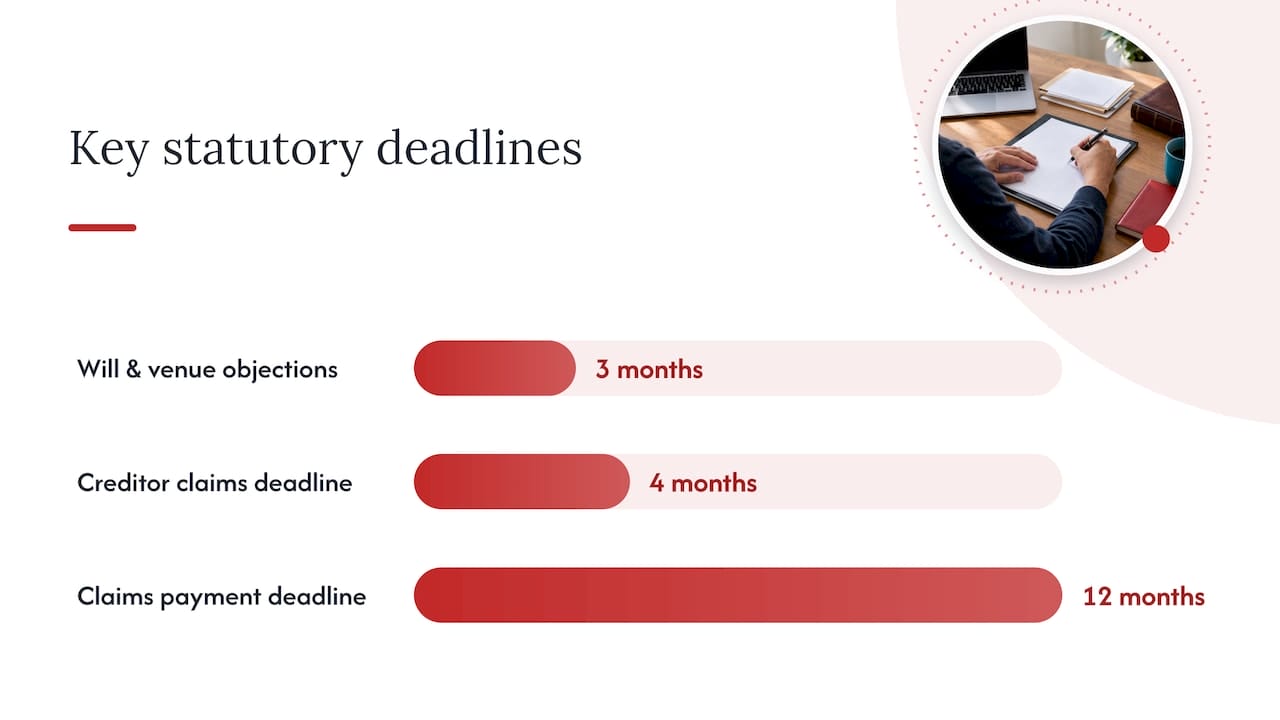
Two notices drive the entire schedule. The notice of administration, required under section 733.212, must be formally served on beneficiaries and other interested parties, and it starts the 3-month clock for objecting to the will, venue, or the court’s jurisdiction. Missing that window generally bars an objection outright, with only narrow exceptions for estoppel.
The notice to creditors, governed by section 733.2121, must run once a week for two consecutive weeks in a county newspaper, and the date of first publication starts the 4-month claims clock.
- Will and venue objections: barred 3 months after service of the notice of administration.
- Creditor claims: generally barred four months after the date of first publication.
- Protective period: the personal representative cannot be compelled to pay debts for several months after first publication.
- Claims payment deadline: claims must generally be paid within 1 year of first publication.
A diligent search for known creditors matters as much as publishing the notice: serving a creditor the personal representative actually knew about protects against claims surfacing well after the estate closes.
Personal representative duties and the statutory order of payment
A personal representative’s core job is to inventory assets, preserve estate property, account for every transaction, and distribute what remains according to the will or Florida’s intestacy rules. Section 733.707 sets a strict payment order, running from Class 1 (administration costs and attorney fees) down through Class 8 obligations.
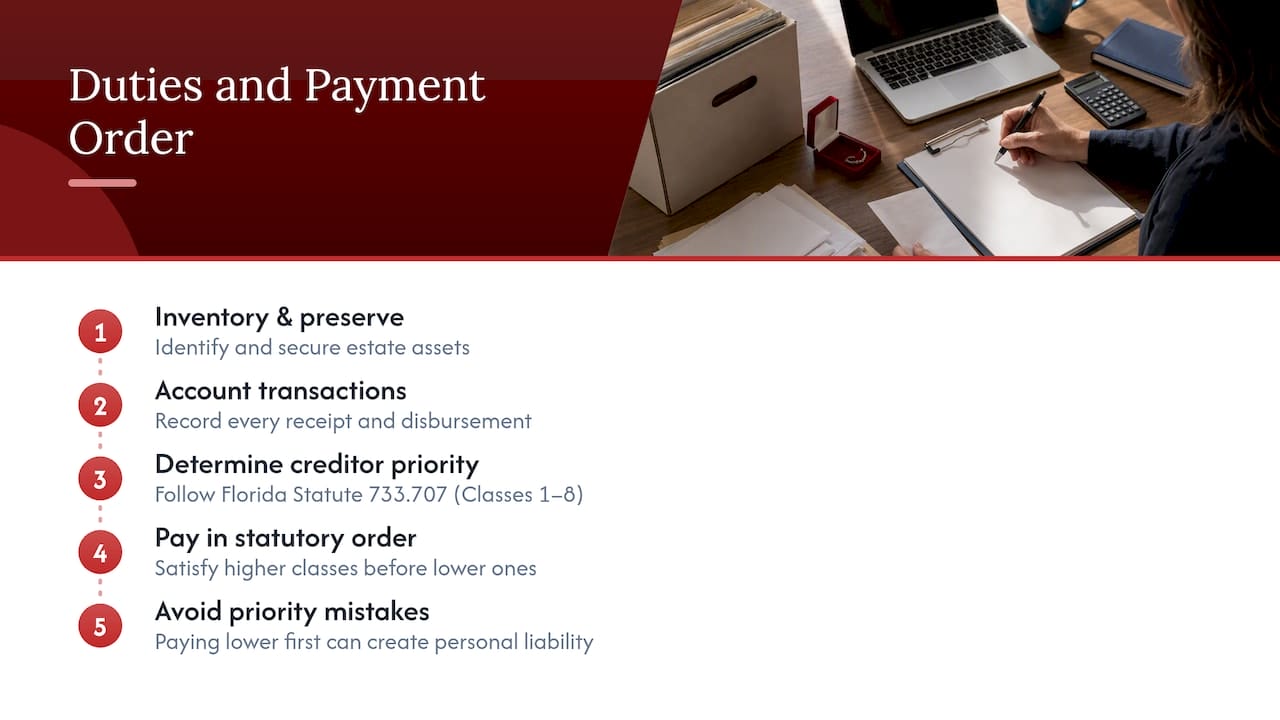
Paying a lower-priority claim before a higher one can create personal liability for the representative if the estate later turns out to be insolvent.
Pro Tip: Talk to an attorney before making any significant distribution or paying a creditor claim if you are not certain the estate has enough assets to cover everything above it in priority.
Closing the estate: inventory, final accounting, and obtaining discharge
Closing formal administration requires its own paper trail, separate from the documents used to open the case.
- File a verified inventory under section 733.604, including appraisals for any asset whose value is not obvious from a statement or receipt.
- Prepare and file the final accounting, along with a petition for discharge and proposed closing orders.
- Cross-check your filings against a county closing checklist before submitting anything, since judges expect every docket item addressed in order.
- Expect the court to review the accounting and petition before issuing a final discharge order that releases the personal representative and authorizes the last distributions.
How to use county checklists and avoid common filing rejections
Every Florida probate division publishes its own opening and closing checklists as PDFs, and the South County checklist is a useful model for what clerks expect statewide. Pull the current version directly from the clerk’s own site, since copies circulating elsewhere can be outdated.
- Missing dates on the petition or oath are among the most common reasons clerks bounce a filing.
- An unsigned attorney certification or a missing original death certificate will also trigger a rejection.
- Incomplete proof-of-service entries are an easy, avoidable mistake that delays the 3-month and 4-month clocks.
- Bundle your proposed orders with the completed checklist in the ePortal submission when the court requires it, and bring that same checklist to your first attorney meeting to speed things along.
Attorney perspective: when hiring counsel helps and what to expect in a consult
Formal administration tends to call for counsel when a will is contested, the estate is large, real property needs to be sold, or a creditor dispute looks likely. We draw on extensive experience and mediation certification to guide families through exactly these situations. Bring the death certificate, any will, and a rough asset list to your first meeting.
What the checklists and deadlines actually mean for your estate
The statutory deadlines get most of the attention, but the real risk in formal administration is usually sequencing, not timing. Families who pay a sympathetic creditor’s bill in month two, before the inventory is complete, often find themselves exposed later if the estate turns out tighter than expected. The checklists exist precisely because courts have seen that mistake often enough to build a form around it.
Conventional advice tends to frame formal administration as a paperwork problem: file the right documents in the right order and the estate closes itself. That undersells how much judgment is involved in deciding what counts as a diligent creditor search, when a bond waiver is actually safe to rely on, and how to value an asset the inventory form does not have a clean box for. Readers who treat the checklist as the finish line, rather than the floor, tend to do better.
If you take one thing from this process, let it be this: resolve the question of estate solvency before you resolve anything else. Everything downstream, from which creditors get paid first to how fast you can close, depends on getting that answer right early.
— John
How our firm can help with formal administration
We handle the petitions, notices, creditor management, inventories, accounting, and court submissions that formal administration requires, so you are not learning Florida probate procedure while grieving a loss.

If you would like a hand with filings or just want a second opinion on where your estate stands, our probate and trust administration team offers a free initial consultation. Bring your checklist and petition materials and we will walk through next steps together.
This article is general information, not a substitute for advice from a qualified lawyer. Consult a qualified legal professional about your own circumstances before acting on anything here.
FAQ
How long does a formal administration take in Florida?
Most formal administrations take roughly six months to a year from filing to final discharge, though contested wills, real property sales, or disputed claims can extend that well past 12 months. The 1-year claims payment deadline sets a practical floor for how quickly most estates can close.
What are the requirements for formal administration in Florida?
Formal administration generally applies when the estate’s nonexempt assets exceed the summary administration threshold or the decedent died within the last two years, under Florida Statutes Chapter 733. It requires filing a petition, obtaining letters of administration, publishing notice to creditors, and eventually filing a final accounting before the court will discharge the personal representative.
What is the 7 year rule in Florida?
Florida probate law does not have a statutory deadline tied to formal administration that lasts several years, instead the governing time limits run on the 3-month will objection window and the 4-month to 1-year creditor claim periods set out in Chapter 733. Readers who have seen a longer time frame mentioned may be thinking of unrelated record-retention or tax rules rather than probate procedure.
Who owns a home during probate?
During formal administration, legal title to a home generally passes to the beneficiaries or heirs at the moment of death, subject to the personal representative’s authority to manage or sell the property as needed to settle the estate. The personal representative does not personally own the home but holds administrative control over it until the estate closes.
Sources
- Chapter 733 PROBATE CODE: ADMINISTRATION OF ESTATES – 2025 Florida Statutes – The Florida Senate
- South County Probate Division checklist: opening formal administration (testate) – Judicial 12 PDF