

Yes, the SCRA lets covered service members pause divorce-related court proceedings and shields them from certain default judgments, but it does not change state rules on property, support, or custody. A covered service member can request an automatic 90-day stay of proceedings and can prevent or reopen default judgments entered without proper notice. It also offers limited financial and housing protections, but it is not a substitute for state divorce law. The best move is to file for a stay promptly, loop in a commanding officer, and talk to a lawyer before deadlines pass.
TL;DR:
- The SCRA grants a 90-day automatic stay of divorce proceedings and protects against default judgments if military duty interferes, but it does not affect property division, support, or custody laws.
- Service members can reopen default judgments within 90 days after leaving active duty if their military service impacted their ability to defend the case and they have a meritorious defense.
- The law limits interest rates to 6 percent on pre-service debts and provides housing protections like lease termination and foreclosure safeguards, but only on recognized obligations.
- Requesting a stay requires prompt action, including submitting affidavits from commanding officers and documentation of military duty, ideally before a default judgment occurs.
- Consulting a military divorce attorney early is crucial if custody disputes or default risks exist, as the law protects procedural fairness but not case outcomes.
Table of Contents
- What is the Servicemembers Civil Relief Act?
- How the SCRA protects service members during divorce
- Financial and housing protections that matter in divorce
- How to request a stay under the SCRA
- What to weigh before requesting a stay
- When to bring in a military divorce attorney
- Statutes and resources worth bookmarking
- A straightforward take on what SCRA can and cannot do
- How our firm helps with SCRA stays and military divorce
- Sources
- FAQ
What is the Servicemembers Civil Relief Act?
The Servicemembers Civil Relief Act is a federal law, the modern version of the old Soldiers’ and Sailors’ Civil Relief Act, built to protect people on active duty from legal and financial harm while they serve. It does not create new grounds for divorce or override a state’s family law. It buys time and prevents courts from punishing someone for being unavailable because of military duty.
Coverage extends to active-duty members, certain federally activated Reservists and National Guard members, and specified commissioned officers, according to the Consumer Financial Protection Bureau. Dependents get some protections too, though theirs are narrower than what the service member gets directly. The statute’s core remedies in a divorce case are a stay of proceedings, protection from default judgments, and a handful of financial and housing safeguards that can matter during a separation.
How the SCRA protects service members during divorce
Before a court can enter a default judgment against someone who does not respond to a divorce filing, it generally has to determine whether that person is in military service. Under 50 U.S.C. § 3931, the court usually requires an affidavit on military status, and it may require the plaintiff to post a bond before moving forward. This affidavit step exists specifically so a deployed spouse does not lose a case simply because paperwork never reached them.
A service member who is in military service, or within 90 days after leaving it, can request a stay of civil proceedings before final judgment. Courts must grant at least 90 days when the statutory conditions are met, and a service member can ask for more time if duty still interferes with the ability to participate.
If a default judgment was entered anyway, it can sometimes be reopened:
- The service member must show that military duty materially affected the ability to defend the case.
- There must be a meritorious defense worth presenting to the court.
- The request to reopen must generally be filed within 90 days of leaving service, when the statutory criteria apply, according to the same statute.
Custody and support hearings can be paused the same way other proceedings are, which protects a deployed parent’s right to be heard. That said, the SCRA does not decide what a parenting plan looks like or what support should be, those calls stay with state family law and the judge assigned to the case. Readers weighing how deployment affects an existing custody order may find more detail in deployment-related custody modifications.
Financial and housing protections that matter in divorce
The SCRA caps interest at 6% on qualifying debts a service member took on before entering active duty, a protection described by the Department of Justice. It applies only to pre-service obligations that meet the statute’s requirements, not to every loan or credit card a spouse might hold during a divorce.
Lease termination and eviction protections can also come up when a military family is separating and one spouse needs to break a lease or stay in military housing longer than planned. Foreclosure and repossession actions against a service member often require a court order first, and DOJ guidance makes clear that creditors cannot penalize someone simply for asserting these rights. In a divorce, these protections can shape how quickly a couple can sell a home, split debt, or settle temporary support while one spouse is deployed.
How to request a stay under the SCRA
Requesting a stay is a structured process, and getting the paperwork right the first time avoids unnecessary delay.
- Act quickly once served with divorce papers: the request should go in before default judgment, while still in service or within 90 days of release.
- Write a letter or statement explaining exactly how military duty affects the ability to appear or respond, including a specific date when you expect to be available.
- Get a letter from your commanding officer confirming that current duty prevents you from participating and that military leave is not currently authorized.
- Submit both to the court handling the divorce case.
- If the court denies a stay, ask whether court-appointed counsel is available to represent your interests until you can participate directly.
Pro Tip: Keep copies of every court filing, deployment order, and commanding-officer letter in one folder, digital and physical, since you may need them again if you request a second stay or move to reopen a default later.
Reservists and Guard members handling this from overseas often coordinate through their base’s Armed Forces Legal Assistance office, which can help draft the commanding-officer communication and answer basic procedural questions at no cost.
What to weigh before requesting a stay
A stay protects your right to be heard, but it does not pause everything for free. Temporary support obligations can still accrue while a case is paused, and arrears can build up if nothing is worked out in the meantime, so it helps to coordinate a temporary arrangement with counsel before or during the stay rather than after. Courts also frequently let uncontested parts of a divorce, like an agreed division of a bank account, move forward while staying only the contested issues, such as custody or property fights.
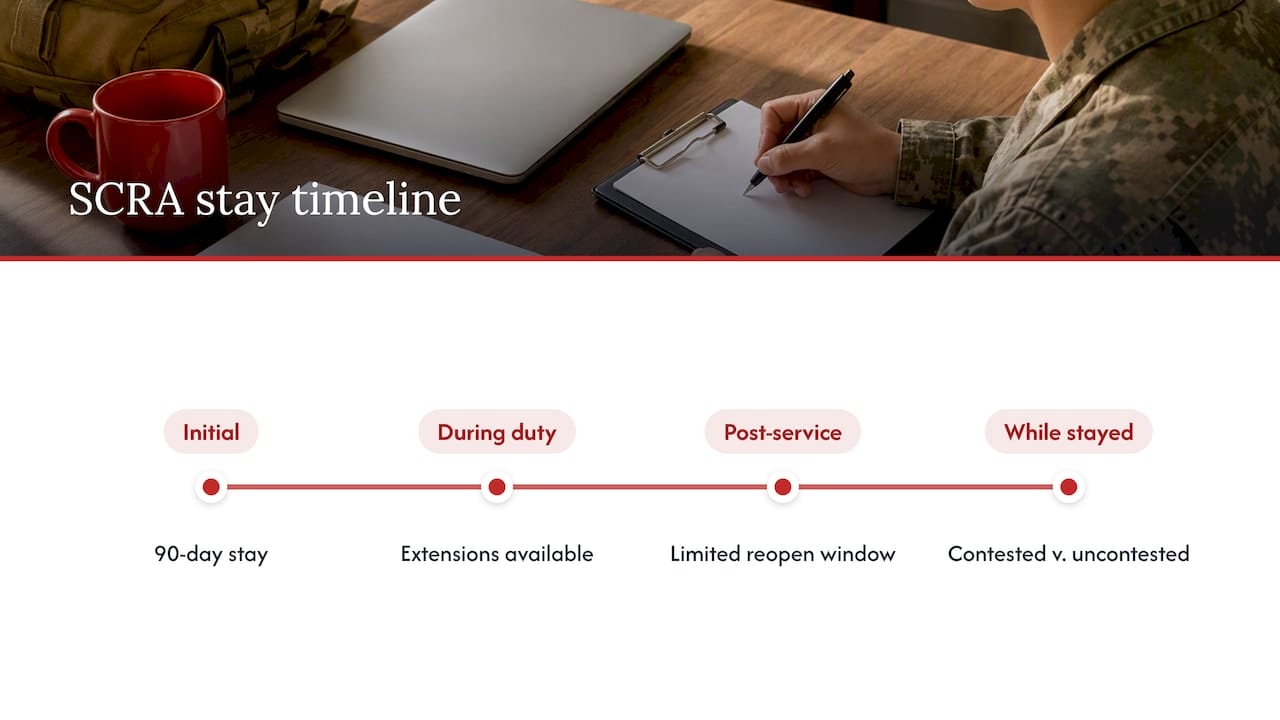
The typical pattern is a 90-day initial stay, with additional stays available if duty still interferes, and a limited window to reopen a default judgment after leaving service. A stay makes sense when a genuine duty conflict exists and the case involves contested issues worth fighting for. It can backfire when it simply delays a resolution both spouses already want, since delay itself carries a cost.
When to bring in a military divorce attorney
Certain situations call for legal help sooner rather than later: contested custody battles, the risk of a default judgment slipping through, disputes over military retirement pay or VA disability interactions, or a deployment date approaching fast. The Law Office of John Vernon Moore, P.A. has experience representing military families, with attorneys knowledgeable about SCRA filings and Florida family court procedure, including mediation certification for couples seeking alternative dispute resolution.
Before an initial consultation, gather:
- Any divorce or custody paperwork you have already been served.
- Proof of your military status and current duty station.
- Deployment orders or documentation showing when you expect to be available.
- Any written communication from your commanding officer about your case.
Worth noting: SCRA protects your ability to participate, not your outcome on custody, support, or property, so how a case is argued still matters. Readers dealing with VA disability and its effect on support calculations can also review the firm’s page on VA disability and divorce for background separate from SCRA procedure.
Statutes and resources worth bookmarking
For anyone who wants the full text or wants to verify a claim before acting, these sources cover the material discussed above:
- 50 U.S.C. § 3932, covering stays of proceedings and what an application must contain.
- 50 U.S.C. § 3931, covering default judgment protections and reopening deadlines.
- Military OneSource, which distinguishes SCRA protections from former-spouse benefit rules under USFSPA.
- Your installation’s Armed Forces Legal Assistance office, for free help preparing a stay request or commanding-officer letter.
A straightforward take on what SCRA can and cannot do
The SCRA gets misunderstood as a shield that stops a divorce cold. It does not. It pauses the clock so a deployed spouse is not steamrolled by a court date they had no real chance to meet, and it stops a default judgment from becoming permanent just because someone was overseas when the paperwork arrived. That is genuinely valuable, and it is also the full extent of what the statute promises.
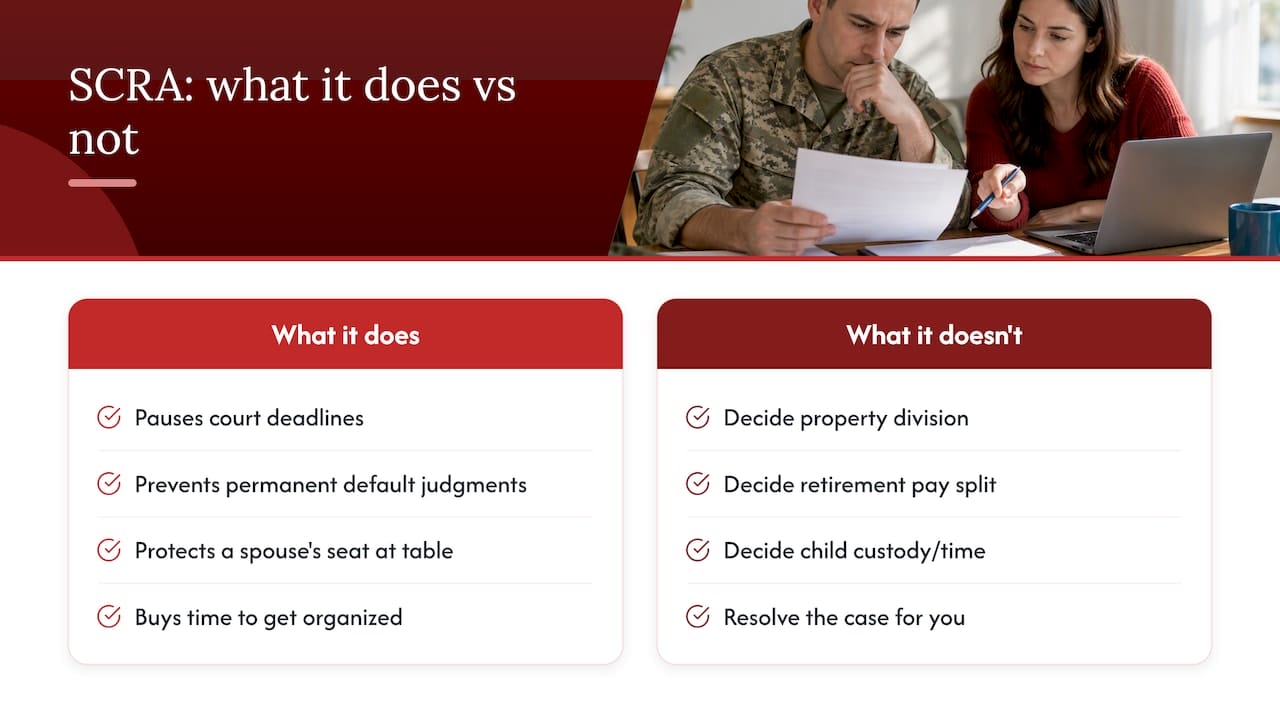
What surprises people is how procedural the protection is. It says nothing about who keeps the house, how retirement pay gets divided, or which parent gets more time with the kids. Those questions still belong to state family law, and delaying a case does not usually make them easier to answer later. If anything, a long stay can let resentment and financial pressure build on both sides. The service members who come out ahead are usually the ones who use the stay to get organized, not the ones who use it to avoid the conversation altogether.
If you think the SCRA might apply to your situation, contact your base legal assistance office and a civilian attorney experienced in military divorce as early as you can. The statute protects your seat at the table. What you do with that seat is still up to you.

— John
How our firm helps with SCRA stays and military divorce
Filing an SCRA stay motion correctly the first time saves months of back-and-forth, and that is exactly the kind of filing our office handles regularly for military families across Brevard County. Whether you need a stay motion drafted, representation in a custody or support dispute, or a mediator to help settle terms without a drawn-out court fight, our military divorce practice covers the full range of what comes up in these cases, including SCRA stay filings, service of process disputes, and coordination around deployment schedules.
Bring your court papers, proof of duty status, and any commanding-officer correspondence to a consultation, and the attorney can explain what a stay may accomplish in your specific case. Reach out through our contact page to schedule a consultation and get a clear read on your next step.
Sources
- The Servicemembers Civil Relief Act: requirements when a servicemember requests a stay or a continuance (UNC SOG)
- Your rights under the Servicemembers Civil Relief Act: 6% interest rate cap (U.S. Department of Justice)
- Rights and benefits of divorced spouses in the military (Military OneSource)
- 50 U.S.C. § 3931 — Protection of servicemembers against default judgments (Cornell Law)
FAQ
What is a military spouse entitled to in a divorce?
A military spouse’s rights in property division, support, and custody are governed by state family law, not the SCRA, which only affects timing and default-judgment protection. Florida courts divide marital assets equitably and set support and custody based on the same standards used in civilian divorces, with added rules for handling deployment schedules and military retirement pay.
Is my spouse entitled to half of my 401k in a divorce?
There is no automatic equal split written into federal law: how military retirement accounts are divided depends on your state’s property division rules and the specifics of the marriage. In Florida, retirement accounts earned during the marriage are typically treated as marital property subject to equitable distribution, which is not always an even split.
How does BAH factor into a military divorce?
Basic Allowance for Housing is income that courts can consider when calculating child support or spousal support, since it affects a service member’s overall take-home pay. It is not directly divided as an asset, but changes in BAH status, such as a move from with-dependents to without-dependents rates, can trigger a support recalculation.
Does the SCRA apply to military spouses?
The SCRA is primarily written to protect the service member, but some of its protections extend to dependents in limited situations, according to guidance from the Consumer Financial Protection Bureau. A spouse generally cannot use the SCRA to request their own stay of proceedings simply because their partner is deployed, since the statute’s stay and default-judgment protections are tied to the service member’s own status.
Does SCRA affect who gets custody?
No, the SCRA can delay a custody hearing so a deployed parent has a fair chance to participate, but it does not decide custody outcomes. Those decisions still rest on the best-interest standard applied under state law, with the Military OneSource guidance confirming that benefit and custody questions are governed separately from SCRA procedure.


