
What is subrogation in a personal injury case?
Subrogation is your insurance company’s legal right to recover money it paid on your behalf from the party who actually caused your injuries. When your health or auto insurer covers your medical bills after an accident, it doesn’t simply absorb that cost. It steps into your legal shoes and pursues reimbursement from the at-fault party or their insurer.
The concept rests on a straightforward principle: the person who caused the harm should ultimately pay for it, not your insurance company. Subrogation rights arise either from your insurance contract or from state law, and they vary depending on the type of plan involved.
Common types of insurance that trigger subrogation in personal injury claims include:
- Health insurance (private plans and employer-sponsored plans)
- Auto insurance (your own policy’s medical payments or PIP coverage)
- Disability insurance
- Workers’ compensation (when a third party caused a workplace injury)
- Government programs such as Medicare and Medicaid
Why subrogation matters to your settlement
Subrogation prevents double recovery by ensuring you don’t collect the same medical expense twice. If your insurer paid bills related to your injury and you later recover that same amount from the at-fault driver, your insurer has a valid claim to that portion of your settlement.

The practical effect is direct: subrogation reduces your net recovery. A settlement that sounds significant may be substantially reduced by lien deductions before you see a dollar. Health insurance subrogation hits settlement proceeds directly and demands close legal oversight, unlike property damage subrogation, which often resolves separately between insurers. Subrogation also affects future premiums indirectly. When insurers recover their costs from at-fault parties, the theory is that overall claim losses stay lower, which can moderate rate increases over time.
How the subrogation process typically unfolds
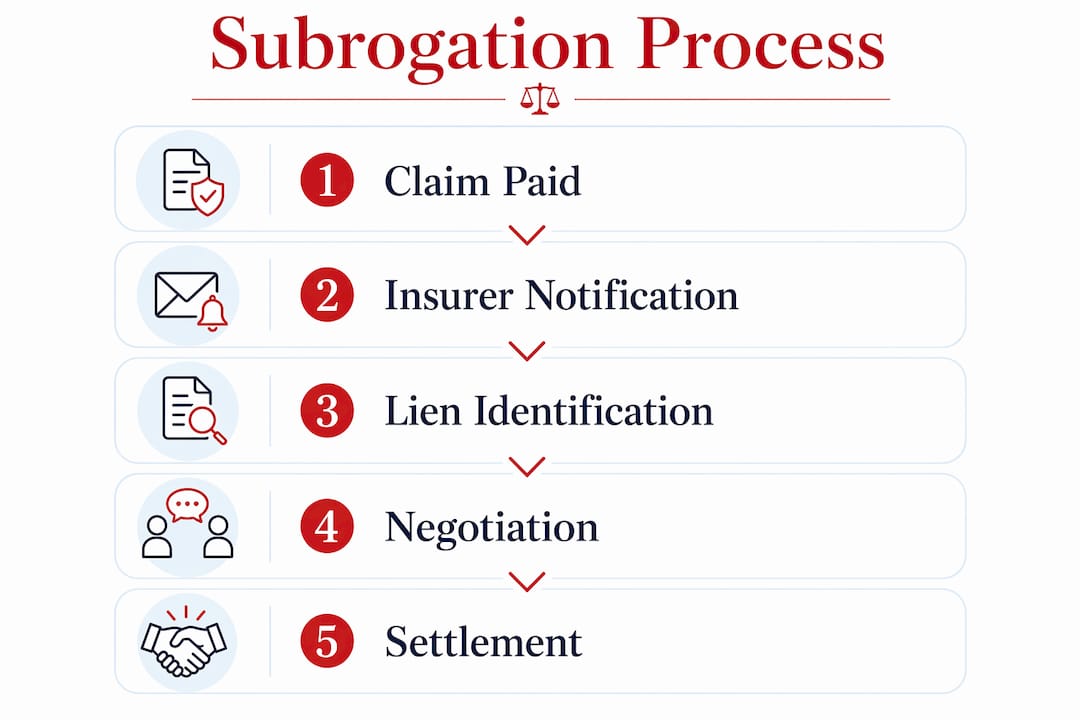
The sequence follows a predictable pattern in most personal injury claims:
- You are injured and seek medical care; your insurer pays the bills.
- Your insurer identifies a potential third-party claim and may send you questionnaires about the accident.
- The insurer asserts a lien or reimbursement claim against your anticipated settlement.
- Your attorney audits the claimed charges, removes unrelated items, and challenges errors.
- Settlement negotiations account for the lien in calculating your net recovery.
- Liens are resolved in writing before funds are distributed to you.
Subrogation often happens behind the scenes, but failing to address it early creates real delays. Insurers sometimes hold up disbursement until their lien is resolved, which can extend your wait by weeks or months after a settlement is reached. Addressing lienholders from the start of your case, not at the finish line, keeps the process moving.
ERISA, Medicare, and Medicaid: the liens that play by different rules
Not all subrogation claims carry the same legal weight. ERISA-governed employer health plans hold federal subrogation rights that can override state protective doctrines, including the made whole doctrine. That means even if your settlement doesn’t fully compensate you for all your losses, an ERISA plan may still demand complete repayment.
Medicare and Medicaid carry mandatory statutory liens that must be resolved before any settlement funds reach you. These aren’t optional or negotiable in the same way private insurance liens are. Your attorney is legally responsible for satisfying Medicare liens under the Medicare Secondary Payer Act, and ignoring them can trigger penalties, interest, and future benefit denials.
- ERISA plans: federal law governs; state protections often don’t apply; full reimbursement frequently required
- Medicare: mandatory lien; attorney liability if not resolved; formal conditional payment process
- Medicaid: statutory lien; state-specific rules; must be cleared before disbursement
- Workers’ compensation: statutory lien against third-party tort recovery; operates similarly to subrogation
Government program liens can consume a meaningful portion of a settlement, particularly in cases involving extended hospitalization or long-term care. Knowing which type of lien you’re dealing with early changes your entire negotiation strategy.
How to protect more of your settlement from subrogation claims
Identifying all lienholders early and auditing every repayment demand is the single most effective way to protect your net recovery. Insurers sometimes include treatment unrelated to your accident, duplicate billing entries, or charges coded incorrectly. A line-by-line review can eliminate those amounts before they come out of your check.
Several legal doctrines work in your favor:
- Made whole doctrine: in many states, your insurer cannot enforce subrogation rights until you have been fully compensated for all losses. Some policies, especially ERISA plans, contractually waive this protection.
- Common fund doctrine: if your attorney’s work created the recovery from which the insurer wants repayment, the insurer may have to share proportional legal fees, reducing the lien amount.
- Negotiation: most private insurance liens are negotiable, especially when the total settlement is limited by the at-fault party’s policy limits or when liability is genuinely disputed.
Pro Tip: Ask your attorney to request the insurer’s complete payment ledger before any settlement discussions begin. Auditing that ledger for unrelated charges, billing errors, and duplicate entries often reduces the lien by a meaningful amount before formal negotiation even starts.
What experienced legal counsel does for subrogation management
Subrogation can silently delay settlements when lienholders aren’t identified and engaged early. An attorney who handles this proactively keeps your case on track and protects the number you actually take home.
Engaging experienced legal counsel to audit lien claims and defend clients prevents excessive repayment and ensures compliance with subrogation obligations. Many liens are negotiable and can be reduced by applying equitable defenses, disputing improper charges, or invoking state law protections where they apply.
At Jmoorelegal, the approach to subrogation starts at case intake, not at settlement. Every potential lienholder gets identified, plan documents get reviewed, and payment ledgers get audited before any number is put on the table. That process protects clients from common personal injury mistakes that shrink recoveries unnecessarily.
Pro Tip: Never sign a settlement release before confirming that every known lien has been addressed in writing. Releasing your claims while a Medicare or ERISA lien remains unresolved can expose you to personal liability for the full lien amount.
When does subrogation actually occur?
Subrogation rights attach the moment your insurer pays a covered claim tied to a third party’s negligence. The formal assertion of those rights, through a lien letter or direct demand, typically follows once your insurer learns you have an active personal injury claim against the at-fault party. Car accidents, slip-and-fall injuries, workplace incidents involving third-party liability, and product liability cases can all trigger subrogation. The key condition is simple: a third party caused the harm, and an insurer paid the bills.
Disputes and litigation in subrogation cases
Subrogation disputes arise when the injured party contests the validity, scope, or amount of a lien. Common flashpoints include charges for treatment unrelated to the accident, disagreements over whether the made whole doctrine applies, and ERISA plan language that conflicts with state law protections. When mediation in personal injury cases doesn’t resolve a lien dispute, litigation becomes possible. An insurer can sue you directly to recover a valid lien if you settle and refuse to honor it. Government programs like Medicare can pursue recovery from multiple parties, including your attorney, if the lien is ignored. The best defense against subrogation litigation is resolving every lien before the settlement closes.
Key Takeaways
Subrogation in personal injury cases reduces your net settlement by the amount your insurer paid on your behalf, but skilled legal management can significantly lower what you owe.
| Point | Details |
|---|---|
| Subrogation definition | Your insurer’s legal right to recover payments it made from the party at fault for your injuries. |
| ERISA and government liens | Medicare, Medicaid, and ERISA plans carry mandatory liens that override many state protections. |
| Made whole doctrine | In most states, your insurer cannot collect until you are fully compensated, unless the policy waives this right. |
| Audit lien claims early | Reviewing payment ledgers before settlement removes unrelated charges and reduces what you owe. |
| Common fund doctrine | Your insurer may owe a share of legal fees, which reduces the lien amount proportionally. |
Recommended
- Personal Injury – The Law Office of John Vernon Moore, P.A.
- Important Things Your Personal Injury Lawyer Needs To Know About Your Claim – The Law Office of John Vernon Moore, P.A.
- What Is Mediation in Personal Injury Cases? – The Law Office of John Vernon Moore, P.A.
- If You Have An Accident In A Public Place, How Do You Claim Compensation? – The Law Office of John Vernon Moore, P.A.