Domestic violence is defined in custody law as a pattern of physical, emotional, or coercive abuse that creates a safety risk for a child or a co-parent. Understanding how domestic violence affects custody is the most critical step any protective parent can take. All 50 U.S. states require courts to consider domestic violence when determining the best interests of the child, and 24 states enforce a rebuttable presumption against awarding custody to an abusive parent. That presumption shifts the legal burden directly onto the abuser. Courts do not treat abuse as a minor factor. It shapes every custody decision from temporary emergency orders through final parenting plans.
How does domestic violence affect custody decisions?
Courts apply the “best interests of the child” standard in every custody case. Domestic violence is one of the most heavily weighted factors within that standard. A judge evaluating child custody and domestic abuse will look at the nature, frequency, and severity of the abuse, along with its direct impact on the child.
Children exposed to domestic violence suffer emotional harm even when they are never physically touched. Exposure disrupts emotional security, lowers school performance, and creates lasting developmental instability. Courts treat witnessed abuse as harm to the child, not just to the adult victim.

The type of abuse matters, too. Physical violence, emotional manipulation, financial control, and coercive behavior all qualify as domestic violence in most state statutes. Judges weigh documented patterns far more heavily than isolated incidents. Recent and ongoing abuse carries the most weight because it signals a current, active threat.
Evidence types courts accept include:
- Police reports and arrest records
- Emergency Protective Order (EPO) documentation
- Medical records showing injuries
- Photographs and video evidence
- Text messages, emails, and voicemails showing threats or control
- Witness statements from neighbors, family members, or teachers
- Counseling and therapy records for the victim or child
Pro Tip: Start a private, dated log of every incident the moment you believe abuse is occurring. Courts respond to documented patterns, not general descriptions. A written record with dates, locations, and specific details is far more persuasive than memory alone.
What custody arrangements do courts order when abuse is present?
When a court finds credible evidence of domestic violence, the custody arrangement shifts decisively toward protecting the child and the non-abusive parent. Joint custody is generally not feasible in abusive situations because it requires cooperative communication, which an abusive dynamic makes impossible.
The most common outcome is sole legal and physical custody awarded to the non-abusive parent. Legal custody covers decision-making authority over education, healthcare, and religion. Physical custody determines where the child lives. Courts grant both to the protective parent when abuse is established.
Visitation for the abusive parent follows a structured, restricted format. Courts use several tools to manage this:
- Supervised visitation. A neutral third party or a professional supervisor is present during all contact between the abusive parent and the child.
- Safe exchange protocols. Transfers happen at a neutral location, often a police station or a supervised visitation center, to prevent contact between the parents.
- Restricted communication. Courts may limit phone or digital contact and require all communication to go through a monitored platform.
- No-contact orders. In severe cases, the court eliminates visitation entirely until the abusive parent demonstrates rehabilitation.
- Therapeutic visitation. Contact occurs only within a structured therapeutic setting with a licensed professional present.
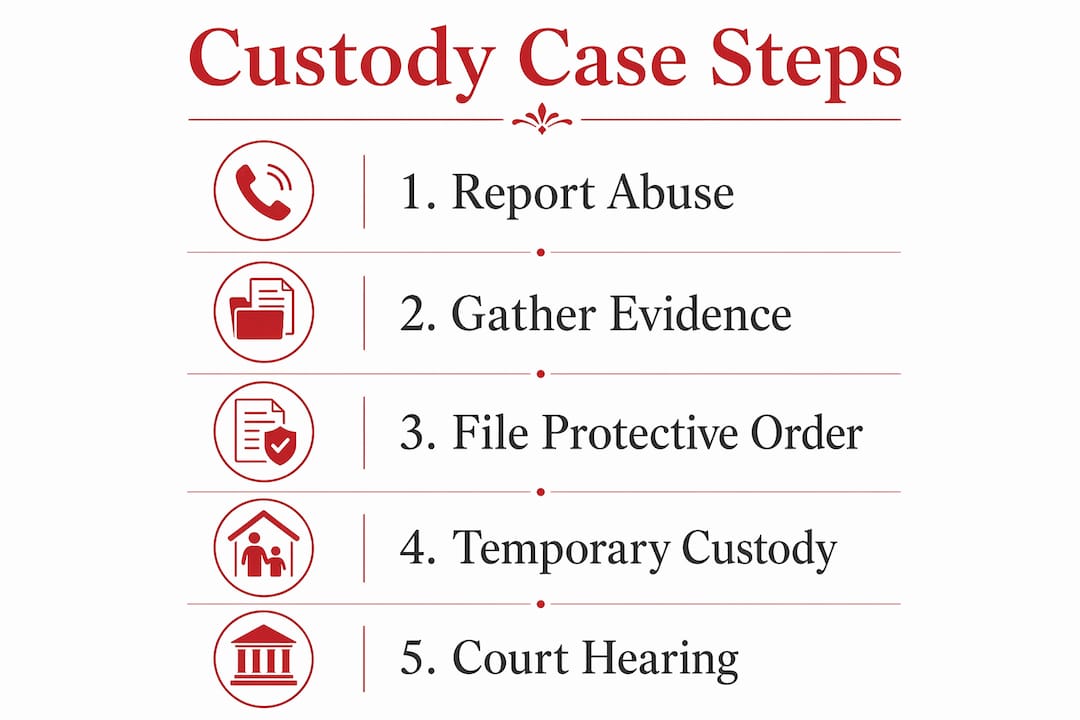
Emergency Protective Orders can be issued immediately at the scene of an incident, lasting up to 7 days. That window gives the protective parent time to file for a temporary custody order before the EPO expires.
| Custody tool | Purpose | Duration |
|---|---|---|
| Emergency Protective Order (EPO) | Immediate restriction of abuser contact | Up to 7 days |
| Temporary custody order | Protects child during court proceedings | Until final hearing |
| Supervised visitation | Allows parent-child contact with oversight | Ongoing, court-reviewed |
| No-contact order | Eliminates direct contact entirely | Indefinite, until modified |
Pro Tip: File for a temporary custody order before your EPO expires. An EPO alone does not create a long-term custody arrangement. Emergency protective orders require follow-up in family court to convert into lasting protections.
What legal presumptions protect children in domestic violence custody cases?
24 states enforce a rebuttable presumption against awarding custody to a parent who has committed domestic violence. This presumption is one of the most powerful legal tools available to a protective parent. It means the court starts from the position that the abusive parent should not have custody, and the burden falls on that parent to prove otherwise.
To overcome the presumption, the abusive parent must typically show evidence of rehabilitation. Courts look for completion of a certified batterer intervention program, a sustained record of safe behavior, and proof that the child’s welfare will not be at risk. A domestic violence finding does not automatically eliminate custody rights permanently, but it creates a high bar the abusive parent must clear.
States without a formal rebuttable presumption still weigh abuse heavily. Judges in those states use broad discretion under the best interests standard, and a well-documented history of abuse produces similar outcomes in practice.
Ohio provides a specific example of how state law shapes these decisions. In Ohio, domestic violence within 5 years of the custody hearing is heavily weighted against the abusive parent, often resulting in supervised visitation or loss of decision-making authority. That 5-year lookback period shows how states build time-specific frameworks to prevent abuse from being minimized as “old news.”
Restraining orders and protective orders also affect custody and visitation decisions directly. A standing protective order restricts the abusive parent’s physical proximity to the child and the other parent, which courts factor into every parenting plan they issue.
How can you document domestic violence to strengthen a custody case?
Effective protection depends on objective evidence rather than accusations alone. Courts hear domestic violence claims in nearly every contested custody case. What separates a successful case from an unsuccessful one is the quality and consistency of the documentation behind it.
The strongest evidence packages include:
- Medical records. Emergency room visits, doctor’s notes, and injury photographs create an objective, timestamped record that is very difficult to dispute.
- Police reports. Even if no arrest was made, a police report documents that an incident occurred and was reported at the time.
- Witness statements. Neighbors, teachers, coaches, and family members who observed the abuse or its effects on the child can provide written or sworn statements.
- Professional evaluations. A licensed therapist or child psychologist who has worked with the child can provide a clinical assessment of the child’s emotional state and its likely causes.
- Communication records. Threatening texts, emails, and voicemails are direct evidence of coercive behavior. Save and back up all of them immediately.
- Incident logs. A private written record with specific dates, times, locations, and descriptions of each incident builds the documented pattern courts require.
Courts are vigilant against misuse of domestic violence allegations in custody disputes. A judge who sees inconsistent claims, no corroborating evidence, or a pattern of allegations timed to custody hearings will treat those claims with skepticism. Consistent, objective documentation is the answer to that scrutiny.
Working with an attorney who understands admissibility of evidence in family court is not optional when abuse is involved. The rules governing what a judge can consider are specific, and improperly gathered evidence can be excluded entirely.
Key Takeaways
Domestic violence reshapes custody outcomes by shifting the court’s primary focus to child safety, often resulting in sole custody for the protective parent and restricted or supervised contact for the abusive parent.
| Point | Details |
|---|---|
| All states consider abuse | Every U.S. state weighs domestic violence in the best interests of the child analysis. |
| 24 states use a presumption | Nearly half of all states start from the position that abusers should not have custody. |
| Documentation wins cases | Objective evidence like police reports and medical records outweighs uncorroborated claims. |
| EPOs provide immediate protection | Emergency Protective Orders last up to 7 days and must be followed by a family court filing. |
| Joint custody is rarely appropriate | Abusive dynamics make the cooperative communication required for joint custody unworkable. |
What I’ve learned after years of domestic violence custody cases
After handling custody cases involving domestic violence for many years in Brevard County, the pattern I see most often is this: protective parents assume the court will automatically side with them once they describe the abuse. That assumption costs them.
Courts want evidence. They want dates, records, and corroboration. A parent who walks into a hearing with a detailed incident log, a police report, and a therapist’s written assessment of the child is in a fundamentally different position than a parent who relies on verbal descriptions alone. The law gives judges tools to protect children, but those tools only activate when the evidence is there to support them.
The second thing I see consistently is confusion about what a domestic violence finding actually means for the abusive parent’s rights. A finding does not automatically end that parent’s relationship with the child forever. It triggers a presumption and shifts the burden. The abusive parent can still work to regain custody rights by demonstrating genuine rehabilitation. That reality can feel unfair to a protective parent, but understanding it helps you build a case that accounts for every stage of the process, not just the first hearing.
My strongest advice: do not wait until a custody hearing to start building your case. Document everything now. Get an attorney who knows this area of law. And if your child is in immediate danger, call law enforcement and file for an EPO the same day.
— John
Jmoorelegal’s approach to custody cases involving domestic violence
Custody disputes involving abuse require legal representation that understands both the emotional weight and the legal complexity of what you are facing. Jmoorelegal has served families in Brevard County for over 85 years, with deep experience in family law cases where domestic violence intersects with custody, visitation, and parental rights.

The firm handles custody modifications, protective order filings, and full representation in contested custody hearings. Every case receives direct attorney attention and a legal strategy built around the specific facts of your situation. If you are a protective parent trying to keep your child safe, or a parent working to demonstrate rehabilitation, Jmoorelegal offers a free initial consultation to evaluate your case and explain your options clearly.
FAQ
How does domestic violence affect custody rights?
Domestic violence is a primary factor in custody decisions across all 50 U.S. states. Courts typically award sole custody to the non-abusive parent and restrict the abusive parent’s visitation, often requiring supervision.
Can an abusive parent ever regain custody?
Yes. A domestic violence finding triggers a rebuttable presumption against custody, but the abusive parent can overcome it by demonstrating rehabilitation through a certified batterer intervention program and a sustained record of safe behavior.
What evidence do courts require in domestic violence custody cases?
Courts require objective, documented evidence such as police reports, medical records, witness statements, and communication records. Documented patterns of behavior carry far more weight than isolated or uncorroborated claims.
What is an Emergency Protective Order and how does it affect custody?
An Emergency Protective Order is issued immediately at the scene of an incident and restricts the abuser’s contact for up to 7 days. It functions as a temporary custody tool but requires a follow-up family court hearing to create lasting protections.
Does witnessing domestic violence count as harm to a child?
Yes. Children who witness domestic violence suffer documented emotional harm affecting their stability and school performance, even without direct physical injury. Courts treat exposure as harm when evaluating the child’s best interests.